Proton-M Briz-M
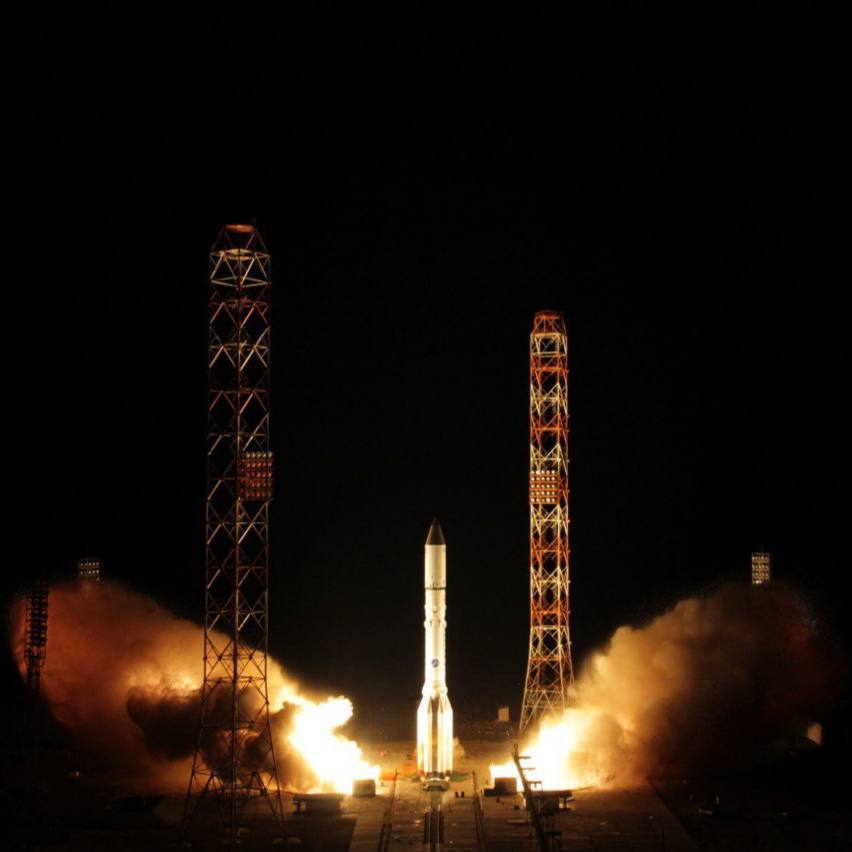
About the Proton-M Briz-M
Proton-M Briz-M
The Proton-M Briz-M is a Russian expendable heavy-lift launch vehicle operated by Khrunichev State Research and Production Space Center and marketed internationally through International Launch Services (ILS). A direct evolution of the Soviet-era Proton family, it served as Russia's primary workhorse for delivering heavy payloads to geostationary and high-energy orbits from the Baikonur Cosmodrome in Kazakhstan.
Vehicle Overview
Standing 53 meters tall with a maximum diameter of 7.4 meters, the Proton-M Briz-M is a substantial three-stage rocket topped by the Briz-M upper stage, which provides the propulsive flexibility needed to reach geostationary transfer orbit (GTO) and beyond. The vehicle is capable of lifting 21,000 kg to low Earth orbit and 4,500 kg to geostationary transfer orbit. The Briz-M upper stage — a significant upgrade over earlier Proton configurations — features a restartable engine and an auxiliary propellant tank, giving it the endurance to execute the complex multi-burn injection sequences required for commercial satellite deliveries.
History and Operational Record
The Proton-M Briz-M entered service in 2001 and remained active through 2023, spanning more than two decades of continuous operation. Across the 68 flights tracked in this database, the vehicle recorded 62 successes alongside 6 failures or partial failures — a strong but not unblemished record that reflects both the vehicle's overall reliability and the complexity inherent in missions requiring the Briz-M upper stage to perform multiple engine restarts over many hours of flight.
The launcher carried a wide range of government and commercial payloads, with Khrunichev and ILS accounting for the majority of missions. Notable recent launches include the communications satellites Yamal-601, Ekspress-80 & Ekspress-103, and Ekspress-AMU3 & AMU7, as well as the Eutelsat 5 West B mission, which also delivered MEV-1, a pioneering in-orbit servicing spacecraft. Military and government payloads flew as well, including Blagovest No.14L (Kosmos 2539) and the secretive Olymp-K #2 (Luch 5X) satellite.
Role and Legacy
Through the ILS partnership, the Proton-M Briz-M became one of the most commercially significant launch vehicles of the 2000s and 2010s, competing directly with Arianespace's Ariane 5 for the lucrative geostationary satellite market. Its large fairing volume and robust GTO performance made it a natural fit for the heavy communications satellites built by major manufacturers worldwide.
The vehicle's commercial prominence waned in the late 2010s following a series of high-profile failures, increasing Western sanctions, and the gradual transition of Russian launch strategy toward the next-generation Angara rocket. By the time of its final tracked missions in the early 2020s, the Proton-M Briz-M was flying almost exclusively for Russian government customers. Its retirement marks the end of a lineage stretching back to the earliest years of Soviet spaceflight, and it remains one of the most frequently flown heavy-lift vehicles in the history of orbital launch.
- Mar 12, 2023Proton-M Briz-M | Olymp-K #2 (Luch 5X)Success
- Dec 13, 2021Proton-M/Briz-M | Ekspress-AMU3 & AMU7Success
- Jul 30, 2020Proton-M/Briz-M | Ekspress-80 & Ekspress-103Success
- Oct 09, 2019Proton-M/Briz-M | Eutelsat 5 West B & MEV-1Success
- Aug 05, 2019Proton-M/Briz-M | Blagovest No.14L (Kosmos 2539)Success
- May 30, 2019Proton-M/Briz-M | Yamal-601Success
- Dec 21, 2018Proton-M/Briz-M | Blagovest N13L (Kosmos 2533)Success
- Apr 18, 2018Proton-M/Briz-M | Blagovest No.12L (Kosmos 2526)Success
- Sep 28, 2017Proton-M Briz-M | AsiaSat 9Success
- Sep 11, 2017Proton-M Briz-M | Amazonas 5Success
- Aug 16, 2017Proton-M/Briz-M | Blagovest No.11L (Kosmos 2520)Success
- Jun 08, 2017Proton-M Briz-M | Echostar 21Success
- Jun 09, 2016Proton-M Briz-M | Intelsat 31/DLA-2Success
- Mar 14, 2016Proton-M Briz-M | ExoMars Trace Gas Orbiter & EDM Schiaparelli landerSuccess
- Jan 29, 2016Proton-M Briz-M | Eutelsat 9BSuccess
- Dec 24, 2015Proton-M Briz-M | Ekspress AMU1 / (EUTELSAT 36C)Success
- Dec 13, 2015Proton-M Briz-M | Garpun No. 12L (Kosmos-2513)Success
- Oct 16, 2015Proton-M/Briz-M | Türksat 4BSuccess
- Aug 28, 2015Proton-M Briz-M | Inmarsat-5 F3Success
- May 16, 2015Proton-M Briz-M | Mexsat-1Failure
- Mar 18, 2015Proton-M Briz-M | Ekspress AM7Success
- Feb 01, 2015Proton-M Briz-M | Inmarsat-5 F2Success
- Dec 27, 2014Proton-M Briz-M | Astra 2GSuccess
- Dec 15, 2014Proton-M Briz-M | Yamal-401Success
- Oct 21, 2014Proton-M Briz-M | Ekspress AM6Partial Failure
- Sep 27, 2014Proton-M Briz-M | Olymp-K (Luch)Success
- May 15, 2014Proton-M Briz-M | Ekspress-AM4RFailure
- Apr 28, 2014Proton-M Briz-M | Luch 5V & KazSat-3Success
- Mar 15, 2014Proton-M Briz-M | Ekspress-AT1 & Ekspress-AT2Success
- Feb 14, 2014Proton-M/Briz-M | Türksat-4ASuccess
- Dec 26, 2013Proton-M Briz-M | Ekspress AM-5Success
- Dec 08, 2013Proton-M Briz-M | Inmarsat-5 F1Success
- Nov 11, 2013Proton-M Briz-M | Raduga-1M 3Success
- Oct 25, 2013Proton-M Briz-M | Sirius FM-6Success
- Sep 29, 2013Proton-M Briz-M | Astra 2ESuccess
- Jun 03, 2013Proton-M Briz-M | SES-6Success
- May 14, 2013Proton-M Briz-M | Eutelsat 3D (W3D)Success
- Apr 15, 2013Proton-M Briz-M | Anik-G1Success
- Mar 26, 2013Proton-M Briz-M | Satmex-8Success
- May 17, 2012Proton-M Briz-M | Nimiq 6Success
- Feb 14, 2012Proton-M Briz-M | SES-4Success
- Nov 04, 2011Proton-M Briz-M | 3 x Glonass-M (Kosmos 2475, Kosmos 2476, Kosmos 2477)Success
- Sep 20, 2011Proton-M Briz-M | Garpun #1 (Kosmos 2473)Success
- Oct 14, 2010Proton-M Briz-M | Sirius XM-5Success
- May 16, 2009Proton-M Briz-M | SES-7 (Indostar 2/ProtoStar 2)Success
- Nov 05, 2008Proton-M Briz-M | Astra 1MSuccess
- Sep 19, 2008Proton-M Briz-M | Nimiq 4Success
- Aug 18, 2008Proton-M Briz-M | Inmarsat 4 F3Success
- Mar 14, 2008Proton-M Briz-M | AMC 14Failure
- Feb 11, 2008Proton-M Briz-M | Thor 5Success
- Jan 28, 2008Proton-M Briz-M | Ekspress AM-33Success
- Dec 09, 2007Proton-M Briz-M | Raduga-1MSuccess
- Nov 17, 2007Proton-M Briz-M | Sirius 4Success
- Sep 05, 2007Proton-M Briz-M | JCSAT 11Failure
- Apr 09, 2007Proton-M Briz-M | Anik F3Success
- Dec 11, 2006Proton-M Briz-M | Measat 3Success
- Nov 08, 2006Proton-M Briz-M | Badr 4Success
- Aug 04, 2006Proton-M Briz-M | Hot Bird 8Success
- Feb 28, 2006Proton-M Briz-M | Arabsat 4AFailure
- Dec 29, 2005Proton-M Briz-M | AMC 23Success
- Sep 08, 2005Proton-M Briz-M | Anik F1RSuccess
- May 22, 2005Proton-M Briz-M | DirecTV-8Success
- Feb 03, 2005Proton-M Briz-M | AMC 12Success
- Oct 14, 2004Proton-M Briz-M | AMC 15Success
- Aug 04, 2004Proton-M Briz-M | Amazonas-1Success
- Jun 16, 2004Proton-M Briz-M | INTELSAT 10-02Success
- Dec 29, 2002Proton-M Briz-M | Nimiq 2Success
- Apr 07, 2001Proton-M Briz-M | Ekran-M 4Success