Proton-M DM-2 Enhanced
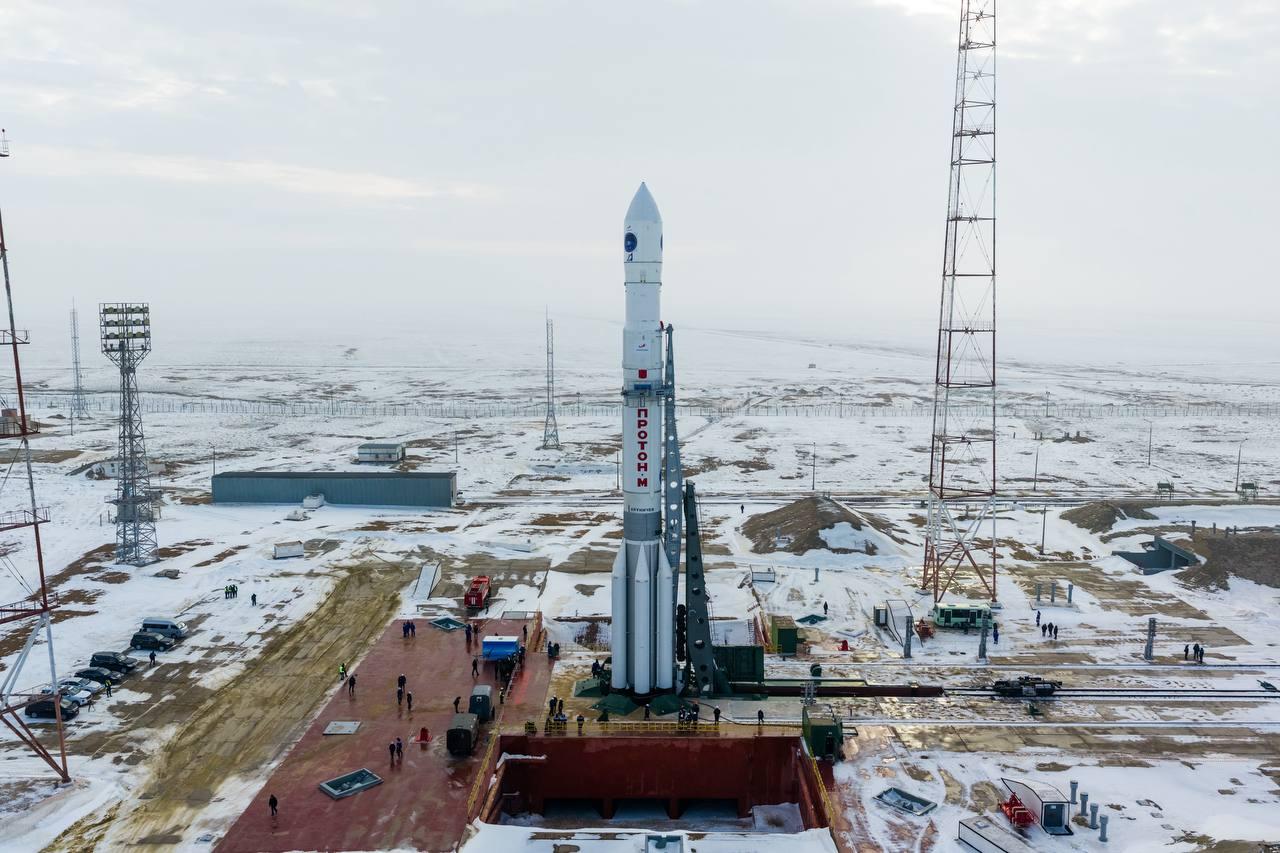
About the Proton-M DM-2 Enhanced
Proton-M DM-2 Enhanced
The Proton-M DM-2 Enhanced is a Russian heavy-lift orbital launch vehicle operated by Khrunichev State Research and Production Space Center and marketed internationally through International Launch Services (ILS). A member of the long-running Proton family, it pairs the upgraded Proton-M core booster with the Blok DM-2 upper stage in an enhanced configuration, enabling the delivery of large payloads to geostationary transfer orbit and beyond. The vehicle launches from the Baikonur Cosmodrome in Kazakhstan, the historic facility that has served as the primary departure point for the Proton family throughout its operational history.
Design and Capability
Standing 58.2 metres tall with a maximum diameter of 7.4 metres, the Proton-M DM-2 Enhanced is a substantial vehicle by any measure. It is capable of delivering up to 23,000 kg to low Earth orbit and 6,920 kg to geostationary transfer orbit, placing it firmly in the heavy-lift class and making it well-suited to the demanding requirements of large communications and science satellites. The Blok DM-2 upper stage provides the additional propulsive energy needed to reach high-energy orbits, and the "Enhanced" designation reflects incremental improvements to propellant loading and guidance systems compared to earlier Proton-M variants.
Operational History
According to tracked flight data, the Proton-M DM-2 Enhanced has been active from 2004 through 2026, accumulating 48 tracked flights over that period. Of those, 43 were fully successful, while 5 resulted in failure or partial failure — a record that reflects both the maturity of the Proton platform and the inherent complexity of demanding high-orbit missions. The vehicle has served as a workhorse for the Russian Federal Space Agency (ROSCOSMOS) alongside its commercial role, supporting national science and Earth observation programs as well as international commercial payloads.
Notable Missions
The Proton-M DM-2 Enhanced's manifest includes some of the most scientifically significant Russian payloads of the modern era. The Spektr-RG space observatory, a flagship astrophysics mission developed in partnership with Germany, was lifted to its transfer trajectory by this vehicle. The MLM Nauka multipurpose laboratory module, a long-awaited addition to the International Space Station, also flew aboard a Proton-M — one of the most complex and closely watched missions in the vehicle's history. A series of Elektro-L geostationary weather satellites (Nos. 3, 4, and 5) further underscores the rocket's importance to Russian Earth observation infrastructure, and the AngoSat-2 mission demonstrated its continued role in delivering telecommunications satellites for international customers.
Legacy and Role
The Proton family represents one of the most enduring lineages in spaceflight, with roots stretching back to the 1960s. The Proton-M DM-2 Enhanced carries that legacy into the modern era, serving state, scientific, and commercial customers across more than two decades of active service. Its combination of heavy-lift capacity and high-energy upper stage capability made it a competitive option on the global launch market during a significant chapter in commercial satellite deployment.
- Feb 12, 2026Proton-M/Blok DM-03 | Elektro-L No.5Success
- Feb 05, 2023Proton-M/Blok DM-03 | Elektro-L No.4Success
- Oct 12, 2022Proton-M/Blok DM-03 | AngoSat-2Success
- Jul 21, 2021Proton-M | MLM NaukaSuccess
- Dec 24, 2019Proton-M/Blok DM-03 | Elektro-L No.3Success
- Jul 13, 2019Proton-M/Blok DM-03 | Spektr-RGSuccess
- Sep 14, 2015Proton-M/Blok DM-03 | Ekspress AM8Success
- Jul 02, 2013Proton-M/Blok DM-03 | Uragan-M No.48, 49 & 50Failure
- Dec 08, 2012Proton-M / Briz-M Enhanced | Yamal-402Partial Failure
- Nov 20, 2012Proton-M / Briz-M Enhanced | EchoStar XVISuccess
- Nov 02, 2012Proton-M / Briz-M Enhanced | Luch 5B & Yamal-300KSuccess
- Oct 14, 2012Proton-M / Briz-M Enhanced | Intelsat 23Success
- Aug 06, 2012Proton-M / Briz-M Enhanced | Telkom-3 & Ekspress MD2Failure
- Jul 09, 2012Proton-M / Briz-M Enhanced | SES-5Success
- Apr 23, 2012Proton-M / Briz-M Enhanced | Yahsat 1BSuccess
- Mar 25, 2012Proton-M / Briz-M Enhanced | Intelsat 22Success
- Dec 11, 2011Proton-M / Briz-M Enhanced | Luch 5A & Amos-5Success
- Nov 25, 2011Proton-M/Briz-M Enhanced | Asiasat 7Success
- Oct 19, 2011Proton-M / Briz-M Enhanced | ViaSat-1Success
- Sep 29, 2011Proton-M / Briz-M Enhanced | QuetzSat 1Success
- Aug 17, 2011Proton-M / Briz-M Enhanced | Ekspress AM-4Failure
- Jul 15, 2011Proton-M / Briz-M Enhanced | SES-3 & KazSat-2Success
- May 20, 2011Proton-M / Briz-M Enhanced | Telstar 14RSuccess
- Dec 26, 2010Proton-M / Briz-M Enhanced | KA-SATSuccess
- Dec 05, 2010Proton-M Blok-DM-03 | 3 x Glonass-M (Kosmos 2470, Kosmos 2471, Kosmos 2472)Failure
- Nov 14, 2010Proton-M / Briz-M Enhanced | SkyTerra-1Success
- Sep 02, 2010Proton-M/DM-2 Enhanced | 3 x Glonass-M (Kosmos 2464, Kosmos 2465, Kosmos 2466)Success
- Jul 10, 2010Proton-M / Briz-M Enhanced | EchoStar XVSuccess
- Jun 03, 2010Proton-M / Briz-M Enhanced | Badr-5 (Arabsat 5B)Success
- Apr 24, 2010Proton-M / Briz-M Enhanced | SES-1Success
- Mar 20, 2010Proton-M / Briz-M Enhanced | Echostar XIVSuccess
- Mar 01, 2010Proton-M/DM-2 Enhanced | 3 x Glonass-M (Kosmos 2459, Kosmos 2460, Kosmos 2461)Success
- Feb 12, 2010Proton-M / Briz-M Enhanced | Intelsat 16Success
- Jan 28, 2010Proton-M / Briz-M Enhanced | Globus-1M #12L (Raduga-1M 2)Success
- Dec 29, 2009Proton-M | DirecTV 12Success
- Dec 14, 2009Proton-M | Uragan-M 21 to 23Success
- Nov 24, 2009Proton-M | Eutelsat W7Success
- Sep 17, 2009Proton-M | Nimiq 5Success
- Aug 11, 2009Proton-M | Asiasat 5Success
- Jun 30, 2009Proton-M | Sirius FM-5Success
- Apr 03, 2009Proton-M | Eutelsat W2ASuccess
- Feb 11, 2009Proton-M | Ekspress AM-44 & MD-1Success
- Dec 25, 2008Proton-M | Uragan-M 18 to 20Success
- Dec 10, 2008Proton-M | Ciel 2Success
- Sep 25, 2008Proton-M | Uragan-M 15 to 17Success
- Dec 25, 2007Proton-M | Uragan-M 12 to 14Success
- Jul 07, 2007Proton-M | DirecTV 10Success
- Mar 15, 2004Proton-M | Eutelsat W3ASuccess