Proton-K/DM-2M
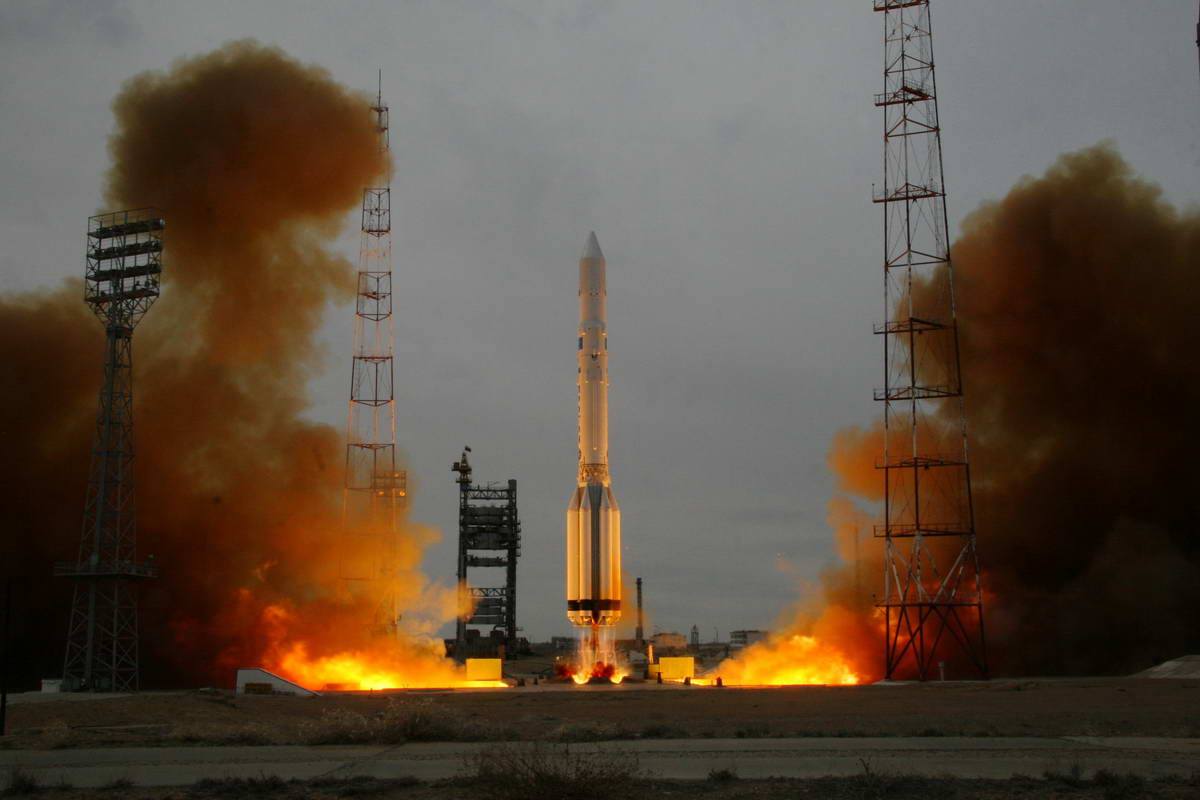
About the Proton-K/DM-2M
Proton-K/DM-2M
The Proton-K/DM-2M is a Russian expendable orbital launch vehicle, a configuration of the long-serving Proton-K booster paired with the DM-2M upper stage. Operated by Khrunichev State Research and Production Space Center and launched from the Baikonur Cosmodrome in Kazakhstan, the vehicle was a workhorse of the Russian commercial and government satellite launch industry during the late 1990s and early 2000s.
Background
The Proton-K is a member of the Proton rocket family, which has its origins in the Soviet space program of the 1960s. Standing 59 meters tall with a core diameter of 4.15 meters, the three-stage Proton-K was designed to lift heavy payloads to a range of orbits. The addition of an upper stage — in this case the DM-2M, a restartable block derived from the heritage Soviet DM upper stage lineage — extended the vehicle's capability to deliver satellites directly to geostationary orbit (GEO), making it highly competitive for the global commercial communications satellite market.
Operational History
According to our flight record, the Proton-K/DM-2M flew 41 tracked missions between 1994 and 2006, achieving 39 successes against 2 failures or partial failures — a strong reliability record for a vehicle operating across more than a decade of commercial and state-sponsored launches. This span coincided with a period of significant international demand for geostationary communications satellites, and the Proton-K/DM-2M was well-positioned to meet it.
Khrunichev was the dominant customer across the vehicle's operational life, reflecting the close relationship between the manufacturer and the Russian federal space program, as well as Khrunichev's role in brokering commercial launch contracts through its International Launch Services (ILS) partnership.
Notable Missions
Among the most recent missions in the flight record are several high-profile Russian telecommunications satellites. The Ekspress AM series — including Ekspress AM-1, AM-2, AM-11, and AM-22 — represented a major modernization of Russia's national satellite communications infrastructure, operated by the Russian Satellite Communications Company (RSCC). The Yamal-202 satellite, launched on behalf of Gazprom Space Systems, served Russia's growing demand for commercial broadcasting and data services. The Kazsat mission carried Kazakhstan's first national communications satellite into orbit, marking a milestone for the Central Asian nation's space ambitions.
Legacy
The Proton-K/DM-2M configuration represented a mature and refined iteration of the Proton-K family. Its retirement around 2006 coincided with the broader transition toward the Proton-M, an upgraded successor offering improved performance and updated systems. Nevertheless, the DM-2M-equipped Proton-K left a substantial legacy as a dependable launcher for geostationary assets during a pivotal era in commercial spaceflight. Its track record of 39 successful missions helped cement the Proton family's reputation as one of the most capable heavy-lift vehicles ever built, and contributed to Baikonur's standing as one of the world's premier orbital launch facilities.
- Jun 17, 2006Proton-K/DM-2M | KazsatSuccess
- Mar 29, 2005Proton-K/DM-2M | Ekspress AM-2Success
- Oct 29, 2004Proton-K/DM-2M | Ekspress AM-1Success
- Apr 26, 2004Proton-K/DM-2M | Ekspress AM-11Success
- Dec 28, 2003Proton-K/DM-2M | Ekspress AM-22Success
- Nov 24, 2003Proton-K/DM-2M | Yamal-202Success
- Dec 25, 2002Proton-K/DM-2M | Uragan 80 to 82Success
- Nov 25, 2002Proton-K/DM-2M | Astra 1KFailure
- Aug 22, 2002Proton-K/DM-2M | Echostar VIIISuccess
- Jun 10, 2002Proton-K/DM-2M | Ekspress A1RSuccess
- May 07, 2002Proton-K/DM-2M | DirecTV-5Success
- Mar 30, 2002Proton-K/DM-2M | INTELSAT 903Success
- Jun 16, 2001Proton-K/DM-2M | Astra 2CSuccess
- May 15, 2001Proton-K/DM-2M | PAS 10Success
- Nov 30, 2000Proton-K/DM-2M | Sirius FM-3Success
- Oct 21, 2000Proton-K/DM-2M | GE 6Success
- Oct 01, 2000Proton-K/DM-2M | GE-1ASuccess
- Sep 05, 2000Proton-K/DM-2M | Sirius FM-2Success
- Jun 30, 2000Proton-K/DM-2M | Sirius FM-1Success
- Jun 24, 2000Proton-K/DM-2M | Ekspress 3ASuccess
- Apr 17, 2000Proton-K/DM-2M | SesatSuccess
- Mar 12, 2000Proton-K/DM-2M | Ekspress 6ASuccess
- Feb 12, 2000Proton-K/DM-2M | Garuda 1Success
- Sep 26, 1999Proton-K/DM-2M | LMI 1Success
- Sep 06, 1999Proton-K/DM-2M | Yamal-101 & 102Success
- Jun 18, 1999Proton-K/DM-2M | Astra 1HSuccess
- May 20, 1999Proton-K/DM-2M | Nimiq 1Success
- Mar 21, 1999Proton-K/DM-2M | Asiasat 3SSuccess
- Feb 15, 1999Proton-K/DM-2M | Telstar 6Success
- Nov 04, 1998Proton-K/DM-2M | PAS 8Success
- Aug 30, 1998Proton-K/DM-2M | Astra 2ASuccess
- May 07, 1998Proton-K/DM-2M | Echostar IVSuccess
- Dec 24, 1997Proton-K/DM-2M | Asiasat 3Failure
- Dec 02, 1997Proton-K/DM-2M | Astra 1GSuccess
- Nov 12, 1997Proton-K/DM-2M | KuponSuccess
- Aug 28, 1997Proton-K/DM-2M | PAS 5Success
- May 24, 1997Proton-K/DM-2M | Telstar 5Success
- Sep 26, 1996Proton-K/DM-2M | Ekspress 2Success
- Apr 08, 1996Proton-K/DM-2M | Astra 1FSuccess
- Oct 13, 1994Proton-K/DM-2M | Ekspress-2Success
- Jan 20, 1994Proton-K/DM-2M | Gals 1Success