Proton-K/DM
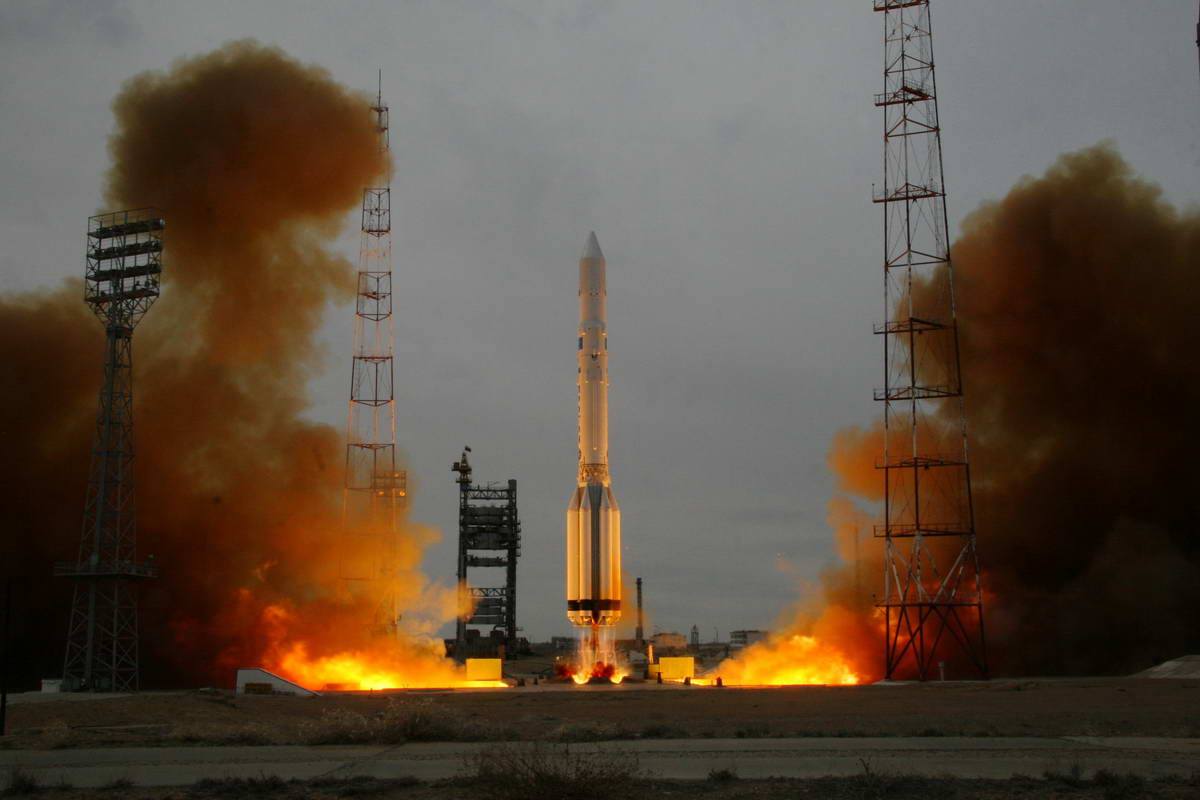
About the Proton-K/DM
Proton-K/DM
The Proton-K/DM is a Soviet orbital launch vehicle operated by the Soviet Space Program, representing one of the most significant heavy-lift configurations developed during the Cold War era of spaceflight. A member of the broader Proton family designed and manufactured by the Khrunichev State Research and Production Space Center, this variant paired the proven Proton-K booster with the DM upper stage — a restartable block developed by Energia — to extend the rocket's reach into geostationary orbit. It launched exclusively from Baikonur Cosmodrome in what is now Kazakhstan.
Role and Configuration
The addition of the DM upper stage was the defining feature of this variant, transforming the Proton-K from a vehicle capable of high-energy Earth orbits into one suited for delivering satellites directly to geostationary orbit (GEO). Standing 59 meters tall with a core diameter of 4.15 meters, the Proton-K/DM carried forward the fundamental three-stage architecture of the Proton-K while the DM stage provided the additional propulsive capability needed for the demanding geostationary transfer and insertion burns. This made it the workhorse of the Soviet Union's civil and military communications satellite infrastructure throughout its operational period.
Operational History
According to tracked flight records, the Proton-K/DM was active from 1974 to 1990, during which it conducted 66 documented flights. Of these, 61 were successful, with 5 resulting in failure or partial failure — a reliability record broadly consistent with the demanding nature of geostationary delivery missions during that era of spaceflight development.
The vehicle's manifest was dominated almost entirely by Soviet government payloads, reflecting its role as a state instrument rather than a commercial launch platform. Its most frequent passengers were satellites from three key Soviet communications programs: the Gorizont series (providing wide-area television and telephone relay), the Ekran series (focused on direct television broadcasting to remote regions of the Soviet Union), and the Raduga series (supporting government and military communications). Recent missions in the tracked record include launches of *Gorizont 20*, *Gorizont 15*, *Gorizont 14*, *Raduga 20*, and multiple *Ekran* satellites, illustrating how thoroughly the Proton-K/DM was woven into the Soviet Union's national communications infrastructure.
Historical Significance
The Proton-K/DM occupies an important place in the history of Soviet and Russian space launch capability. By reliably placing communications satellites into geostationary orbit over a sixteen-year period, it helped the Soviet Union establish and maintain a national satellite communications network spanning one of the largest landmasses on Earth — a strategic necessity given the country's vast geography and the limitations of ground-based infrastructure in remote areas.
The Proton-K platform itself would continue to evolve well beyond this variant's operational window, with later upper-stage configurations extending the vehicle's service life deep into the post-Soviet era. The DM stage similarly continued in use on successor configurations. The Proton-K/DM thus represents a foundational chapter in that long lineage, demonstrating the viability of restartable upper stages for geostationary delivery and setting the operational template that Soviet — and later Russian — heavy-lift launches would follow for decades.
- Jun 20, 1990Proton-K/DM | Gorizont 20Success
- May 06, 1988Proton-K/DM | EkranSuccess
- Mar 31, 1988Proton-K/DM | Gorizont 15Success
- Sep 03, 1987Proton-K/DM | EkranSuccess
- May 11, 1987Proton-K/DM | Gorizont 14Success
- Mar 19, 1987Proton-K/DM | Raduga 20Success
- Nov 18, 1986Proton-K/DM | Gorizont 13Success
- Oct 25, 1986Proton-K/DM | Raduga 19Success
- Jun 10, 1986Proton-K/DM | Gorizont 12Success
- May 24, 1986Proton-K/DM | EkranSuccess
- Apr 04, 1986Proton-K/DM | Potok 3Success
- Jan 17, 1986Proton-K/DM | Raduga 18Success
- Nov 15, 1985Proton-K/DM | Raduga 17Success
- Aug 08, 1985Proton-K/DM | Raduga 16Success
- Mar 22, 1985Proton-K/DM | EkranSuccess
- Feb 21, 1985Proton-K/DM | US-KS 3Success
- Jan 18, 1985Proton-K/DM | Gorizont 11Success
- Aug 24, 1984Proton-K/DM | EkranSuccess
- Aug 01, 1984Proton-K/DM | Gorizont 10Success
- Jun 22, 1984Proton-K/DM | Raduga 15Success
- Apr 22, 1984Proton-K/DM | Gorizont 9Success
- Mar 29, 1984Proton-K/DM | US-KS 2Success
- Mar 16, 1984Proton-K/DM | EkranSuccess
- Mar 02, 1984Proton-K/DM | Potok 2Success
- Feb 15, 1984Proton-K/DM | Raduga 14Success
- Nov 30, 1983Proton-K/DM | Gorizont 8Success
- Sep 29, 1983Proton-K/DM | EkranSuccess
- Aug 25, 1983Proton-K/DM | Raduga 13Success
- Jun 30, 1983Proton-K/DM | Gorizont 7Success
- Apr 08, 1983Proton-K/DM | Raduga 12Success
- Mar 12, 1983Proton-K/DM | EkranSuccess
- Dec 24, 1982Proton-K/DM | Raduga 22LFailure
- Nov 26, 1982Proton-K/DM | Raduga 11Success
- Oct 20, 1982Proton-K/DM | Gorizont 6Success
- Sep 16, 1982Proton-K/DM | EkranSuccess
- Jul 22, 1982Proton-K/DM | EkranFailure
- May 17, 1982Proton-K/DM | Potok 1Success
- Mar 15, 1982Proton-K/DM | Gorizont 5Success
- Feb 05, 1982Proton-K/DM | EkranSuccess
- Oct 09, 1981Proton-K/DM | Raduga 10Success
- Jul 30, 1981Proton-K/DM | Raduga 9Success
- Jun 25, 1981Proton-K/DM | EkranSuccess
- Mar 18, 1981Proton-K/DM | Raduga 8Success
- Dec 26, 1980Proton-K/DM | EkranSuccess
- Oct 05, 1980Proton-K/DM | Raduga 7Success
- Jul 14, 1980Proton-K/DM | EkranSuccess
- Jun 14, 1980Proton-K/DM | Gorizont 4Success
- Feb 20, 1980Proton-K/DM | Raduga 6Success
- Dec 28, 1979Proton-K/DM | Gorizont 3Success
- Oct 03, 1979Proton-K/DM | EkranSuccess
- Jul 05, 1979Proton-K/DM | Gorizont 2Success
- Apr 25, 1979Proton-K/DM | Raduga 5Success
- Feb 21, 1979Proton-K/DM | EkranSuccess
- Dec 19, 1978Proton-K/DM | Gorizont 1Success
- Oct 17, 1978Proton-K/DM | EkranFailure
- Aug 17, 1978Proton-K/DM | EkranFailure
- Jul 18, 1978Proton-K/DM | Raduga 4Success
- May 27, 1978Proton-K/DM | EkranFailure
- Sep 20, 1977Proton-K/DM | EkranSuccess
- Jul 23, 1977Proton-K/DM | Raduga 3Success
- Oct 26, 1976Proton-K/DM | EkranSuccess
- Sep 11, 1976Proton-K/DM | Raduga 2Success
- Dec 22, 1975Proton-K/DM | Raduga 1Success
- Oct 08, 1975Proton-K/DM | US-KS 1Success
- Jul 29, 1974Proton-K/DM | Molniya-1SSuccess
- Mar 26, 1974Proton-K/DM | Raduga-GVMSuccess