Proton-K/D-2
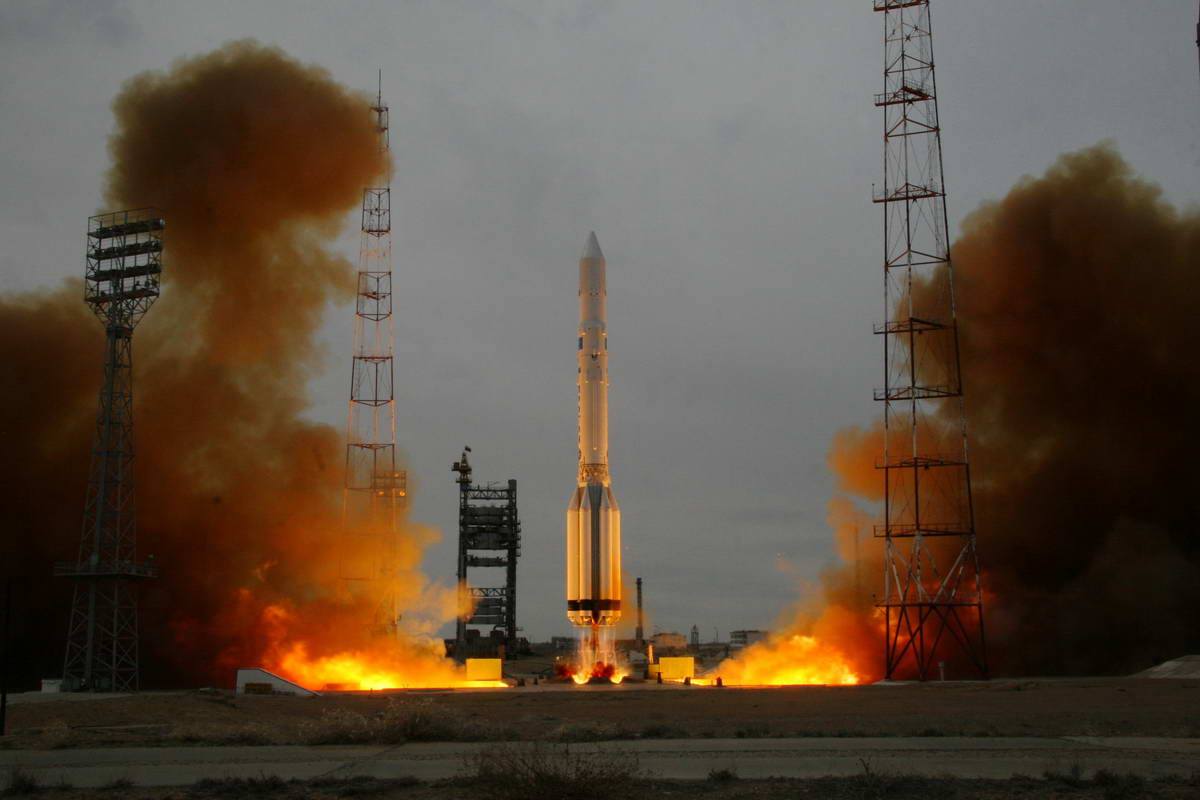
About the Proton-K/D-2
Proton-K/D-2
The Proton-K/D-2 is a Soviet and Russian expendable orbital launch vehicle, operated by the Soviet Space Program and manufactured by the Khrunichev State Research and Production Space Center. A specialized configuration of the broader Proton-K family, it pairs the proven Proton-K core stack with the D-2 upper stage, optimizing the vehicle for deep-space and high-energy missions that demand trajectories beyond standard Earth orbit.
Background and Configuration
The Proton-K itself is one of the most significant heavy-lift rockets in spaceflight history, having served as the Soviet Union's primary workhorse for large payloads since the 1960s. The D-2 upper stage — a variant of the Blok D stage lineage — provides the additional propulsive capability needed to dispatch spacecraft on interplanetary trajectories. This configuration stands 57 meters tall with a core diameter of 4.15 meters, dimensions consistent with the broader Proton-K family's characteristic wide, low-slung booster arrangement driven by the constraints of its storable propellant tanks. The vehicle launches from Baikonur Cosmodrome in Kazakhstan, the historic hub of Soviet and Russian space activity.
Flight Record
In the data tracked here, the Proton-K/D-2 recorded 3 flights between 1988 and 1996, all of which were successful at the launch vehicle level. The three missions documented are closely associated with Soviet planetary science: Fobos-1 and Fobos-2, both launched in 1988 as part of an ambitious program to study Mars and its moon Phobos, and Mars-96, launched in 1996 as Russia's major post-Soviet attempt at Mars exploration.
It is worth noting that while the Proton-K/D-2 performed successfully as a launch vehicle in all three tracked missions, the spacecraft themselves experienced separate, well-documented failures after separation. Contact with Fobos-1 was lost en route to Mars due to a software command error, and Fobos-2 failed before completing its primary objectives at Mars. Mars-96 suffered a catastrophic spacecraft failure shortly after launch, preventing it from escaping Earth's gravity. These outcomes reflect the difficulty of deep-space missions rather than any deficiency in the launch vehicle itself.
Role and Significance
The Proton-K/D-2 represents a niche but important configuration within the Proton family, purpose-built for planetary science missions that require escape from Earth's gravitational influence. Its payload capability to low Earth orbit is listed at 6,220 kg, though in practice its most meaningful performance parameter for the missions it flew was its ability to deliver spacecraft onto interplanetary trajectories, where the D-2 upper stage provided the critical final energy to reach Mars.
The vehicle's active window of 1988 to 1996 spans one of the most turbulent periods in Russian space history, bridging the late Soviet era and the early years of the Russian Federation. Despite the difficult political and economic climate of that transition, the Proton-K/D-2 configuration continued to serve as Russia's instrument for reaching beyond the Earth-Moon system, underscoring the enduring ambition of its planetary science program even under severe institutional strain.