Proton-K/D-1
About the Proton-K/D-1
Proton-K/D-1
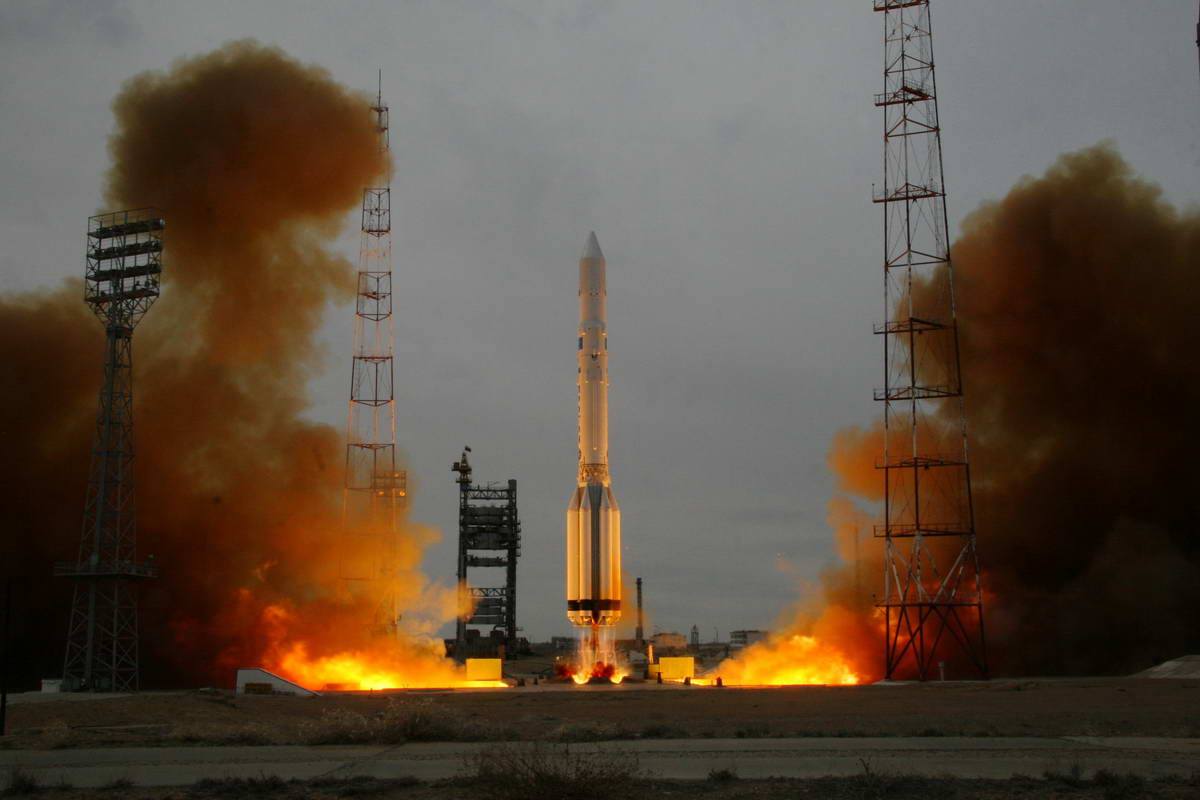
The Proton-K/D-1 is a Soviet expendable orbital launch vehicle, operated by the Soviet Space Program and manufactured by the Khrunichev State Research and Production Space Center. A member of the long-serving Proton family developed in the 1960s, the Proton-K/D-1 represents a specific upper-stage configuration pairing the proven Proton-K core with the D-1 (Blok D) upper stage, optimizing the stack for high-energy missions beyond low Earth orbit. The vehicle launches from Baikonur Cosmodrome in present-day Kazakhstan, the historic heart of Soviet and Russian spaceflight operations.
Standing 57 meters tall with a core diameter of 4.15 meters, the Proton-K/D-1 shares the distinctive silhouette of the broader Proton-K family — a large first stage characterized by six strap-on fuel tanks clustered around a central oxidizer body, feeding a cluster of powerful engines. The D-1 upper stage provided the additional propulsive kick needed to dispatch payloads toward interplanetary trajectories and high orbits.
Role and Mission Profile
The Proton-K/D-1 was purpose-built for ambitious deep-space and science missions, serving as the Soviet Union's primary workhorse for planetary exploration during its operational years. Its high-energy upper stage made it especially well-suited to dispatching spacecraft across the inner solar system — a capability that defined much of its mission manifest.
Flight Record
According to tracked flight data, the Proton-K/D-1 was active from 1975 to 1989, completing 12 tracked flights with a record of 11 successes and 1 failure or partial failure — a strong reliability profile for a vehicle dedicated to complex, high-value science payloads.
The vehicle's mission history reads as a chronicle of Soviet planetary science at its most ambitious. Notable missions include the Venera-15 and Venera-16 spacecraft, which mapped Venus using synthetic aperture radar; the twin Vega-1 and Vega-2 probes, which conducted a remarkable dual mission visiting both Venus and Halley's Comet; the Astron ultraviolet space observatory; and Granat, an international astrophysics observatory dedicated to high-energy X-ray and gamma-ray astronomy. These missions reflect the Proton-K/D-1's consistent role as a launcher of consequence — carrying instruments and spacecraft that produced lasting scientific contributions.
Legacy
The Proton-K/D-1 configuration occupies a significant place in Soviet spaceflight history, bridging the era of early planetary exploration and the more sophisticated science missions of the 1980s. Its relatively compact operational window of roughly fourteen years nonetheless encompassed some of the most scientifically productive interplanetary missions ever mounted by the Soviet Union. The broader Proton-K platform on which it was based continued to evolve and operate for decades beyond the D-1 configuration's retirement, cementing the Proton family's reputation as one of the most enduring and capable heavy-lift rocket lineages in the history of spaceflight.
The top customer throughout its operational life was, exclusively, the Soviet Space Program — reflecting the vehicle's status as a strictly government-operated asset dedicated to national scientific and strategic objectives.
- Dec 01, 1989Proton-K/D-1 | GranatSuccess
- Dec 21, 1984Proton-K/D-1 | Vega-2Success
- Dec 15, 1984Proton-K/D-1 | Vega-1Success
- Jun 07, 1983Proton-K/D-1 | Venera-16Success
- Jun 02, 1983Proton-K/D-1 | Venera-15Success
- Mar 23, 1983Proton-K/D-1 | AstronSuccess
- Nov 04, 1981Proton-K/D-1 | Venera-14Success
- Oct 30, 1981Proton-K/D-1 | Venera-13Success
- Sep 14, 1978Proton-K/D-1 | Venera-12Success
- Sep 09, 1978Proton-K/D-1 | Venera-11Success
- Aug 09, 1976Proton-K/D-1 | Luna-24Success
- Oct 16, 1975Proton-K/D-1 | Luna-24aFailure