Proton-K/Briz-M
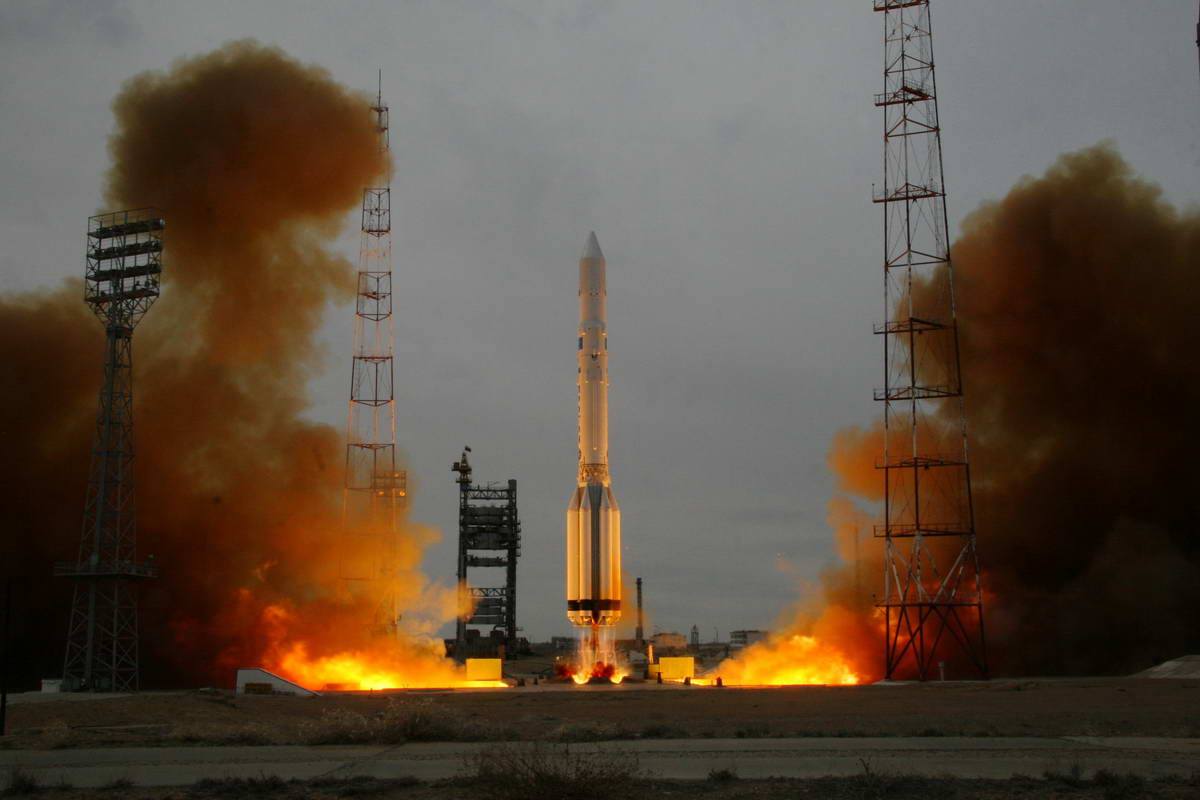
About the Proton-K/Briz-M
Proton-K/Briz-M
The Proton-K/Briz-M is a heavy-lift expendable launch vehicle operated by Khrunichev State Research and Production Space Center, the Russian aerospace manufacturer responsible for producing and marketing the Proton family of rockets. A variant of the long-serving Soviet-era Proton-K booster, this configuration pairs the established three-stage Proton-K core with the Briz-M ("Breeze-M") upper stage, a restartable, storable-propellant stage designed to deliver payloads more precisely and efficiently to geostationary transfer orbit and other high-energy destinations.
The Proton-K itself traces its origins to the 1960s and became one of the most prolific heavy-lift vehicles in spaceflight history, launching Soviet and later Russian satellites, space station modules, and interplanetary probes over several decades. The addition of the Briz-M upper stage represented a significant modernization, improving the vehicle's competitiveness on the commercial launch market by enabling more flexible injection profiles for geostationary communications satellites.
Configuration and Capabilities
Standing 57 meters tall with a core diameter of 4.15 meters, the Proton-K/Briz-M is a large vehicle by any measure. Its payload capacity to low Earth orbit is quoted at 19,760 kg, reflecting the substantial lifting power of the Proton-K core stages. Launches are conducted from Baikonur Cosmodrome in Kazakhstan, the historic spaceport from which the Proton family has operated throughout its history.
The Briz-M upper stage burns nitrogen tetroxide and unsymmetrical dimethylhydrazine, propellants long associated with the Proton family. Its ability to perform multiple engine restarts during a mission allows it to execute complex, multi-burn trajectories that place payloads directly into their intended operational orbits, reducing the work required of onboard satellite propulsion systems.
Flight Record
In the tracking data assembled here, the Proton-K/Briz-M flew four missions between 1999 and 2003, recording three successes and one failure or partial failure. This relatively brief window reflects the transitional role this specific configuration played before the newer Proton-M/Briz-M largely superseded it in commercial service.
The missions logged include a range of satellite types. The Gorizont 33 and Raduga 34 payloads represent Russia's domestic communications satellite programs, while AMC 9 was a commercial geostationary communications satellite. The Uragan 83, 84 & Uragan-M 2 mission carried navigation satellites for Russia's GLONASS positioning system, underscoring the vehicle's role in supporting critical national infrastructure alongside its commercial work.
Significance
The Proton-K/Briz-M occupies an important transitional place in the history of Russian commercial launch services. It demonstrated that the mature, highly reliable Proton-K core could be combined with a modern, capable upper stage to compete effectively for international satellite contracts. The experience and technology developed with this configuration directly informed the Proton-M/Briz-M, which went on to become one of the most frequently used commercial heavy-lift vehicles of the 2000s and 2010s. Though short-lived in its own right, the Proton-K/Briz-M helped establish the Briz-M as a credible and capable upper stage for geostationary payload delivery.