Proton-K/17S40
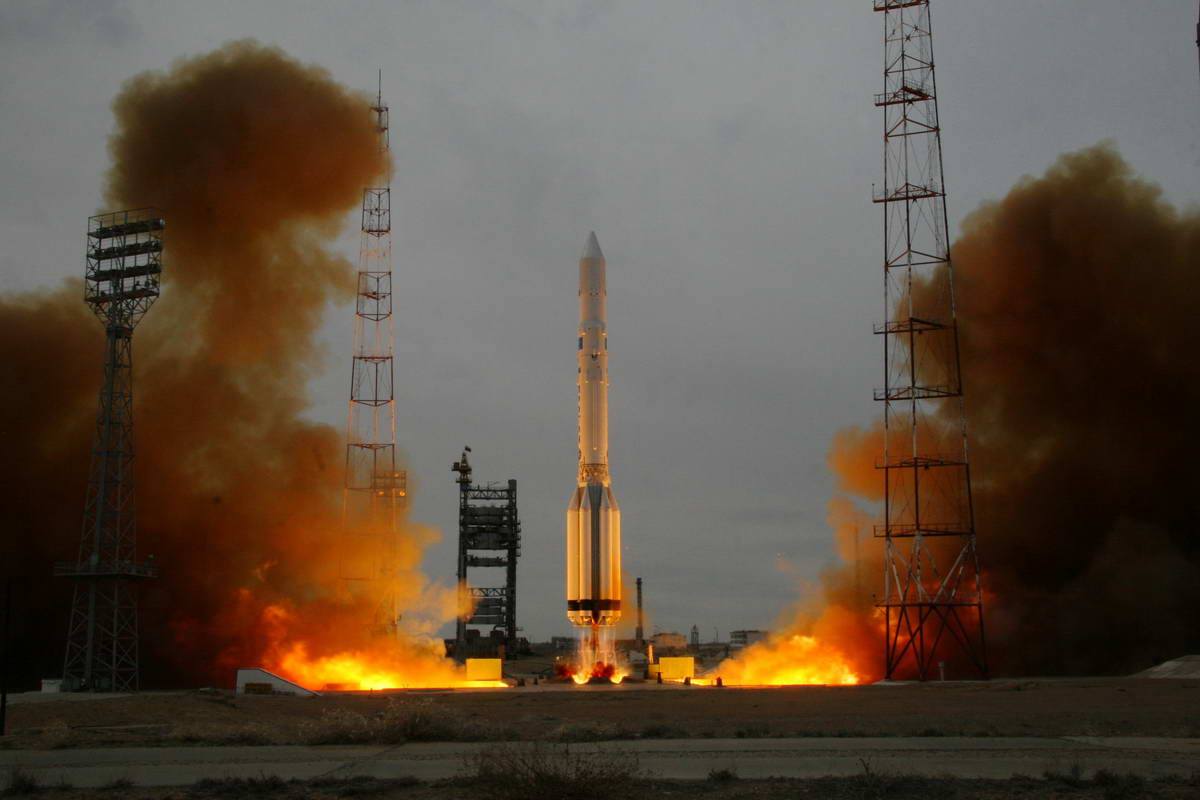
About the Proton-K/17S40
Proton-K/17S40
The Proton-K/17S40 is a variant of the venerable Soviet-designed Proton-K launch vehicle, operated by Khrunichev State Research and Production Space Center of Russia. It represents a specialized upper-stage configuration of the Proton-K, adapted to deliver payloads into specific orbits that the baseline vehicle's standard upper stages were not optimized to reach. Like all members of the Proton family, it launches from the Baikonur Cosmodrome in Kazakhstan.
Background and Development
The Proton rocket has been a cornerstone of Soviet and Russian space launch capability since the 1960s, and the Proton-K variant served as the workhorse configuration for much of the latter twentieth century. The 17S40 designation refers to a particular upper-stage assembly integrated atop the standard Proton-K three-stage booster, tailoring the vehicle's performance profile for missions that required a distinct departure trajectory or injection geometry. At 59 meters tall and 4.15 meters in diameter, the Proton-K/17S40 shares the imposing physical profile common to the Proton family, with a rated payload capacity to low Earth orbit of 6,000 kg.
Flight Record
The Proton-K/17S40 flew a compact but consistent operational career, with six tracked flights between 1997 and 2002, all of which were successful. This unblemished record across its entire service life speaks to the maturity of the underlying Proton-K platform and the reliability of the 17S40 upper-stage configuration.
Its mission manifest was notably diverse. The vehicle supported commercial constellation deployment through multiple Iridium satellite launches, orbiting batches of the low Earth orbit communications satellites in three separate missions: *Iridium 09 to 14 & Iridium 16*, *Iridium 27 to 33*, and *Iridium 62 to 68*. These missions positioned Khrunichev as a significant commercial launch provider during the late 1990s boom in satellite constellation development.
The Proton-K/17S40 also carried the two Araks-N reconnaissance satellites — *Araks-N 1* and *Araks-N 2* — reflecting the vehicle's continued utility for Russian government and defense-related payloads alongside its commercial work. The final tracked mission in the record was the launch of Integral, the European Space Agency's gamma-ray space observatory, in 2002. This high-profile scientific mission demonstrated the vehicle's capability to serve international customers and deliver precision-pointed scientific instruments to demanding orbits.
Legacy
Although the Proton-K/17S40 flew only six times, its missions spanned commercial telecommunications, national security payloads, and international scientific cooperation — a breadth that illustrates the flexibility of the Proton-K platform in accommodating varied upper-stage configurations. The vehicle's operational window coincided with a period of significant transition for Russian launch services, as Khrunichev actively pursued international contracts in a newly competitive global launch market. The successful delivery of the Integral observatory in particular cemented the variant's reputation and served as a fitting conclusion to its operational career.
- Oct 17, 2002Proton-K/17S40 | IntegralSuccess
- Jul 25, 2002Proton-K/17S40 | Araks-N 2Success
- Apr 07, 1998Proton-K/17S40 | Iridium 62 to 68Success
- Sep 14, 1997Proton-K/17S40 | Iridium 27 to 33Success
- Jun 18, 1997Proton-K/17S40 | Iridium 09 to 14 & Iridium 16Success
- Jun 06, 1997Proton-K/17S40 | Araks-N 1Success