Proton-K
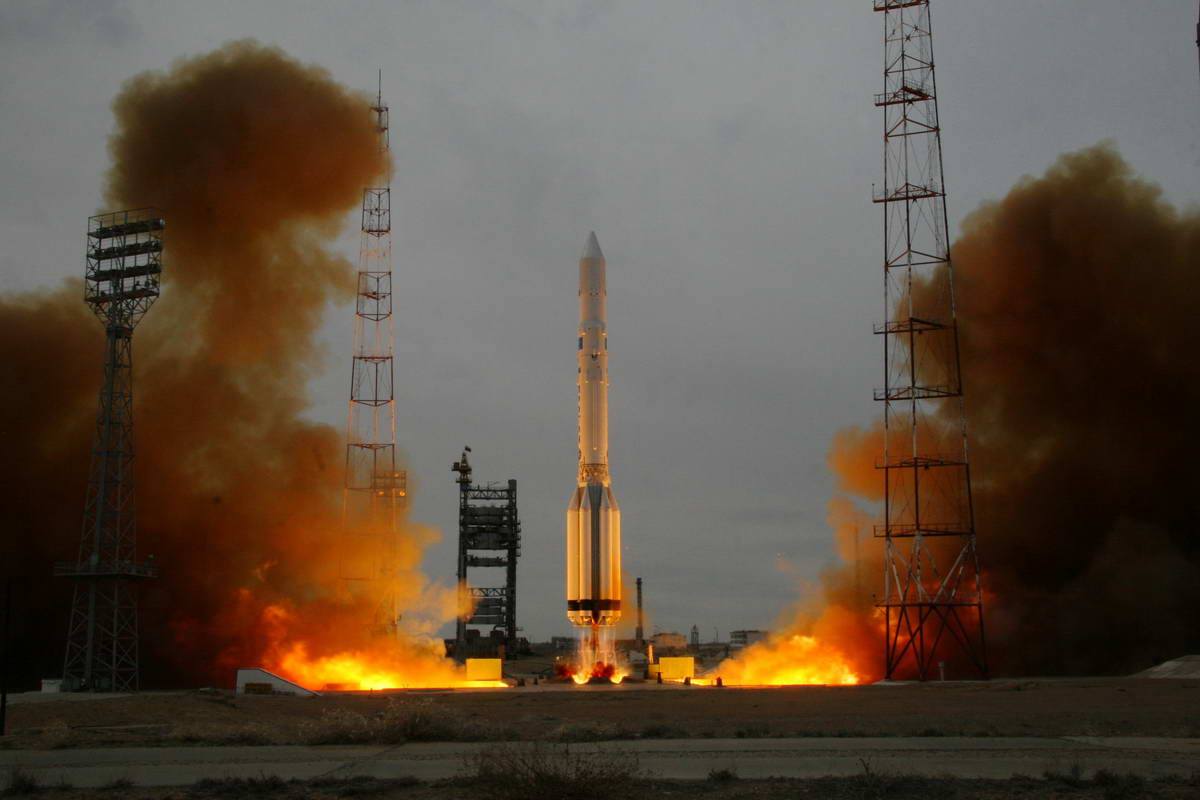
About the Proton-K
Proton-K
The Proton-K is a Soviet and Russian heavy-lift expendable launch vehicle developed by the Khrunichev State Research and Production Space Center and operated primarily by the Soviet Space Program and its successors. One of the most consequential rockets of the Space Age, the Proton-K served as the Soviet Union's primary workhorse for high-energy missions, placing military reconnaissance satellites, communications spacecraft, and deep-space probes into orbit across five decades of continuous service.
Development and Design
Standing 57 metres tall with a core diameter of 4 metres, the Proton-K is a large, multi-stage vehicle recognizable by its distinctive first stage, which clusters six fuel tanks around a central oxidizer body — an unconventional arrangement driven by the constraints of road and rail transport to the Baikonur Cosmodrome in Kazakhstan, from which all Proton launches have taken place. The vehicle uses nitrogen tetroxide and unsymmetrical dimethylhydrazine (UDMH) as propellants, a hypergolic combination that is storable but highly toxic, contributing to strict ground-handling protocols throughout the rocket's operational life.
The Proton-K evolved from the original Proton design first flown in the mid-1960s and was frequently paired with upper stages — most notably the Block D and DM series — to extend its reach to geostationary orbit and beyond.
Operational History
Our flight record tracks 178 launches of the Proton-K between 1967 and 2012, of which 153 were fully successful and 25 resulted in failure or partial failure. This record reflects both the vehicle's essential reliability over a long career and the inherent challenges of operating a complex heavy-lift system across such an extended period.
The Proton-K's manifests were dominated by Soviet and Russian government payloads. Military missions — particularly Uragan navigation satellites, US-KMO early-warning spacecraft, and Raduga communications satellites — formed a substantial portion of its workload, underscoring the rocket's strategic importance to Soviet and later Russian national security space infrastructure. The inclusion of GLONASS-series Uragan satellites among its final missions illustrates how the Proton-K supported the long-running effort to build and replenish Russia's global navigation constellation.
Among the vehicle's recent tracked missions are the Proton-K/DM-2 | US-KMO (Kosmos-2479) flight and several Uragan-M constellation replenishment launches, demonstrating that even in its final years the Proton-K was entrusted with high-priority national payloads.
Legacy
The Proton-K's 45-year operational span — from the late 1960s through 2012 — places it among the longest-serving orbital launch vehicles in history. It enabled the Soviet Union to sustain a robust presence in geostationary orbit for military and civilian communications, contributed to interplanetary exploration programs, and established Baikonur Cosmodrome as one of the world's premier launch sites. The vehicle was eventually succeeded by the Proton-M, an upgraded variant incorporating modernized avionics and improved upper stages, which carried forward the core architecture of the Proton-K into the twenty-first century.
- Mar 30, 2012Proton-K/DM-2 | US-KMO (Kosmos-2479)Success
- Feb 28, 2009Proton | Raduga-1 8Success
- Jun 26, 2008Proton | US-KMO 7Success
- Oct 26, 2007Proton | Uragan-M 9 to 11Success
- Dec 25, 2006Proton | Uragan-M 6 to 8Success
- Dec 25, 2005Proton | Uragan 87, Uragan-M 4 & 5Success
- Jun 24, 2005Proton | Ekspress AM-3Success
- Dec 26, 2004Proton | Uragan 85, 86 & Uragan-M 3Success
- Mar 27, 2004Proton | Raduga-1 7Success
- Apr 24, 2003Proton | US-KMO 6Success
- Dec 01, 2001Proton | Uragan 78, 79 & Uragan-M 1Success
- Oct 06, 2001Proton | Raduga-1 6Success
- Aug 24, 2001Proton | US-KMO 5Success
- Oct 13, 2000Proton | Uragan 75 to 77Success
- Aug 28, 2000Proton | Raduga-1 5Success
- Jul 12, 2000Proton | ZvezdaSuccess
- Jul 04, 2000Proton | Potok 10Success
- Oct 27, 1999Proton | Ekspress-A No. 1Failure
- Feb 28, 1999Proton | Raduga-1 4Success
- Dec 30, 1998Proton | Uragan 72 to 74Success
- Nov 20, 1998Proton | ZaryaSuccess
- Apr 29, 1998Proton | US-KMO 4Success
- Aug 14, 1997Proton | US-KS 7Success
- Sep 06, 1996Proton | INMARSAT III F-2Success
- May 25, 1996Proton | Gorizont 32Success
- Apr 23, 1996Proton | PrirodaSuccess
- Feb 19, 1996Proton | Raduga 33Success
- Jan 25, 1996Proton | Gorizont 31Success
- Dec 14, 1995Proton | Uragan 69 to 71Success
- Nov 17, 1995Proton | Gals 2Success
- Oct 11, 1995Proton | Luch 2Success
- Aug 30, 1995Proton | Potok 9Success
- Jul 24, 1995Proton | Uragan 66 to 68Success
- May 20, 1995Proton | SpektrSuccess
- Mar 07, 1995Proton | Uragan 63 to 65Success
- Dec 28, 1994Proton | Raduga 32Success
- Dec 16, 1994Proton | Altair 13L (Luch 1)Success
- Nov 20, 1994Proton | Uragan 60 to 62Success
- Oct 31, 1994Proton | ElektroSuccess
- Sep 21, 1994Proton | Potok 8Success
- Aug 11, 1994Proton | Uragan 57 to 59Success
- Jul 06, 1994Proton | US-KMO 3Success
- May 20, 1994Proton | Rimsat G2Success
- Apr 11, 1994Proton | Uragan 54 to 56Success
- Feb 18, 1994Proton | Raduga 31Success
- Feb 05, 1994Proton | Raduga-1 3Success
- Nov 18, 1993Proton | Rimsat G1Success
- Oct 28, 1993Proton | Gorizont 28Success
- Sep 30, 1993Proton | Raduga 30Success
- May 27, 1993Proton | Gorizont 39LFailure
- Mar 25, 1993Proton | Raduga 29Success
- Feb 17, 1993Proton | Uragan 51 to 53Success
- Dec 17, 1992Proton | US-KMO 2Success
- Nov 27, 1992Proton | Gorizont 27Success
- Oct 30, 1992Proton | Ekran-M 3Success
- Sep 10, 1992Proton | US-KS 6Success
- Jul 30, 1992Proton | Uragan 48 to 50Success
- Jul 14, 1992Proton | Gorizont 26Success
- Apr 02, 1992Proton | Gorizont 25Success
- Jan 29, 1992Proton | Uragan 45 to 47Success
- Dec 19, 1991Proton | Raduga 28Success
- Nov 22, 1991Proton | Potok 7Success
- Oct 23, 1991Proton | Gorizont 24Success
- Sep 13, 1991Proton | US-KS 5Success
- Jul 01, 1991Proton | Gorizont 23Success
- Apr 04, 1991Proton | Uragan 42 to 44Success
- Mar 31, 1991Proton | Almaz-1Success
- Feb 28, 1991Proton | Raduga 27Success
- Feb 14, 1991Proton | US-KMO 1Success
- Dec 27, 1990Proton | Raduga-1 2Success
- Dec 20, 1990Proton | Raduga 26Success
- Dec 08, 1990Proton | Uragan 39 to 41Success
- Nov 23, 1990Proton | Gorizont 22Success
- Nov 03, 1990Proton | Gorizont 21Success
- Aug 09, 1990Proton | Ekran-M 14LFailure
- Jul 18, 1990Proton | Potok 6Success
- May 31, 1990Proton | KristallSuccess
- May 19, 1990Proton | Uragan 36 to 38Success
- Feb 15, 1990Proton | Raduga 25Success
- Dec 27, 1989Proton | Luch #3Success
- Dec 15, 1989Proton | Raduga 24Success
- Nov 26, 1989Proton | Kvant-2Success
- Sep 28, 1989Proton | Gorizont 19Success
- Jul 05, 1989Proton | Gorizont 18Success
- Jun 21, 1989Proton | Raduga-1 1Success
- May 31, 1989Proton | Uragan 34 & 35Success
- Apr 14, 1989Proton | Raduga 23Success
- Jan 26, 1989Proton | Gorizont 17Success
- Jan 10, 1989Proton | Uragan 32 & 33Success
- Dec 10, 1988Proton | Ekran-M 2Success
- Oct 20, 1988Proton | Raduga 22Success
- Sep 16, 1988Proton | Uragan 29 to 31Success
- Aug 18, 1988Proton | Gorizont 16Success
- Aug 01, 1988Proton | Potok 5Success
- May 21, 1988Proton | Uragan 26 to 28Success
- Apr 26, 1988Proton | GeofizikaSuccess
- Feb 17, 1988Proton | Uragan 23 to 25Failure
- Jan 18, 1988Proton | Gorizont 25LFailure
- Dec 27, 1987Proton | Ekran-M 1Success
- Dec 10, 1987Proton | Raduga 21Success
- Nov 26, 1987Proton | Luch #2Success
- Oct 28, 1987Proton | US-KS 4Success
- Oct 01, 1987Proton | Potok 4Success
- Sep 16, 1987Proton | Uragan 20 to 22Success
- Jul 25, 1987Proton | Almaz-T 2Success
- Apr 24, 1987Proton | Uragan 17 to 19Failure
- Mar 31, 1987Proton | KvantSuccess
- Jan 30, 1987Proton | Ekran-M 11LFailure
- Nov 29, 1986Proton | Almaz-T 1Failure
- Sep 16, 1986Proton | Uragan 14 to 16Success
- Feb 19, 1986Proton | MirSuccess
- Dec 24, 1985Proton | Uragan 12 & 13Success
- Oct 25, 1985Proton | Luch #1Success
- Sep 27, 1985Proton | TKS-MSuccess
- May 30, 1985Proton | Tselina-2 2Success
- May 17, 1985Proton | Uragan 10 & 11Success
- Sep 28, 1984Proton | Tselina-2 1Success
- Sep 04, 1984Proton | Uragan 8 & 9Success
- May 19, 1984Proton | Uragan 6 & 7Success
- Dec 29, 1983Proton | Uragan 4 & 5Success
- Aug 10, 1983Proton | Uragan 2 &3Success
- Mar 02, 1983Proton | TKS 3Success
- Oct 12, 1982Proton | Uragan 1Success
- Apr 19, 1982Proton | Salyut-7Success
- Apr 25, 1981Proton | TKS 2Success
- May 22, 1979Proton | TKS-VA 9 & 10Success
- Mar 30, 1978Proton | TKS-VA 5 & 6Success
- Sep 29, 1977Proton | Salyut-6Success
- Aug 04, 1977Proton | TKS-VA 3 & 4Failure
- Jul 17, 1977Proton | TKS 1Success
- Dec 15, 1976Proton | TKS-VA 1 & 2Success
- Jun 22, 1976Proton | Salyut-5Success
- Jun 14, 1975Proton | Venera-10Success
- Jun 08, 1975Proton | Venera-9Success
- Dec 26, 1974Proton | Salyut-4Success
- Oct 28, 1974Proton | Luna-23Success
- Jun 24, 1974Proton | Salyut-3Success
- May 29, 1974Proton | Luna-22Success
- Aug 09, 1973Proton | Mars-7Success
- Aug 05, 1973Proton | Mars-6Success
- Jul 25, 1973Proton | Mars-5Success
- Jul 21, 1973Proton | Mars-4Success
- May 11, 1973Proton | Salyut-3aSuccess
- Apr 03, 1973Proton | Salyut-2Success
- Jan 08, 1973Proton | Luna-21Success
- Jul 29, 1972Proton | Salyut-2aFailure
- Feb 14, 1972Proton | Luna-20Success
- Sep 28, 1971Proton | Luna-19Success
- Sep 02, 1971Proton | Luna-18Success
- May 28, 1971Proton | Mars-3Success
- May 19, 1971Proton | Mars-2Success
- May 10, 1971Proton | Mars-2dFailure
- Apr 19, 1971Proton | Salyut 1Success
- Dec 02, 1970Proton | L1E 2KSuccess
- Nov 10, 1970Proton | Luna-17Success
- Oct 20, 1970Proton / UR-500 K/D | Zond 8Success
- Sep 12, 1970Proton | Luna-16Success
- Feb 06, 1970Proton | Luna-16cFailure
- Nov 28, 1969Proton / UR-500 K/D | Soyuz 7K-L1E No.1Failure
- Oct 22, 1969Proton | Luna-16bFailure
- Sep 23, 1969Proton | Luna-16aFailure
- Aug 07, 1969Proton / UR-500 K/D | Zond 7Success
- Jul 13, 1969Proton | Luna-15Success
- Jun 14, 1969Proton | Luna-15bFailure
- Apr 02, 1969Proton | Mars-2cFailure
- Mar 27, 1969Proton | Mars-2bFailure
- Feb 19, 1969Proton | Luna-15aFailure
- Jan 20, 1969Proton / UR-500 K/D | Soyuz 7K-L1 No.13LFailure
- Nov 16, 1968Proton | Proton-4Success
- Nov 10, 1968Proton / UR-500 K/D | Zond 6Success
- Sep 14, 1968Proton / UR-500 K/D | Zond 5Success
- Jul 21, 1968Proton / UR-500 K/D | Soyuz 7K-L1 No.8LFailure
- Apr 22, 1968Proton / UR-500 K/D | Soyuz 7K-L1 No.7LFailure
- Mar 02, 1968Proton / UR-500 K/D | Zond 4Success
- Nov 22, 1967Proton / UR-500 K/D | Soyuz 7K-L1 No.5LFailure
- Sep 27, 1967Proton / UR-500 K/D | Soyuz 7K-L1 No.4LFailure
- Apr 08, 1967Proton / UR-500 K/D | Kosmos 154Failure
- Mar 10, 1967Proton / UR-500 K/D | Kosmos 146Success