Pegasus XL
About the Pegasus XL
Pegasus XL
The Pegasus XL is an air-launched orbital rocket developed and operated by Orbital Sciences Corporation, later Orbital ATK, and subsequently Northrop Grumman Space Systems. Built in the United States, it represents the stretched, higher-performance evolution of the original Pegasus vehicle and has served as one of the few operationally successful air-launch-to-orbit systems in spaceflight history.
Design and Configuration
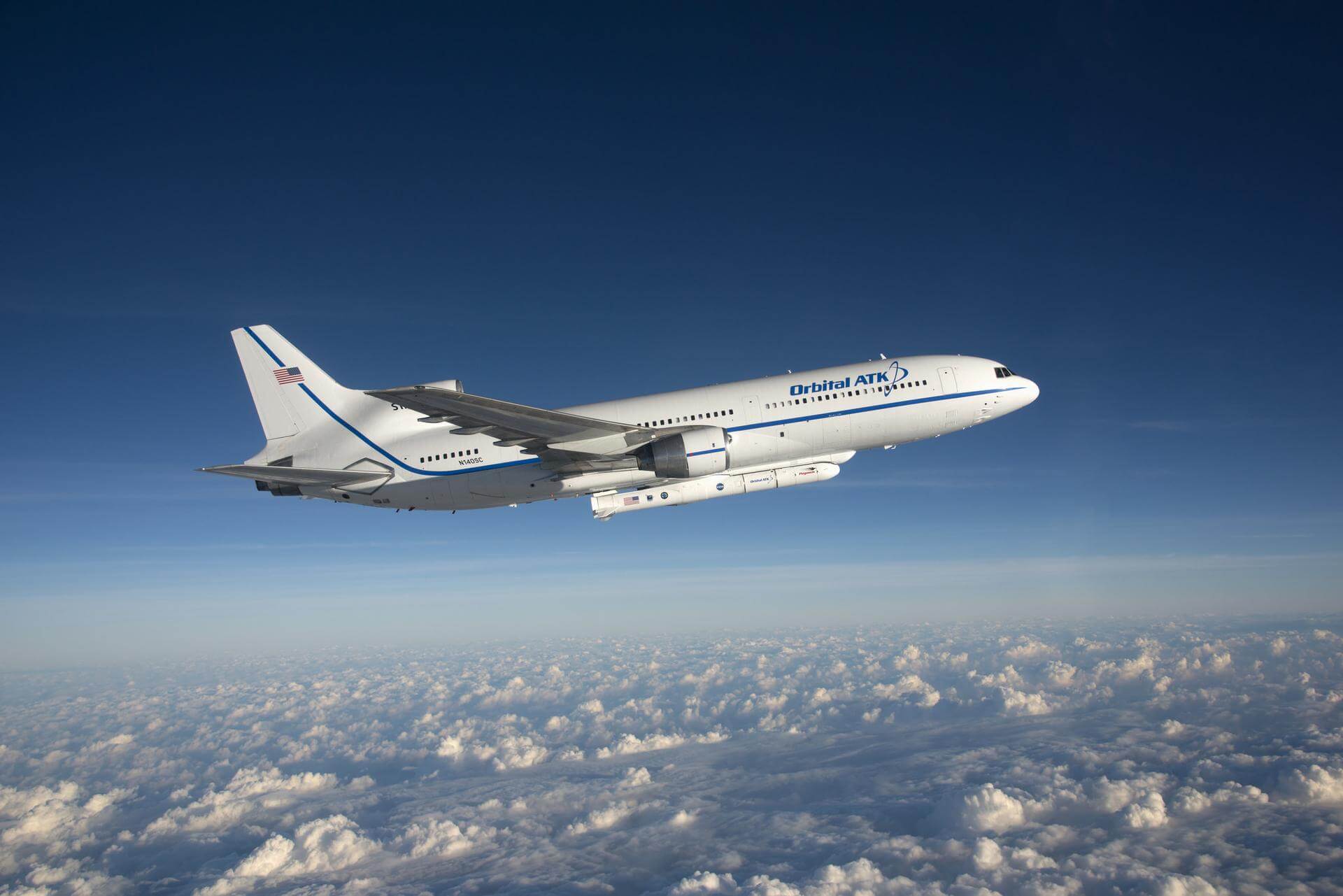
Rather than lifting off from a ground pad, the Pegasus XL is carried aloft by a specially modified carrier aircraft — a Lockheed L-1011 TriStar known as Stargazer — and released at altitude before its solid-fueled stages ignite. This "drop launch" approach allows the vehicle to begin its ascent above the densest layers of the atmosphere, reducing aerodynamic drag and enabling launches from a variety of coastal sites around the world. The rocket stands 17.6 meters tall with a diameter of 1.27 meters, and is capable of delivering up to 443 kilograms to low Earth orbit.
The XL designation reflects a lengthened first stage compared to the original Pegasus, providing meaningfully greater performance for heavier scientific and government payloads. Its three solid-rocket stages and a small liquid-fueled fourth stage work in sequence to place payloads into a wide range of orbital inclinations.
Operational History
Our flight record spans 1994 through 2026, during which the Pegasus XL conducted 32 tracked flights, achieving 28 successes alongside 3 failures or partial failures. This record places it among the more reliable small-lift vehicles of its era, particularly given the technical complexity of air-launched ascent.
The vehicle has been a favored platform for NASA science missions, with several high-profile spacecraft carried to orbit across its operational life. Notable missions include the Nuclear Spectroscopic Telescope Array (NuSTAR), a cutting-edge X-ray astronomy observatory; the Interface Region Imaging Spectrograph (IRIS), designed to study the Sun's atmosphere; the Ionospheric Connection Explorer (ICON), which investigates the boundary between Earth's upper atmosphere and space; and the 8-satellite CYGNSS constellation, which monitors hurricane wind speeds using GPS signals. The Odyssey (TacRL-2) mission demonstrated rapid-response space access for the U.S. military, while the Swift Rescue Mission marked a recent operational highlight in the vehicle's later career.
Role and Legacy
The Pegasus XL occupies a distinct niche in the small-launch market. Its air-launch architecture offers schedule flexibility and geographic reach that fixed ground ranges cannot easily match, making it well suited to the specialized orbital requirements of scientific and government customers. Northrop Grumman Space Systems, which absorbed the vehicle's lineage through a series of corporate mergers, remains its manufacturer and operator.
Over more than three decades, the Pegasus XL has delivered an impressive catalog of Earth-observation, heliophysics, astrophysics, and national security payloads — cementing its reputation as a reliable, if specialized, workhorse for missions that demand a small, responsive, and highly flexible launch capability.
- Jul 03, 2026Pegasus XL | Swift Boost MissionSuccess
- Jun 13, 2021Pegasus XL | Odyssey (TacRL-2)Success
- Oct 11, 2019Pegasus XL | Ionospheric Connection Explorer (ICON)Success
- Dec 15, 2016Pegasus XL | 8 x CYGNSSSuccess
- Jun 28, 2013Pegasus XL | Interface Region Imaging Spectrograph (IRIS)Success
- Jun 13, 2012Pegasus XL | Nuclear Spectroscopic Telescope Array (NuSTAR)Success
- Oct 19, 2008Pegasus XL | Interstellar Boundary Explorer (IBEX)Success
- Apr 16, 2008Pegasus XL | Communications/Navigation Outage Forecasting System (C/NOFS)Success
- Apr 25, 2007Pegasus XL | Aeronomy of Ice in the Mesosphere (AIM)Success
- Mar 28, 2006Pegasus XL | Space Technology 5 (ST-5) (3x microsats)Success
- Mar 22, 2006Pegasus XL | ST-5 FWDSuccess
- Apr 15, 2005Pegasus XL | Demonstration for Autonomous Rendezvous Technology (DART)Success
- Aug 13, 2003Pegasus XL | SCISAT-1Success
- Jun 26, 2003Pegasus XL | OrbView-3Success
- Apr 28, 2003Pegasus XL | Galaxy Evolution Explorer (GALEX)Success
- Jan 25, 2003Pegasus XL | Solar Radiation and Climate Experiment (SORCE)Success
- Feb 05, 2002Pegasus XL | Reuven Ramaty High Energy Solar Spectroscopic Imager (RHESSI)Success
- Jun 07, 2000Pegasus XL | Tri-Services Experiments Platform-5 (TSX-5)Success
- Mar 05, 1999Pegasus XL | Wide Field Infrared Explorer (WIRE)Success
- Dec 06, 1998Pegasus XL | Submillimeter Wave Astronomy Satellite (SWAS)Success
- Apr 02, 1998Pegasus XL | Transition Region and Coronal Explorer (TRACE)Success
- Feb 26, 1998Pegasus XL | Broadband Advanced Technologies Satellite (BATSAT/Teledesic T1) & Student Nitric Oxide Explorer (SNOE)Success
- Oct 22, 1997Pegasus XL | Space Test Experiments Platform-4 (STEP-4)Success
- Aug 29, 1997Pegasus XL | Fast On-orbit Rapid Recording of Transient Events (FORTE)Success
- Aug 01, 1997Pegasus XL | OrbView-2Success
- Apr 21, 1997Pegasus XL | Minisat & Celestis Space Burial #1Success
- Nov 04, 1996Pegasus XL | High Energy Transient Explorer (HETE) & Satelite de Aplicaciones Cientificas-B (SAC-B)Failure
- Aug 21, 1996Pegasus XL | Fast Auroral Snapshot Explorer (FAST)Success
- Jul 02, 1996Pegasus XL | Total Ozone Mapping Spectrometer (TOMS)Success
- Mar 09, 1996Pegasus XL | REX IISuccess
- Jun 22, 1995Pegasus XL | Space Test Experiments Platform-3 (STEP-3)Failure
- Jun 27, 1994Pegasus XL | Space Test Experiments Platform 1 (STEP-1)Failure