Pegasus Hybrid
About the Pegasus Hybrid
Pegasus Hybrid
The Pegasus Hybrid is an air-launched orbital rocket developed and operated by Orbital Sciences Corporation (now part of Northrop Grumman) as a transitional variant within the broader Pegasus family of small launch vehicles. Designed to serve the lightweight satellite market, it bridges the original Pegasus and the more capable Pegasus XL, offering modest improvements while retaining the distinctive air-launch architecture that made the Pegasus family a landmark in commercial spaceflight.
Design and Configuration
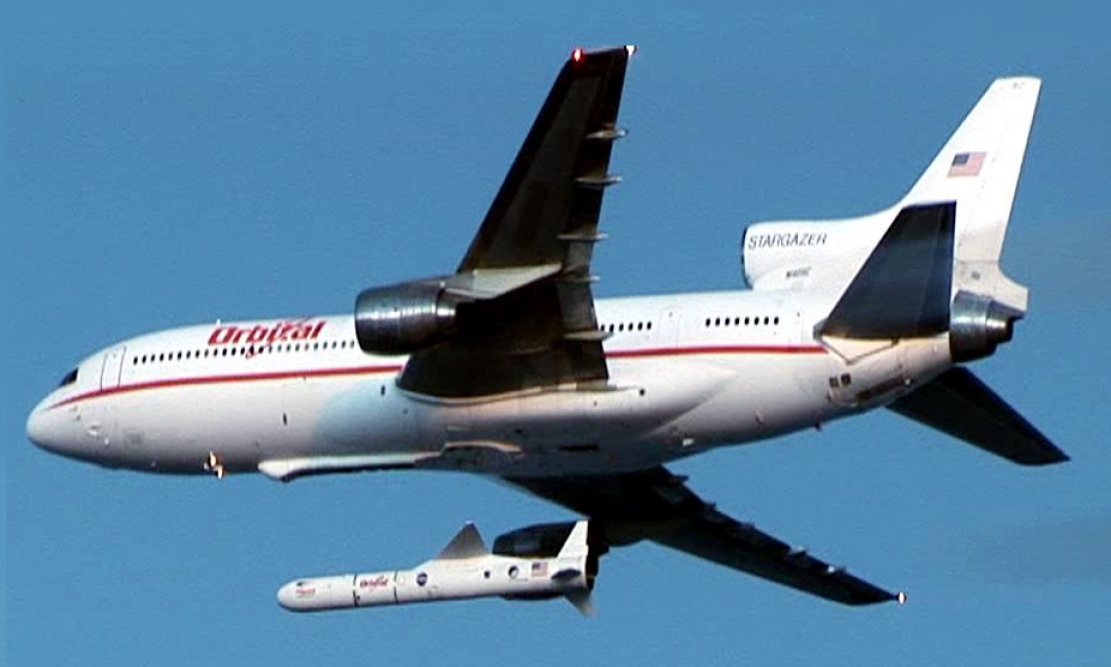
Like all members of the Pegasus family, the Pegasus Hybrid is carried aloft by a modified carrier aircraft — typically the L-1011 TriStar known as *Stargazer* — and released at high altitude before igniting its first stage. This air-launch approach allows the vehicle to operate from a variety of coastal sites worldwide, bypassing the logistical constraints of traditional ground-based launch pads. The rocket stands 15.5 meters tall with a diameter of 1.28 meters, making it a compact and relatively slender vehicle well suited to the small-satellite missions it services. It is capable of delivering up to 350 kilograms to low Earth orbit (LEO), positioning it firmly in the lightweight launch category.
The "Hybrid" designation reflects a configuration that mixes components from different stages of the Pegasus line's development, incorporating elements that enhanced performance over the original baseline vehicle without fully adopting the stretched airframe of the XL variant.
Flight History
The Pegasus Hybrid conducted four flights between 1995 and 2000, achieving a perfect success record with no failures or partial failures recorded across its operational life. All four missions were completed on behalf of Orbital Sciences Corporation itself or associated customers, reflecting the company's dual role as both manufacturer and frequent launch customer during this era.
Among its notable missions, the vehicle deployed the Orbcomm F1–F2 communications satellites alongside OrbView-1, a demonstration of the Pegasus family's capacity to serve commercial constellation and imaging customers in a single flight. The MSTI-3 (Miniature Sensor Technology Integration 3) mission supported U.S. defense research into small satellite sensor technologies. The Brazilian SCD-2 (Satélite de Coleta de Dados 2) payload demonstrated the vehicle's appeal for international scientific customers, carrying an environmental data-collection satellite for Brazil's National Institute for Space Research (INPE). The final tracked mission carried the HETE-2 (High Energy Transient Explorer 2), a multinational astrophysics satellite dedicated to detecting and localizing gamma-ray bursts — a mission that would go on to produce significant scientific results in high-energy astronomy.
Legacy and Context
Though the Pegasus Hybrid occupied a relatively brief window in the broader Pegasus program's history, its four successful launches reinforced the reliability and operational flexibility that defined the family as a whole. The Pegasus line, of which this variant is a part, was the first privately developed orbital launch vehicle to reach space, and it helped establish the commercial small-launch market that has since expanded dramatically. The Hybrid variant's clean record and diverse payload manifest — spanning commercial communications, defense technology, international science, and astrophysics — illustrate the versatility that made air-launched small rockets an attractive option for a wide range of operators throughout the 1990s.