Pegasus HAPS
About the Pegasus HAPS
Pegasus HAPS
The Pegasus HAPS (Hydrazine Auxiliary Propulsion System) is a variant of the air-launched Pegasus small orbital launch vehicle, developed and operated by Orbital Sciences Corporation of the United States. It represents a performance-enhanced configuration of the baseline Pegasus rocket, distinguished by the addition of a hydrazine-fueled upper stage designed to improve insertion accuracy and expand the vehicle's capability to serve missions requiring precise orbital placement.
Background and Vehicle Family
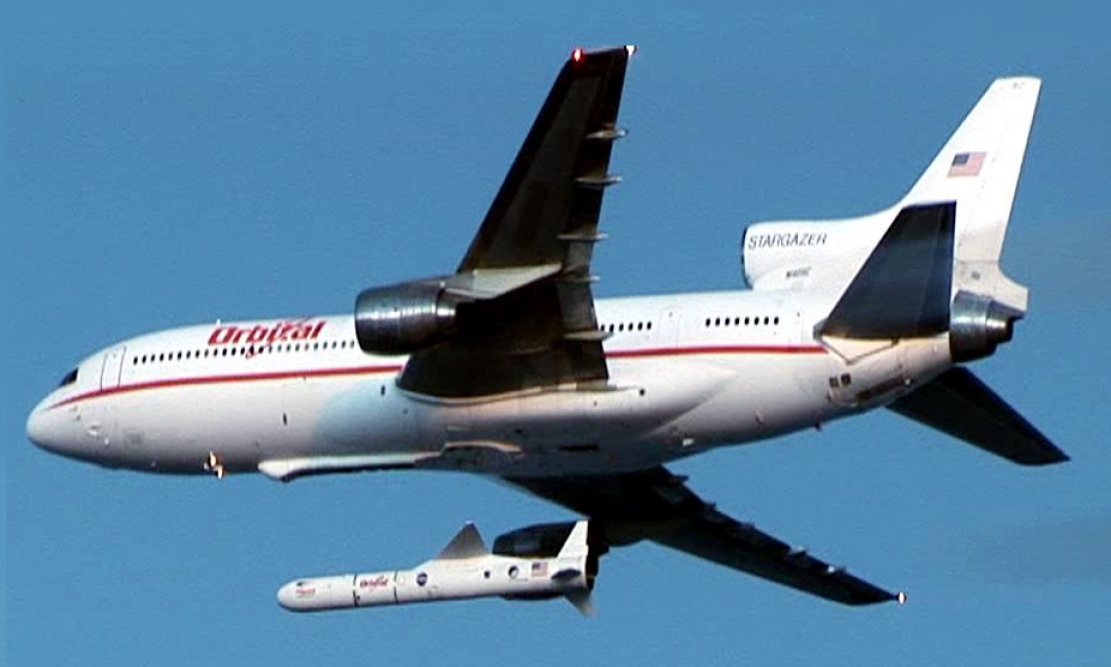
The Pegasus family holds a significant place in spaceflight history as the world's first privately developed orbital launch vehicle to reach space successfully. Carried aloft and released from a modified carrier aircraft — typically a converted Lockheed L-1011 TriStar operating under the callsign "Stargazer" — Pegasus ignites its first stage at altitude, dispensing with the need for a traditional ground-based launch pad. This air-launch approach gives the vehicle geographic flexibility and allows it to reach a wide range of orbital inclinations efficiently.
The HAPS upper stage was introduced to address mission profiles where residual velocity corrections or fine orbit-trimming were required after the solid-fueled main stages completed their burns. Standing 15.5 meters tall with a diameter of 1.28 meters, the Pegasus HAPS is a compact vehicle by orbital rocket standards, befitting its role as a dedicated small-satellite launcher. Its payload capacity to low Earth orbit is rated at 250 kg.
Flight Record
According to tracked flight data, the Pegasus HAPS flew twice between 1991 and 1994, with both missions recorded as successes. This 100% success rate across its operational period speaks to the maturity of the underlying Pegasus design and the focused mission scope for which the HAPS variant was employed.
The two tracked missions illustrate the vehicle's intended customer base and payload profile. One mission carried the Space Test Experiments Platform 2 (STEP-2), a U.S. military technology demonstration satellite reflecting the strong Department of Defense interest in reliable small-lift launch services during the early 1990s. The second mission deployed seven microsats simultaneously, demonstrating the Pegasus HAPS's capacity to serve rideshare or constellation-deployment missions even within its modest payload class. Both missions were conducted under the auspices of Orbital Sciences Corporation, which served as both manufacturer and primary customer during this period.
Significance
The Pegasus HAPS occupied a notable niche in the early commercial launch market, bridging the gap between the baseline Pegasus and missions demanding greater orbital precision. Its operational window in the first half of the 1990s coincided with growing institutional interest in small satellites for scientific, military, and commercial purposes — a trend that the broader Pegasus family helped to enable. While the HAPS configuration had a brief flight history compared to other Pegasus variants, its perfect mission record and the diversity of its payloads underscore its role as a reliable, specialized tool in the small-launch ecosystem of its era.