Pegasus
About the Pegasus
Pegasus
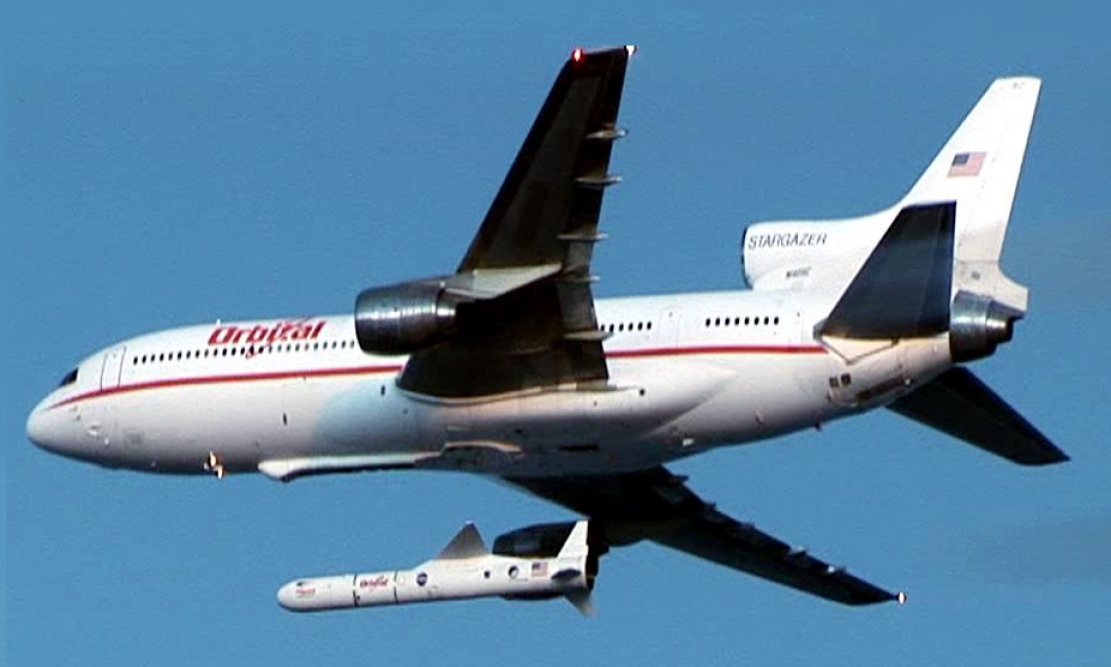
The Pegasus is an air-launched orbital rocket developed and operated by Orbital Sciences Corporation, an American aerospace company. Introduced in 1990, it holds the distinction of being the first privately developed orbital launch vehicle to reach space, marking a landmark moment in commercial spaceflight history. Rather than lifting off from a ground-based launch pad, Pegasus is carried aloft by a modified carrier aircraft and released at altitude before igniting its first stage — an approach that offers flexibility in launch location and reduces dependence on fixed ground infrastructure.
Design and Configuration
Pegasus is a small, winged, three-stage solid-fueled rocket. At 16.9 meters in length and 1.27 meters in diameter, it is compact by orbital launch standards, purpose-built for delivering small payloads to low Earth orbit. A distinctive delta wing mounted near the forward section generates aerodynamic lift during the initial phase of powered flight following air-launch, a design feature unique among orbital vehicles. Its payload capacity to low Earth orbit is 443 kg, placing it firmly in the small-lift category and making it well suited for scientific satellites, technology demonstrators, and small government payloads.
Launch Operations
The air-launch profile is central to the Pegasus concept. By releasing the vehicle from a carrier aircraft at high altitude, the rocket begins its flight above the densest part of the atmosphere, reducing aerodynamic drag losses that would otherwise consume propellant. This approach also allows launches to be conducted over a wide range of azimuths and from various geographic locations, giving mission planners considerable orbital flexibility without the permitting and range constraints associated with fixed launch sites.
Flight History
Our tracking record covers four flights conducted between 1990 and 1994, all of which were successful. The missions during this period reflect the diverse range of customers and scientific disciplines that Pegasus served in its early years.
The inaugural tracked mission, Pegsat and NavySat, demonstrated the vehicle's capability from the outset. Subsequent flights expanded its scientific utility considerably. The Satélite de Coleta de Dados-1 (SCD-1) mission delivered a Brazilian environmental data-collection satellite to orbit, representing an early example of Pegasus serving international customers. The ALEXIS (Array of Low Energy X-ray Imaging Sensors) mission carried an astrophysics payload designed to survey the sky in soft X-ray wavelengths. The APEX (Advanced Photovoltaic and Electronics Experiments) mission addressed space environment research and solar power technology.
Throughout this period, Orbital Sciences Corporation was both the vehicle's manufacturer and its primary customer — a natural arrangement for a company simultaneously developing a new rocket and building a commercial launch business around it.
Significance
Pegasus arrived at a time when small satellites were emerging as a practical tool for science and technology demonstration, and the rocket's air-launch architecture addressed a genuine gap in the market for responsive, flexible small-payload access to orbit. Its early success across the four missions in our record established a strong foundation for what would become a long operational career, influencing thinking about how commercial launch services could be structured outside the traditional government-contractor model.