KSLV-2 Nuri
About the KSLV-2 Nuri
KSLV-2 Nuri
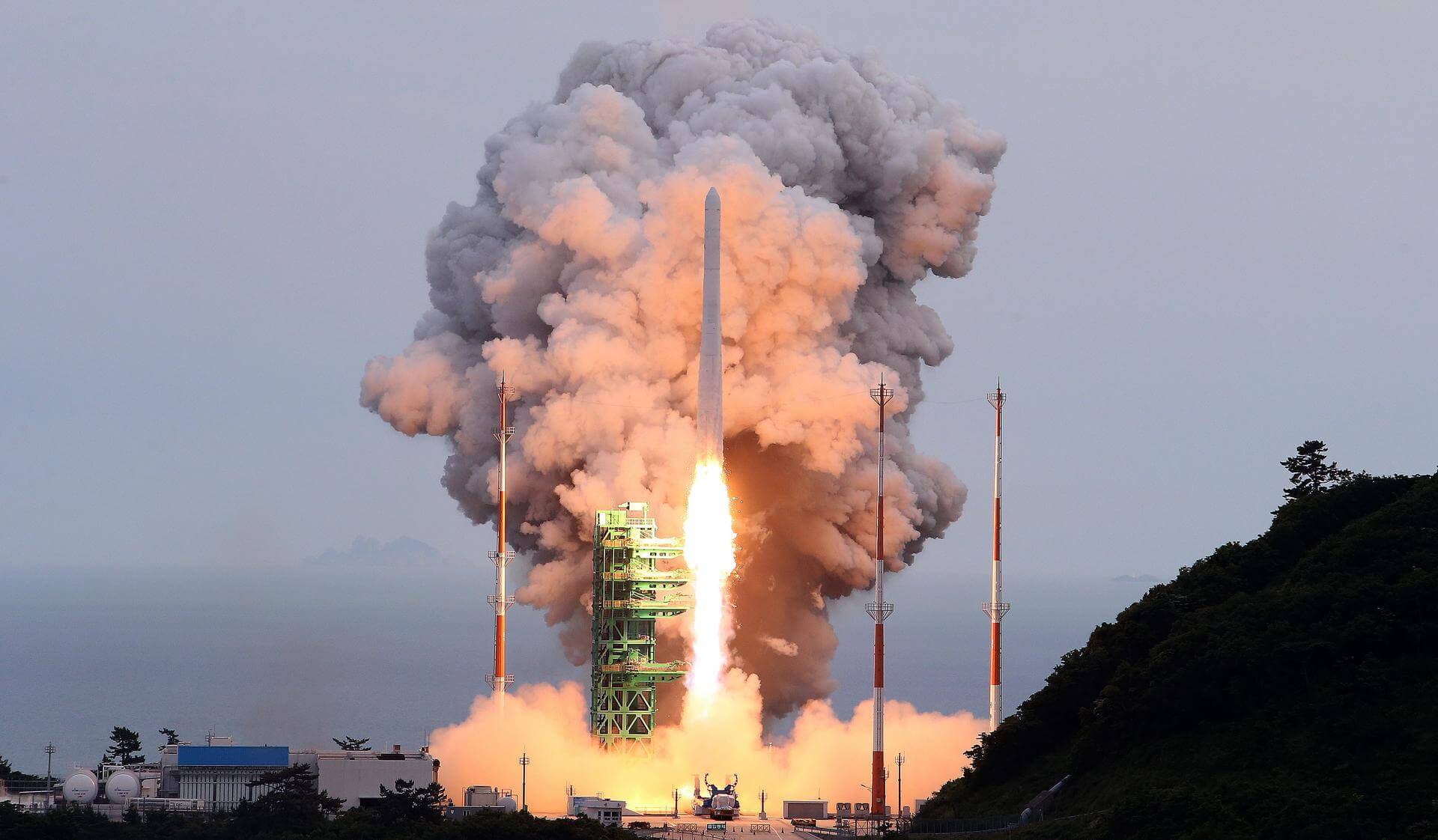
The KSLV-2 Nuri (also known simply as Nuri) is a South Korean orbital launch vehicle developed and operated by the Korea Aerospace Research Institute (KARI). It represents South Korea's first indigenously developed rocket capable of placing a meaningful payload into orbit, making it a milestone in the country's broader ambitions to establish an independent launch capability. Nuri lifts off from the Naro Space Center on the southern tip of the Korean Peninsula.
Design and Capabilities
Nuri stands 47.2 metres tall with a diameter of 3.5 metres, placing it in the medium-class category of orbital launch vehicles. It is capable of delivering up to 2,600 kg to low Earth orbit (LEO), a capacity that comfortably supports small-to-medium satellite missions for domestic and commercial customers. The vehicle is a three-stage rocket powered by liquid propellants, with its first stage clustering multiple engines developed domestically — a significant engineering achievement for a country relatively new to large-scale rocket development.
Flight History
Nuri has accumulated six tracked flights in our records, spanning 2021 to 2027, with three successes and one failure or partial failure among the resolved outcomes.
The program opened with Nuri | Flight Test, the vehicle's debut mission in October 2021. That flight demonstrated the first stage but carried a non-functional payload mass simulator; the upper stage fell short of reaching orbit, marking the partial failure in the record. Nuri | Flight Test 2, conducted in June 2022, achieved orbit for the first time — a historic moment for South Korean spaceflight — and successfully deployed a performance verification satellite along with cubesats.
Subsequent missions transitioned Nuri into an operational role. Nuri | NEXTSat-2 & SNIPE delivered a next-generation small satellite and a formation-flying cubesat constellation, demonstrating the vehicle's utility for science missions. Nuri | CAS500-3 continued the cadence of domestic satellite deployments, while the NeonSat series of missions — including NeonSat-2 to 6 and NeonSat-7 to 11 — have represented Nuri's highest-tempo operational phase, launching batches of Earth-observation satellites that form part of South Korea's growing national space infrastructure.
Role and Significance
Korea Aerospace Research Institute is both the primary developer and the dominant customer, reflecting the reality that Nuri's early operational life is largely oriented toward building South Korea's national satellite constellation rather than competing aggressively in the open commercial launch market. The vehicle nonetheless establishes the technical foundation and industrial base from which future Korean launch services — potentially including a next-generation vehicle — can be developed.
Nuri occupies a meaningful place in regional spaceflight history as the launch vehicle that gave South Korea sovereign access to space, independent of foreign propulsion technology. Its progression from a partial failure on debut to a steady cadence of successful constellation deployments illustrates a development trajectory common among emerging national launch programs, combining technical maturation with growing operational confidence over a relatively short period.