N1
About the N1
N1
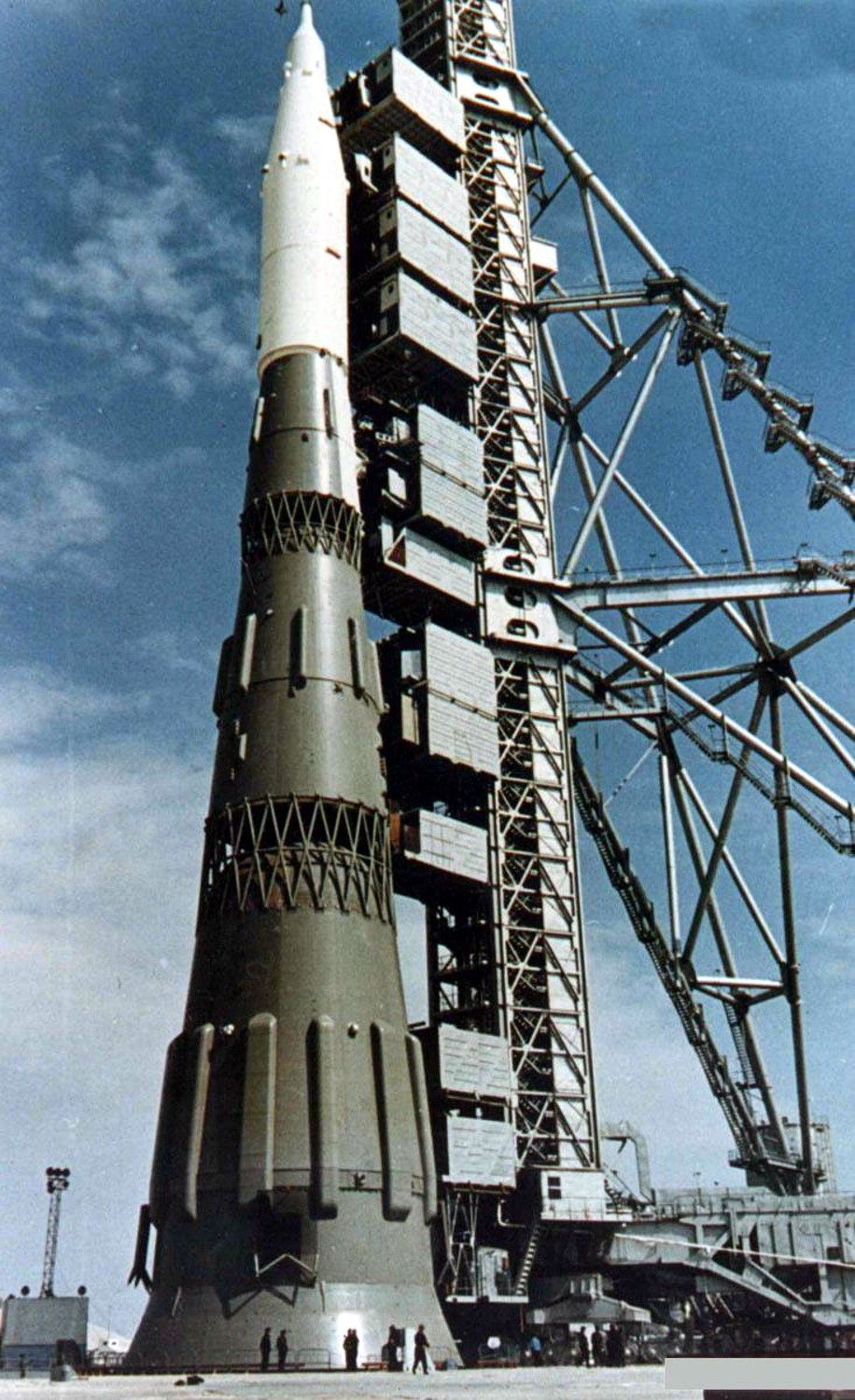
The N1 (also rendered as H-1 in some transliterations) was a Soviet super-heavy orbital launch vehicle developed by OKB-1 under the direction of chief designer Sergei Korolev, and later Vasily Mishin. Operated exclusively by the Soviet Space Program, the N1 was designed to serve as the USSR's primary crewed lunar launch vehicle, intended to carry cosmonauts to the Moon in direct competition with NASA's Apollo program and its Saturn V rocket. It remains one of the largest and most powerful rockets ever constructed, and one of the most consequential failures in the history of spaceflight.
Design and Configuration
The N1 stood 105 metres tall with a base diameter of 17 metres, giving it an imposing, tapered profile across its multiple stages. It was designed to deliver up to 95,000 kilograms to low Earth orbit — a payload capacity comparable to the Saturn V and reflecting its ambitions as a true Moon rocket. The vehicle's first stage was powered by an extraordinarily large cluster of NK-15 engines, a design choice driven by the Soviet Union's difficulty in developing large single-chamber engines of equivalent thrust. This clustering approach proved to be a persistent and ultimately fatal engineering challenge throughout the program.
Launch History
Our flight record tracks four launches of the N1, all conducted between 1969 and 1972, and all resulting in failure. No N1 flight achieved a successful orbital insertion. The rocket launched from the Baikonur Cosmodrome in what is now Kazakhstan.
The four missions tracked are Zond-M 1, Zond-M 2, N1 | Soyuz 7K-LOK No.1, and N1 | Soyuz 7K-LOK No.2 — the latter two carrying the Soyuz 7K-LOK lunar orbital spacecraft intended to support crewed Moon missions. Each attempt ended in catastrophic failure shortly after liftoff or during the early phases of ascent, with the second launch in July 1969 producing one of the largest non-nuclear explosions in history when the vehicle fell back onto its own launch pad. The destruction was so severe that it set the program back by nearly two years.
Program Context and Legacy
The N1 program was plagued throughout its existence by inadequate funding, the loss of Korolev's guiding leadership following his death in 1966, inter-bureau rivalries, and a compressed development schedule that bypassed full-scale static engine testing — a standard practice that might have caught the systemic problems responsible for each failure. The Soviet Space Program was the vehicle's sole customer, and the rocket never carried a paying or civilian payload in any conventional sense; all missions were in direct service of state lunar ambitions.
Following the fourth and final failed launch in November 1972, the program was formally cancelled in 1974. Completed hardware was destroyed, and the Soviet Union pivoted toward other heavy-lift concepts. The N1's story stands as a defining episode of the Space Race — a technically audacious machine that never overcame the gap between its extraordinary ambitions and the engineering realities of its rushed development.