Launch Vehicle Mark-3 (GSLV Mk III)
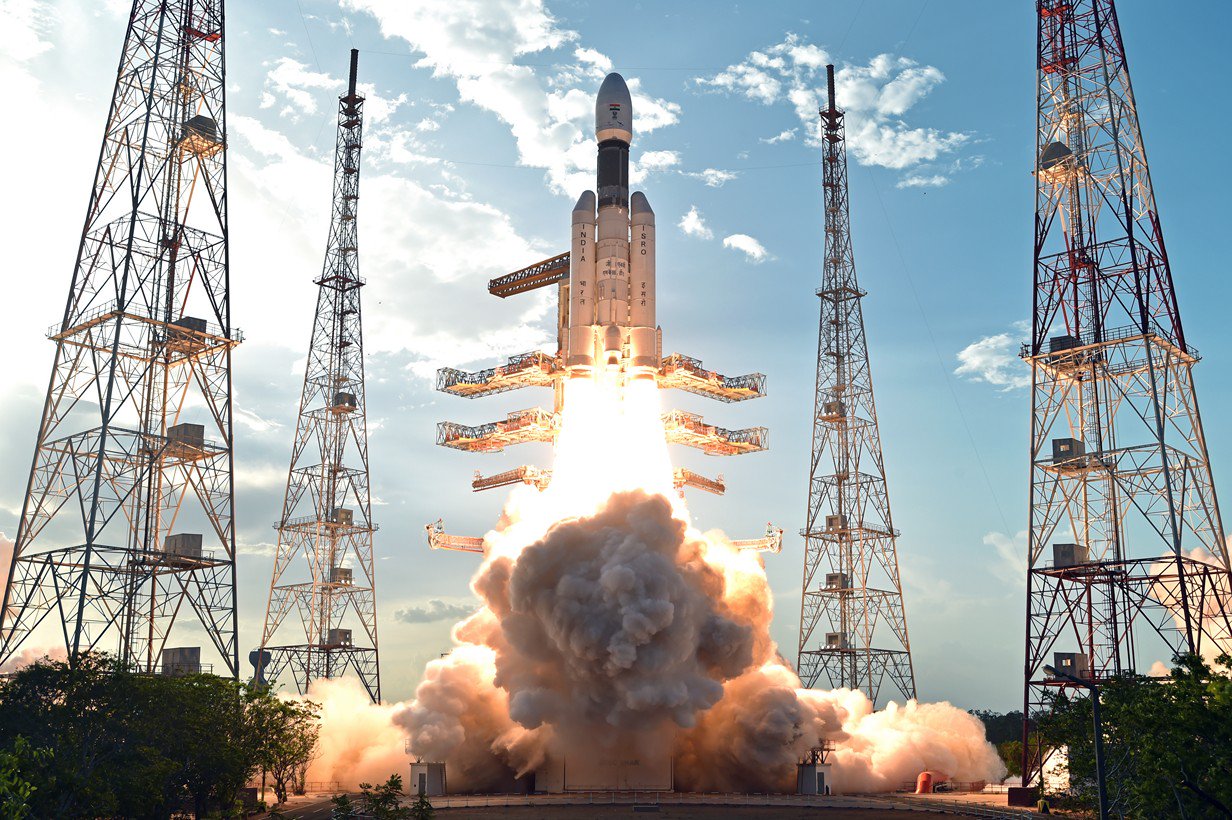
About the Launch Vehicle Mark-3 (GSLV Mk III)
Launch Vehicle Mark-3 (GSLV Mk III)
The Launch Vehicle Mark-3, commonly known as the LVM-3 or GSLV Mk III, is a heavy-lift orbital launch vehicle developed and operated by the Indian Space Research Organisation (ISRO). It represents India's most capable rocket to date and serves as the cornerstone of the country's ambitions in human spaceflight, deep-space exploration, and large geostationary satellite deployment.
Design and Capability
Standing 43.4 metres tall with a core diameter of 4 metres, the LVM-3 is a three-stage vehicle combining two solid-fuelled strap-on boosters, a liquid-fuelled core stage, and a cryogenic upper stage. The cryogenic third stage, powered by an indigenously developed engine, was a landmark achievement for ISRO, making India one of a small number of nations to have mastered cryogenic propulsion technology. The vehicle is capable of delivering 10,000 kg to low Earth orbit and 5,000 kg to geostationary transfer orbit, placing it firmly in the heavy-lift class among contemporary launch vehicles.
Development and Launch Site
Development of the LVM-3 spanned more than a decade, with early experimental flights beginning in 2014. The vehicle lifts off from the Second Launch Pad at Satish Dhawan Space Centre on Sriharikota Island, off the southeastern coast of India. Its design was driven by the need to launch India's heavier GSAT communication satellites without reliance on foreign launch providers, and later expanded to support crewed missions under the Gaganyaan programme.
Flight History
Our records track 15 flights of the LVM-3 family spanning 2014 to 2027, of which 9 are confirmed successes, with no recorded failures or partial failures in the dataset. This represents a strong reliability profile for a vehicle of its generation. The rocket's primary customer across its operational history has been ISRO itself, reflecting the vehicle's central role in India's national space programme rather than a broad commercial manifest, though it has also been used for commercial satellite deployment contracts.
Notable Missions
The vehicle's recent mission history underscores its evolution from an uncrewed heavy-lift workhorse into a human-rated launch system. The Gaganyaan series of missions — including Gaganyaan-1 through Gaganyaan-4 — represents India's inaugural human spaceflight programme, making the LVM-3 the rocket that carried Indian astronauts, known as Gagannauts, to orbit for the first time. Alongside the crewed programme, the vehicle has supported the ambitious Chandrayaan-4 lunar mission, with two dedicated launches indicating a multi-module mission architecture requiring separate orbital injections.
Significance
The LVM-3 occupies a historically significant position in spaceflight, marking India's transition to self-sufficient heavy-lift capability and indigenous crewed launch operations. Its consistent performance across a diverse range of mission profiles — geostationary communications satellites, lunar exploration, and human spaceflight — establishes it as one of the most versatile rockets in ISRO's fleet and a defining vehicle in the broader story of Asia's expanding role in space exploration.
- Dec 31, 2027LVM-3 | Chandrayaan-4 Second LaunchTBD
- Dec 31, 2027LVM-3 | Chandrayaan-4 First LaunchTBD
- Mar 31, 2027LVM-3 | Gaganyaan-4TBD
- Dec 31, 2026LVM-3 | Gaganyaan-3TBD
- Dec 31, 2026LVM-3 | GSAT-32 (GSAT-N3)TBD
- Dec 31, 2026LVM-3 | Gaganyaan-2TBD
- Nov 30, 2026LVM-3 | Gaganyaan-1TBD
- Dec 24, 2025LVM-3 | BlueBird Block 2 #1Success
- Nov 02, 2025LVM-3 | CMS-03 (GSAT-7R)Success
- Jul 14, 2023LVM-3 | Chandrayaan-3Success
- Mar 26, 2023LVM-3 | OneWeb 18Success
- Oct 22, 2022LVM-3 | OneWeb 14Success
- Jul 22, 2019LVM-3 | Chandrayaan-2Success
- Nov 14, 2018LVM-3 | GSAT-29Success
- Jun 05, 2017LVM-3 | GSAT-19Success
- Dec 18, 2014LVM-3 | CARE (Demo Flight)Success