Long March 7
About the Long March 7
Long March 7
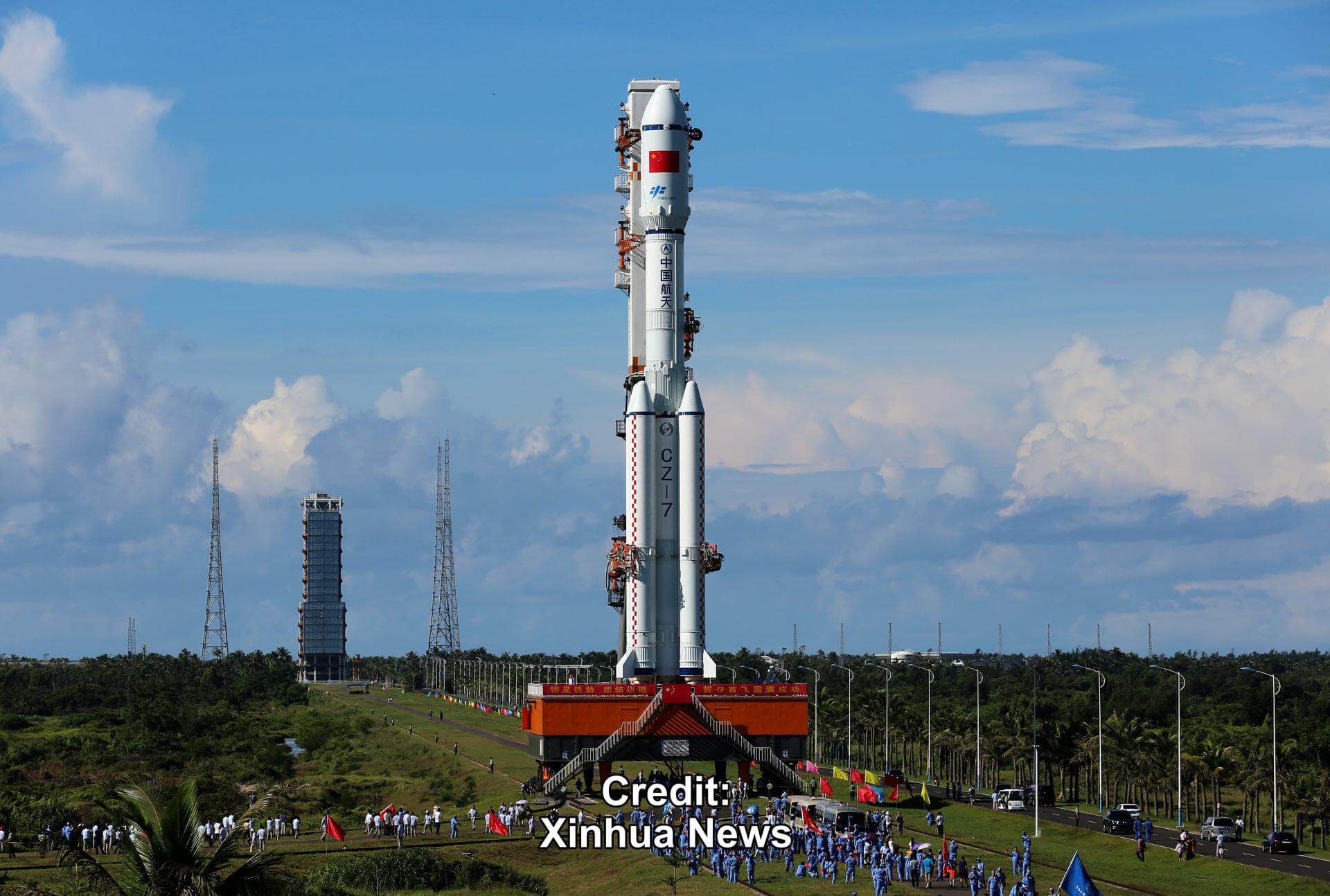
The Long March 7 (CZ-7) is a medium-to-large Chinese orbital launch vehicle developed and operated by the China Aerospace Science and Technology Corporation (CASC). Designed as a modern, liquid-fueled rocket using non-toxic propellants, it represents a significant step in China's effort to replace older, more hazardous launcher generations with cleaner, higher-performance systems.
Design and Capabilities
Standing 53.1 meters tall with a core diameter of 3.35 meters, the Long March 7 uses liquid oxygen and kerosene as propellants — a combination chosen for both performance and environmental safety. The vehicle is capable of lifting 13,500 kg to low Earth orbit (LEO) and 5,500 kg to geostationary transfer orbit (GTO), placing it firmly in the medium-to-heavy lift category. These figures make it well suited to the demanding requirements of crewed spaceflight logistics, where both mass margins and reliability are critical.
Launch Site and Operations
The Long March 7 launches exclusively from the Wenchang Space Launch Center on China's Hainan Island, a modern coastal facility opened specifically to support new-generation rockets. Wenchang's low-latitude location provides favorable orbital mechanics for LEO and GTO missions, and its coastal geography allows the large rocket stages to be transported by sea rather than by rail.
Flight History and Role
Our flight record shows 10 tracked launches between 2017 and 2026, all successful, reflecting a strong and consistent operational record. The vehicle's primary operational role has been delivering Tianzhou automated cargo spacecraft to the Chinese Space Station (CSS/Tiangong), and this mission profile has dominated its manifest. Recent flights include Tianzhou-5, -6, -7, -8, -9, and -10, forming an unbroken chain of resupply missions that have been essential to sustaining the station's crewed operations.
This tight coupling with the Tianzhou program means the Long March 7 occupies a uniquely critical position in China's human spaceflight infrastructure — functionally analogous to roles played by vehicles like the Ariane 5 in European logistics or the Falcon 9 in commercial cargo delivery to the International Space Station. Without regular, reliable Long March 7 launches, continuous habitation of Tiangong would not be feasible.
Significance
The Long March 7's development marked a deliberate modernization of China's launch vehicle fleet. Its use of non-hypergolic propellants distinguishes it from older Long March variants that relied on toxic nitrogen tetroxide and unsymmetrical dimethylhydrazine. This shift improves ground handling safety and reduces environmental risk around launch and landing zones.
With a perfect launch record across all 10 tracked flights, the Long March 7 has established itself as one of China's most dependable operational rockets. Its continued cadence of Tianzhou missions ensures it will remain at the center of China's national space station program for the foreseeable future, serving as the logistical backbone of one of the world's two permanently crewed orbital outposts.
- May 11, 2026Long March 7 | Tianzhou-10Success
- Jul 14, 2025Long March 7 | Tianzhou-9Success
- Nov 15, 2024Long March 7 | Tianzhou-8Success
- Jan 17, 2024Long March 7 | Tianzhou-7Success
- May 10, 2023Long March 7 | Tianzhou-6Success
- Nov 12, 2022Long March 7 | Tianzhou-5Success
- May 09, 2022Long March 7 | Tianzhou-4Success
- Sep 20, 2021Long March 7 | Tianzhou-3Success
- May 29, 2021Long March 7 | Tianzhou-2Success
- Apr 20, 2017Long March 7 | Tianzhou-1Success