Long March 6A
About the Long March 6A
Long March 6A
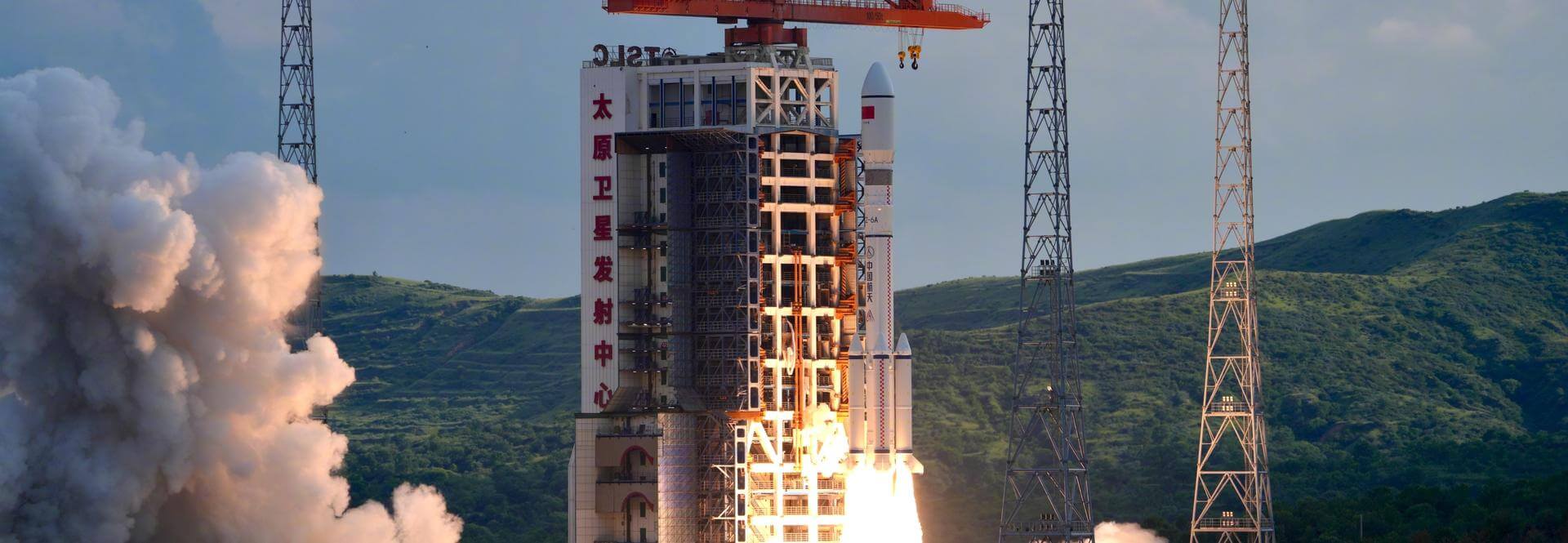
The Long March 6A (also written CZ-6A) is a Chinese orbital launch vehicle developed and operated by the Shanghai Academy of Spaceflight Technology (SAST), a subsidiary of the China Aerospace Science and Technology Corporation (CASC). It represents a significant evolution in China's medium-lift rocket family, combining a liquid-fueled core stage with solid-fueled strap-on boosters — a hybrid propulsion configuration that distinguishes it from earlier Long March variants.
Design and Configuration
The Long March 6A stands 50 meters tall with a core diameter of 3.35 meters, placing it in the medium-lift class of China's launch vehicle lineup. Its defining characteristic is the pairing of a liquid-propellant core stage, which uses liquid oxygen and kerosene, with four solid rocket boosters. This arrangement was designed to increase payload capacity over the original Long March 6 while maintaining the operational flexibility of liquid-fueled systems. The vehicle is capable of delivering payloads to sun-synchronous and low Earth orbits, making it well suited for the large satellite constellation missions that have come to define its manifest.
Operational History
The Long March 6A made its debut in 2022 and has since established a strong reliability record. Across 24 tracked flights between 2022 and 2026, the vehicle has recorded 23 successes, with no confirmed failures or partial failures in the dataset. This performance places it among the more dependable additions to China's modern launch vehicle fleet during this period.
The rocket's launch cadence reflects China's accelerating ambitions in satellite infrastructure. Its manifest is heavily weighted toward constellation deployment missions, most prominently supporting SatNet (the national low Earth orbit broadband network) and SpaceSail broadband polar coverage groups. Missions such as *SatNet LEO Group 15*, *SatNet LEO Group 21*, and *SpaceSail Polar Group #8* illustrate the vehicle's central role in building out China's sovereign satellite internet capabilities. The Yaogan 50 series — with both Yaogan 50-01 and Yaogan 50-02 appearing among recent missions — points to a parallel role supporting remote sensing and reconnaissance satellite programs.
CASC is the dominant customer in the vehicle's flight record, consistent with Long March 6A's position as a state-owned workhorse serving national space programs rather than commercial third-party clients.
Role and Significance
The Long March 6A occupies an important niche in China's launch architecture. By offering greater capacity than the original Long March 6 while operating from the Taiyuan Satellite Launch Center — China's primary site for polar and sun-synchronous orbit missions — it is purpose-built for exactly the kind of high-volume, high-inclination constellation deployments that now dominate the global launch market. Its rapid accumulation of flights since 2022 reflects how deliberately SAST and CASC have positioned this vehicle to meet surging domestic demand for broadband and Earth observation infrastructure. The Long March 6A's trajectory through the mid-2020s suggests it will remain one of China's most actively flown medium-lift rockets for the foreseeable future.
- Oct 23, 2026Long March 6A | Yaogan 50-03Success
- Sep 24, 2026Long March 6A | Yaogan 40 Group 04Success
- Jul 30, 2026Long March 6A | TJSW-27A & BSuccess
- Jul 04, 2026Long March 6A | SpaceSail Polar Group #13Success
- Jun 04, 2026Long March 6A | SpaceSail Polar Group #11Success
- May 12, 2026Long March 6A | SpaceSail Polar Group #8Success
- Apr 08, 2026Long March 6A | SatNet LEO Group 21Success
- Mar 15, 2026Long March 6A | Yaogan 50-02Success
- Jan 13, 2026Long March 6A | Yaogan 50-01Success
- Dec 08, 2025Long March 6A | SatNet LEO Group 15Success
- Oct 17, 2025Long March 6A | SpaceSail Polar Group #6Success
- Sep 27, 2025Long March 6A | SatNet LEO Group 11Success
- Sep 06, 2025Long March 6A | Yaogan 40 Group 03Success
- Aug 17, 2025Long March 6A | SatNet LEO Group 09Success
- Jul 27, 2025Long March 6A | SatNet LEO Group 05Success
- Jun 05, 2025Long March 6A | SatNet LEO Group 04Success
- May 11, 2025Long March 6A | Yaogan 40 Group 02Success
- Apr 18, 2025Long March 6A | Shiyan 27 01-06Success
- Jan 23, 2025Long March 6A | SpaceSail Polar Group #4Success
- Dec 05, 2024Long March 6A | SpaceSail Polar Group #3Success
- Oct 15, 2024Long March 6A | SpaceSail Polar Group #2Success
- Aug 06, 2024Long March 6A | SpaceSail Polar Group #1Success
- Jul 04, 2024Long March 6A | Tianhui 5 Group 02Success
- Mar 26, 2024Long March 6A | Yunhai 3-02Success
- Oct 31, 2023Long March 6A | Tianhui 5Success
- Sep 10, 2023Long March 6A | Yaogan 40Success
- Nov 11, 2022Long March 6A | Yunhai 3Success
- Mar 29, 2022Long March 6A | Demo Flight (Pujiang-2 & Tiankun-2)Success