Long March 5B
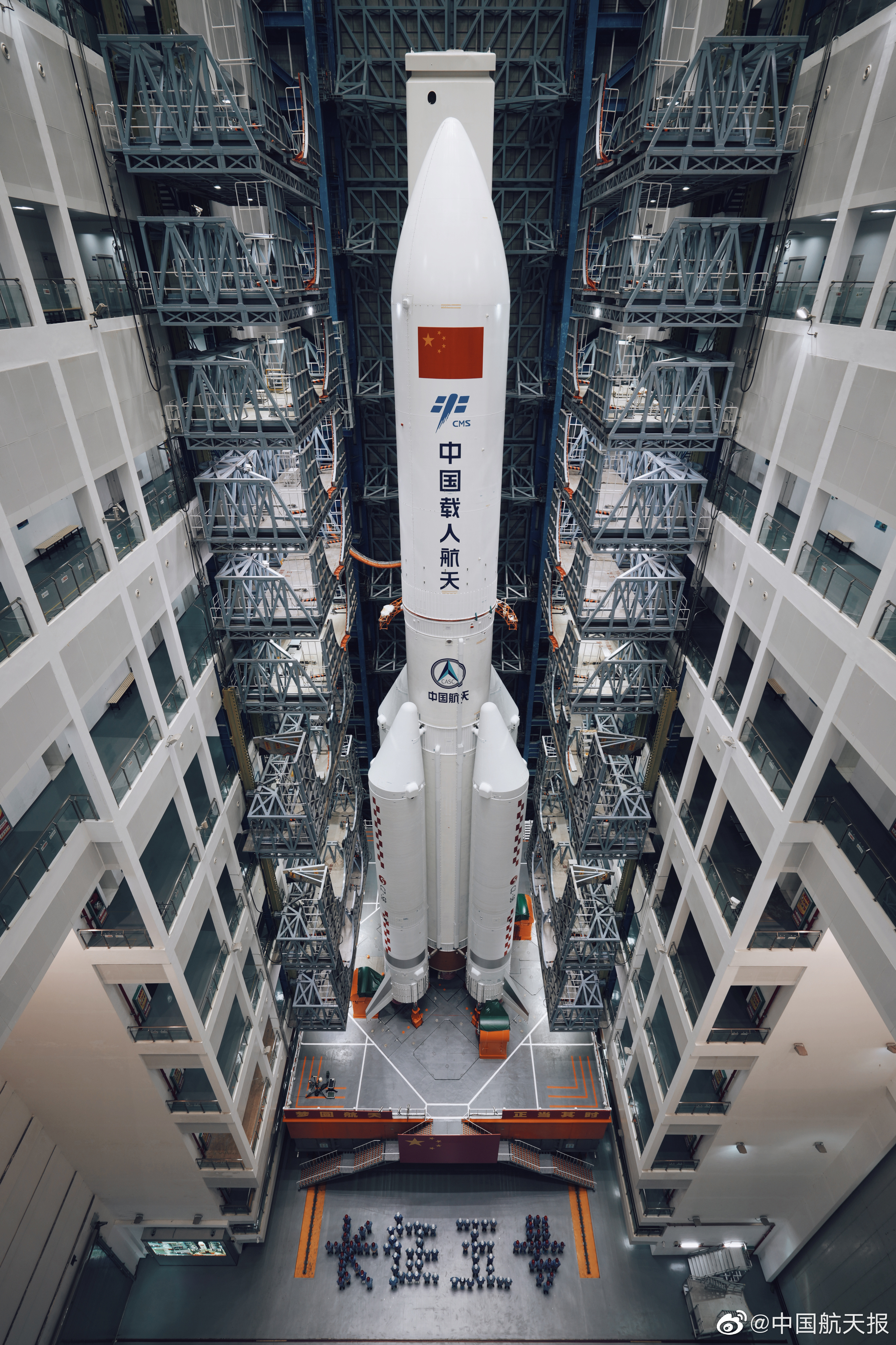
About the Long March 5B
Long March 5B
The Long March 5B (CZ-5B) is a Chinese heavy-lift orbital launch vehicle operated by the China Aerospace Science and Technology Corporation (CASC) and developed by the China Academy of Launch Vehicle Technology (CALT). It represents one of the most capable rockets in China's launch fleet and serves as the dedicated launcher for crewed space station modules, playing a central role in the construction and expansion of the Chinese Space Station (CSS).
Design and Capabilities
The Long March 5B stands 53.66 metres tall with a core diameter of 5 metres, making it one of the widest launch vehicles currently in operation worldwide. It is a variant of the broader Long March 5 family, distinguished by its single-stage-to-orbit configuration that pairs a large core stage with four liquid-propellant strap-on boosters. This architecture allows it to deliver up to 25,000 kg to low Earth orbit (LEO), placing it firmly in the heavy-lift category. The vehicle launches from the Wenchang Space Launch Center on Hainan Island, China's newest and most modern launch facility.
Flight History
The Long March 5B made its maiden flight in May 2020, successfully demonstrating the vehicle's core capabilities. All five missions tracked in our record across 2020 to 2027 have achieved successful outcomes, reflecting the vehicle's strong reliability record to date.
Its most historically significant missions followed in close succession as China assembled its permanent space station. The Tianhe mission in 2021 delivered the core module of the Chinese Space Station to orbit, marking a landmark moment in Chinese spaceflight. This was followed by the Wentian and Mengtian laboratory cabin modules, completing the station's three-module configuration. More recently, the Long March 5B launched the Xuntian Space Telescope, a large co-orbital observatory designed to conduct wide-field sky surveys in proximity to the Chinese Space Station.
Role and Significance
The Long March 5B occupies a unique and critical niche in China's launch architecture. No other vehicle in the Chinese fleet matches its combination of fairing volume and LEO payload capacity, making it effectively irreplaceable for missions requiring the delivery of large, pressurized modules. Its consistent record across station-assembly missions has established it as a cornerstone of China's human spaceflight program.
The vehicle has also attracted international attention due to the uncontrolled reentry of its large core stages following each mission, an aspect of its flight profile that has drawn scrutiny from the global space safety community. Unlike most comparable launch vehicles, the Long March 5B's core stage reaches orbital velocity during ascent and subsequently reenters the atmosphere in an unguided manner.
Operator
CASC remains the sole customer represented in our flight record, consistent with the vehicle's purpose-built role supporting Chinese national space infrastructure. Given the ongoing operational life of the Chinese Space Station and the planned launch of the Xuntian telescope for servicing and co-orbital operations, the Long March 5B is expected to remain an active and essential component of China's heavy-lift launch capability for the foreseeable future.