Long March 5/YZ-2
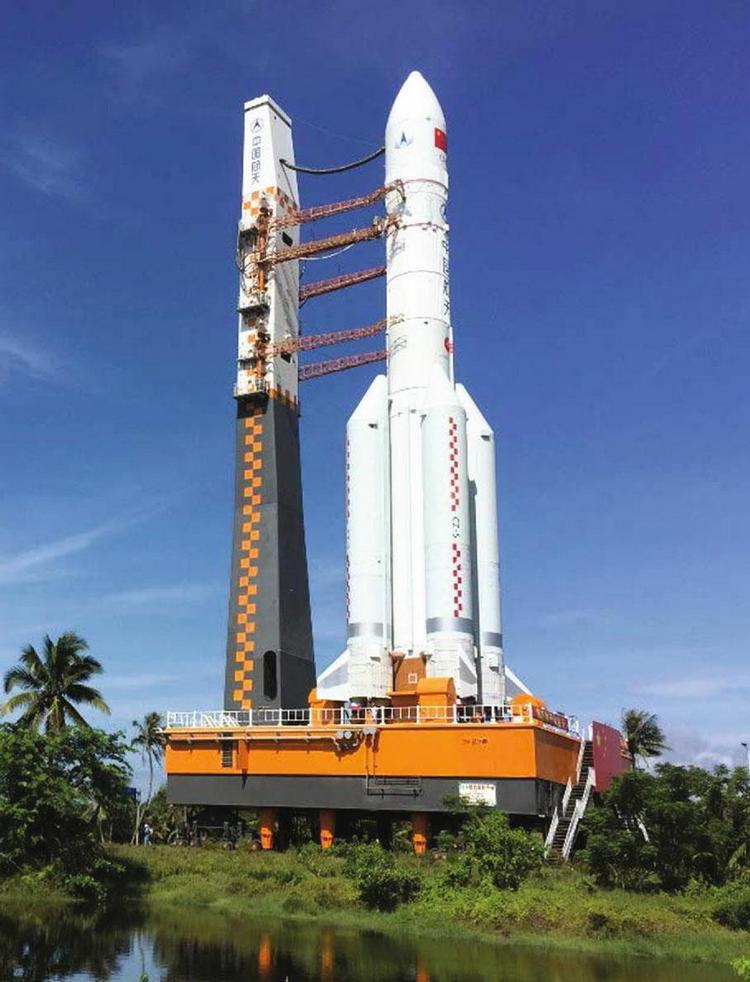
About the Long March 5/YZ-2
Long March 5/YZ-2
The Long March 5/YZ-2 is a Chinese orbital launch vehicle configuration combining the Long March 5 heavy-lift rocket with the Yuanzheng-2 ("Expedition-2") upper stage. It is operated by the China Aerospace Science and Technology Corporation (CASC) and represents one of the most capable launch configurations in China's modern launch vehicle inventory, designed primarily for delivering payloads to geostationary orbit (GEO) and other high-energy trajectories.
Vehicle Architecture
The Long March 5, known colloquially as "Fat Five" due to its wide core stage, is China's largest operational rocket and marked a significant departure from earlier Chinese launch vehicles by relying on liquid hydrogen/liquid oxygen and liquid oxygen/kerosene propulsion, eliminating the toxic hypergolic fuels historically common in Chinese rockets. The Yuanzheng-2 upper stage added a restartable propulsion capability atop this stack, allowing precise insertion of payloads into high-altitude or inclined orbits that would otherwise be difficult to achieve directly. This configuration substantially extends the mission flexibility of the Long March 5 baseline.
Launches of this vehicle take place from the Wenchang Space Launch Center on Hainan Island, China's newest and most modern launch facility, whose low-latitude location provides a natural advantage for GEO missions.
Flight History
According to tracked flight records, the Long March 5/YZ-2 configuration flew twice, spanning the years 2016 to 2017, recording one success and one failure or partial failure. Both missions were conducted on behalf of China Aerospace Science and Technology Corporation, reflecting the vehicle's early role in supporting China's domestic satellite infrastructure.
The first tracked mission carried Shijian 17, a geostationary technology demonstration satellite. The second mission, carrying Shijian 18 — a high-capacity communications satellite — ended in failure when the rocket experienced a malfunction during ascent, resulting in the loss of the payload. This failure was a significant setback for China's heavy-lift ambitions and prompted an extended stand-down period for the Long March 5 family while engineers investigated and corrected the fault.
Significance
The Long March 5/YZ-2 configuration occupies an important place in contemporary Chinese spaceflight history. The Long March 5 program as a whole was critical infrastructure for China's broader space ambitions, underpinning plans for lunar exploration, space station construction, and Mars missions. The Yuanzheng-2 upper stage demonstrated China's growing sophistication in mission design, enabling direct-to-GEO or multi-orbit deployment profiles comparable to capabilities long held by American, European, and Russian launch providers.
The early partial failure illustrated the inherent challenges of developing a next-generation heavy-lift vehicle and validated the importance of the subsequent recovery effort, which ultimately restored the Long March 5 to flight and allowed China to pursue an ambitious cadence of deep-space and large satellite missions in subsequent years.
The short operational window captured in tracked data — just two flights over roughly one year — reflects this configuration's role as an early, high-stakes pathfinder for China's most powerful rocket platform.