Long March 5
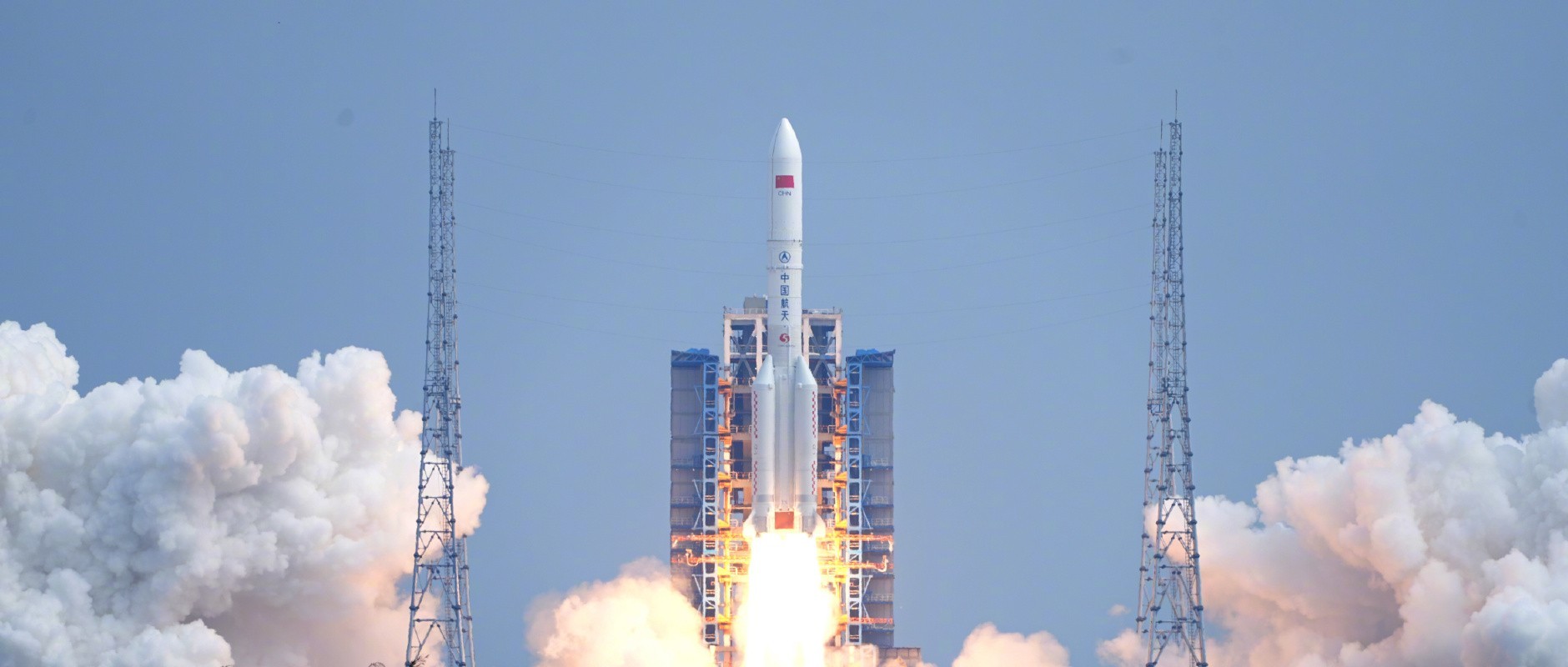
About the Long March 5
Long March 5
The Long March 5 (also known as CZ-5 or colloquially as "Fat Five") is a heavy-lift orbital launch vehicle developed and operated by the China Aerospace Science and Technology Corporation (CASC), China's primary state-owned space contractor. Manufactured by the China Academy of Launch Vehicle Technology (CALT), it represents the most capable rocket in China's current operational fleet and a cornerstone of the country's ambitious civil and scientific space program.
Design and Capabilities
Standing 57 metres tall with a core diameter of 5 metres, the Long March 5 is substantially larger than its predecessors in the Long March family, which is why it earned its informal nickname. Its enlarged core stage enabled a significant leap in Chinese launch capability, supporting a payload capacity of 25,000 kg to low Earth orbit (LEO) and 14,000 kg to geostationary transfer orbit (GTO). These figures place it broadly in the same class as other international heavy-lift vehicles. The rocket uses a combination of liquid oxygen and kerosene in its booster stages, alongside liquid oxygen and liquid hydrogen in its core upper stage — a shift away from the toxic storable propellants traditionally associated with Chinese launch vehicles.
The Long March 5 launches exclusively from the Wenchang Space Launch Center on Hainan Island, China's southernmost major launch facility. Wenchang's low-latitude location provides an orbital mechanics advantage for high-energy missions, and its coastal setting was chosen in part to accommodate the rocket's large component shipments by sea.
Flight History
Our tracking data records 11 flights of the Long March 5, spanning 2019 to 2029, with 8 confirmed successes. The vehicle's manifest reflects China's most scientifically significant and strategically important missions. Lunar exploration has been a defining theme: recent tracked missions include Chang'e 6, Chang'e 7, and Chang'e 8, representing successive phases of China's robotic lunar program. The Chang'e 6 mission, notably, involved the first sample return from the Moon's far side.
The rocket has also lofted multiple Tianwen planetary probes and carried the Tianhe core module of the Chinese Space Station into orbit. Among more recent tracked payloads, TJSW-20 and TJSW-23 represent missions associated with China's experimental telecommunications satellite programs.
Role and Significance
The Long March 5 occupies a unique position in contemporary spaceflight as the vehicle that enabled China to pursue deep-space exploration, large space infrastructure, and high-mass geostationary satellites without dependence on foreign launch services. Its development marked a generational leap in Chinese propulsion technology and manufacturing.
The top customer reflected in our flight data is China Aerospace Science and Technology Corporation itself, underscoring that the Long March 5 primarily serves national mission priorities — science, exploration, and strategic communications — rather than the commercial satellite market. As China's lunar and planetary ambitions grow through the late 2020s, the Long March 5 continues to serve as the country's primary vehicle for its most demanding missions.
- Dec 31, 2029Long March 5 | Chang'e 8TBD
- Sep 30, 2026Long March 5 | Chang'e 7TBD
- Jun 11, 2026Long March 5 | TJSW-25Success
- Dec 20, 2025Long March 5 | TJSW-23Success
- Oct 23, 2025Long March 5 | TJSW-20Success
- May 03, 2024Long March 5 | Chang'e 6Success
- Feb 23, 2024Long March 5 | TJSW-11Success
- Dec 15, 2023Long March 5 | Yaogan 41Success
- Nov 23, 2020Long March 5 | Chang'e 5Success
- Jul 23, 2020Long March 5 | Tianwen-1 (Mars Global Remote Sensing Orbiter and Small Rover)Success
- Dec 27, 2019Long March 5 | Shijian 20Success