Long March 4B
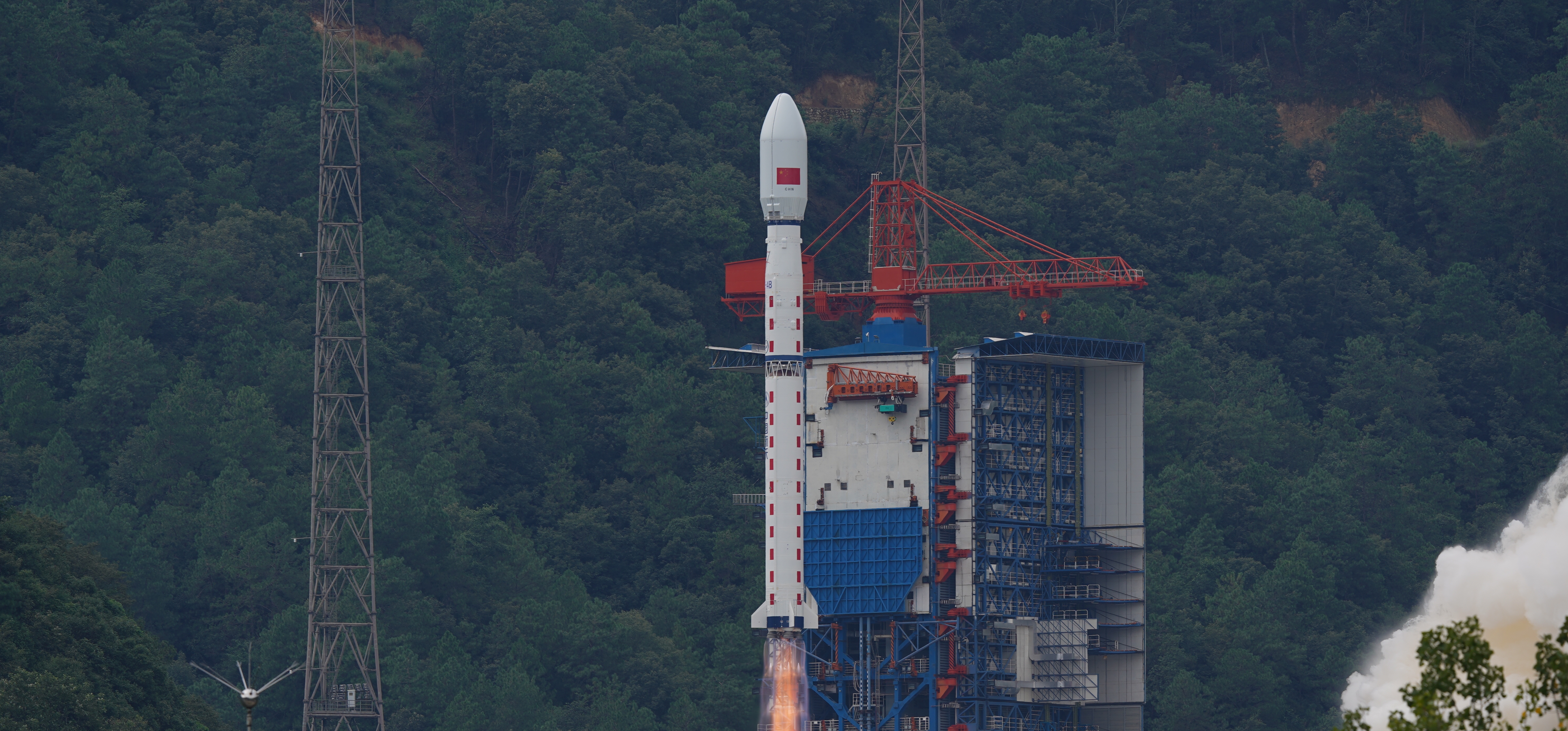
About the Long March 4B
Long March 4B
The Long March 4B (also written as CZ-4B) is a Chinese expendable orbital launch vehicle developed and operated by the Shanghai Academy of Spaceflight Technology (SAST), a subsidiary of the China Aerospace Science and Technology Corporation (CASC). It serves as one of China's workhorse medium-lift rockets, fulfilling a dedicated role in the deployment of Earth observation, remote sensing, and scientific satellites into sun-synchronous and polar orbits.
Development and Design
The Long March 4B is an evolution of the earlier Long March 4A, sharing the same three-stage, storable-propellant architecture that uses nitrogen tetroxide and unsymmetrical dimethylhydrazine (UDMH) as propellants. Standing 44.1 metres tall with a core diameter of 3.35 metres, the vehicle is sized for medium-class payloads. It is capable of delivering 4,200 kg to low Earth orbit (LEO) and 1,500 kg to geostationary transfer orbit (GTO), making it well suited to the reconnaissance and civil remote sensing satellites that constitute its primary manifest. The rocket launches predominantly from the Taiyuan Satellite Launch Center in Shanxi Province, a facility specifically oriented toward polar and sun-synchronous missions.
Operational History
Our flight record documents 56 launches of the Long March 4B between 1999 and 2025, of which 55 were fully successful and one resulted in a failure or partial failure — a reliability record that reflects the vehicle's mature, well-understood design. That record places it among the more dependable members of the Long March family and of the global medium-lift launcher class more broadly.
The rocket's customer base is concentrated within the Chinese state space sector. China Aerospace Science and Technology Corporation and China Aerospace Corporation account for the majority of its payload manifest, consistent with the vehicle's role as an institutional workhorse rather than a commercial competitor on the open market.
Recent Missions
Recent launches have demonstrated the continued demand for the Long March 4B across multiple mission types. The Haiyang 4-01 mission extended China's ocean observation constellation, while the Ziyuan-3-04 and Tianhui 7 launches supported land surveying and mapping capabilities. The Yaogan 43 Group 02, Yaogan 47, and Shijian 26 missions reflect the rocket's persistent use for reconnaissance and experimental spacecraft — categories that have defined much of its career since the late 1990s. This diversity of recent payloads underscores the vehicle's flexibility across civil, scientific, and military-adjacent remote sensing applications.
Role and Legacy
Over more than two decades of operation, the Long March 4B has quietly established itself as a reliable, unpretentious tool of China's space programme. While newer vehicles in the Long March family attract attention for their scale or advanced technology, the 4B's consistency and specialisation have kept it in regular rotation. Its longevity from 1999 through to at least 2025 — spanning China's emergence as a major spacefaring nation — makes it a vehicle of genuine historical significance within the broader story of Chinese spaceflight.
- Oct 23, 2026Long March 4B | Yaogan 53-07 to 09/56-19 to 21Success
- Sep 10, 2026Long March 4B | Yaogan 53-01 to 03/56-01 to 03Success
- Jul 01, 2026Long March 4B | Haiyang 2ESuccess
- Dec 30, 2025Long March 4B | Tianhui 7Success
- Dec 16, 2025Long March 4B | Ziyuan-3-04Success
- Dec 09, 2025Long March 4B | Yaogan 47Success
- May 29, 2025Long March 4B | Shijian 26Success
- Nov 13, 2024Long March 4B | Haiyang 4-01Success
- Sep 03, 2024Long March 4B | Yaogan 43 Group 02Success
- Aug 16, 2024Long March 4B | Yaogan 43 Group 01Success
- Jul 19, 2024Long March 4B | Gaofen-11-05Success
- Apr 16, 2023Long March 4B | Fengyun-3GSuccess
- Dec 27, 2022Long March 4B | Gaofen-11-04Success
- Aug 04, 2022Long March 4B | Terrestrial Ecosystem Carbon Inventory Satellite (TECIS)Success
- Dec 10, 2021Long March 4B | Shijian 6 Group 05Success
- Nov 20, 2021Long March 4B | Gaofen-11-03Success
- Aug 18, 2021Long March 4B | Tianhui-2-02Success
- May 19, 2021Long March 4B | Haiyang 2DSuccess
- Apr 08, 2021Long March 4B | Shiyan-6-03Success
- Sep 27, 2020Long March 4B | Huanjing 2A, 2BSuccess
- Sep 21, 2020Long March 4B | Haiyang 2CSuccess
- Sep 07, 2020Long March 4B | Gaofen-11-02Success
- Jul 25, 2020Long March 4B | Ziyuan-3-03Success
- Jul 03, 2020Long March 4B | Gaofen MultimodeSuccess
- Dec 20, 2019Long March 4B | CBERS-4ASuccess
- Nov 03, 2019Long March 4B | Gaofen-7 & othersSuccess
- Sep 12, 2019Long March 4B | Ziyuan-2D, Tianyi MV-1, BNU-1Success
- Apr 29, 2019Long March 4B | Tianhui-2-01Success
- Oct 24, 2018Long March 4B | Haiyang 2BSuccess
- Jul 31, 2018Long March 4B | Gaofen-11Success
- Jun 15, 2017Long March 4B | Huiyan (HXMT (Hard X-ray Modulation Telescope))Success
- Jun 29, 2016Long March 4B | Shijian 16-02Success
- May 30, 2016Long March 4B | Ziyuan 3-02 & ÑuSat-1 & -2 (Fresco and Batata)Success
- Nov 08, 2015Long March 4B | Yaogan-28Success
- Jun 26, 2015Long March 4B | Gaofen 8Success
- Dec 27, 2014Long March 4B | Yaogan-26Success
- Dec 07, 2014Long March 4B | CBERS-4Success
- Sep 08, 2014Long March 4B | Yaogan 21 & Tiantuo 2Success
- Aug 19, 2014Long March 4B | Gaofen 2 & HeweliuszSuccess
- Dec 09, 2013Long March 4B | CBERS-3Failure
- Oct 25, 2013Long March 4B | Shijian 16Success
- May 10, 2012Long March 4B | Yaogan 14 & Tiantuo 1Success
- Jan 09, 2012Long March 4B | Ziyuan 3 & VesselSat-2Success
- Dec 22, 2011Long March 4B | Zi Yuan 1-02CSuccess
- Nov 09, 2011Long March 4B | Yaogan 12 & Tianxun-1Success
- Aug 15, 2011Long March 4B | Hai Yang 2ASuccess
- Oct 06, 2010Long March 4B | Shijian 6G & Shijian 6HSuccess
- Dec 15, 2008Long March 4B | Yaogan Weixing 5Success
- Oct 25, 2008Long March 4B | Shi Jian 6E & 6FSuccess
- Sep 19, 2007Long March 4B | Zi Yuan 1-2BSuccess
- Oct 23, 2006Long March 4B | Shi Jian 6C & 6DSuccess
- Nov 06, 2004Long March 4B | Zi Yuan 2-3Success
- Sep 08, 2004Long March 4B | Shi Jian 6A & 6BSuccess
- Oct 21, 2003Long March 4B | Zi Yuan 1-2Success
- Oct 27, 2002Long March 4B | Zi Yuan-2 02 xingSuccess
- May 15, 2002Long March 4B | Hai Yang 1 & Feng Yun 1DSuccess
- Sep 01, 2000Long March 4B | Zi Yuan-2 01 xingSuccess
- Oct 14, 1999Long March 4B | Zi Yuan 1-1Success
- May 10, 1999Long March 4B | Feng Yun 1CSuccess