Long March 3C/E
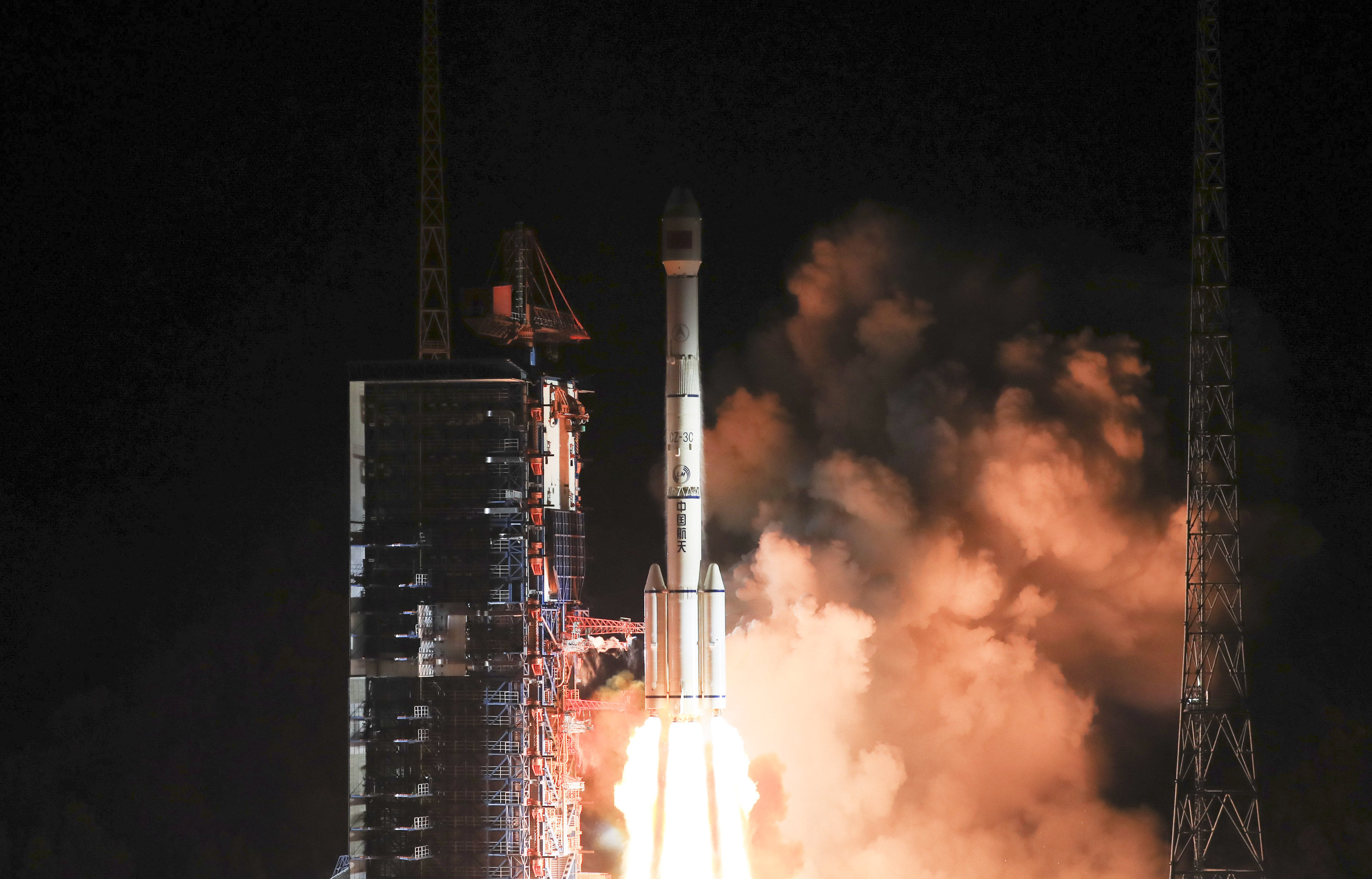
About the Long March 3C/E
Long March 3C/E
The Long March 3C/E (also written CZ-3C/E) is a Chinese expendable orbital launch vehicle operated by the China Aerospace Science and Technology Corporation (CASC) and manufactured by the China Academy of Launch Vehicle Technology (CALT). An enhanced derivative of the Long March 3C, it serves as a medium-to-heavy-lift booster in the Long March family, China's longest-running and most extensive lineage of orbital rockets.
Design and Configuration
Standing 55.64 metres tall with a core diameter of 3.35 metres, the Long March 3C/E follows the general configuration of its Long March 3 siblings: a three-stage architecture with cryogenic upper staging and a liquid-fueled first stage augmented by strap-on boosters. The "E" designation indicates an extended variant, featuring enlarged strap-on boosters that provide additional thrust at liftoff compared to the standard 3C. This enhancement gives the vehicle a lift capacity of up to 8,000 kg to low Earth orbit and 3,900 kg to geostationary transfer orbit (GTO), making it well suited for heavier communications satellites and lunar-trajectory missions.
Role and Launch History
The Long March 3C/E occupies an important niche in China's launch portfolio, bridging the gap between the lighter Long March 3A and the more capable Long March 3B/E. Its GTO capacity makes it particularly valuable for domestic communications satellite deployments and high-energy orbital missions. The vehicle launches from the Xichang Satellite Launch Center in Sichuan Province, the primary Chinese facility for geostationary and deep-space missions owing to its lower latitude.
Our flight record documents three flights of the Long March 3C/E between 2014 and 2025, all of which concluded successfully, reflecting a 100% success rate across tracked missions.
Notable Missions
The Long March 3C/E's tracked mission history spans a range of significant payloads. The Chang'e 5-T1 mission in 2014 was a landmark flight, serving as a technology demonstrator for China's lunar sample-return program — the reentry capsule validated critical atmospheric reentry technologies ahead of the full Chang'e 5 mission. Tianlian 1-05, launched in 2021, continued the build-out of China's Tianlian relay satellite network, which provides data relay services for crewed spacecraft and low Earth orbit assets. Most recently, TJSW-19 extended the vehicle's record of supporting Chinese government communications infrastructure.
Operator and Context
All three tracked missions were carried out on behalf of China Aerospace Science and Technology Corporation, the state-owned enterprise that encompasses both the manufacture and operation of China's primary launch vehicles. The Long March 3C/E represents the mature, reliable end of a rocket family that has been central to China's civil, commercial, and military space ambitions for decades. Its consistent performance across a diverse range of high-value payloads — from lunar precursor probes to relay satellites — underscores its standing as a dependable workhorse within China's medium-to-heavy launch capability.