Long March 3C
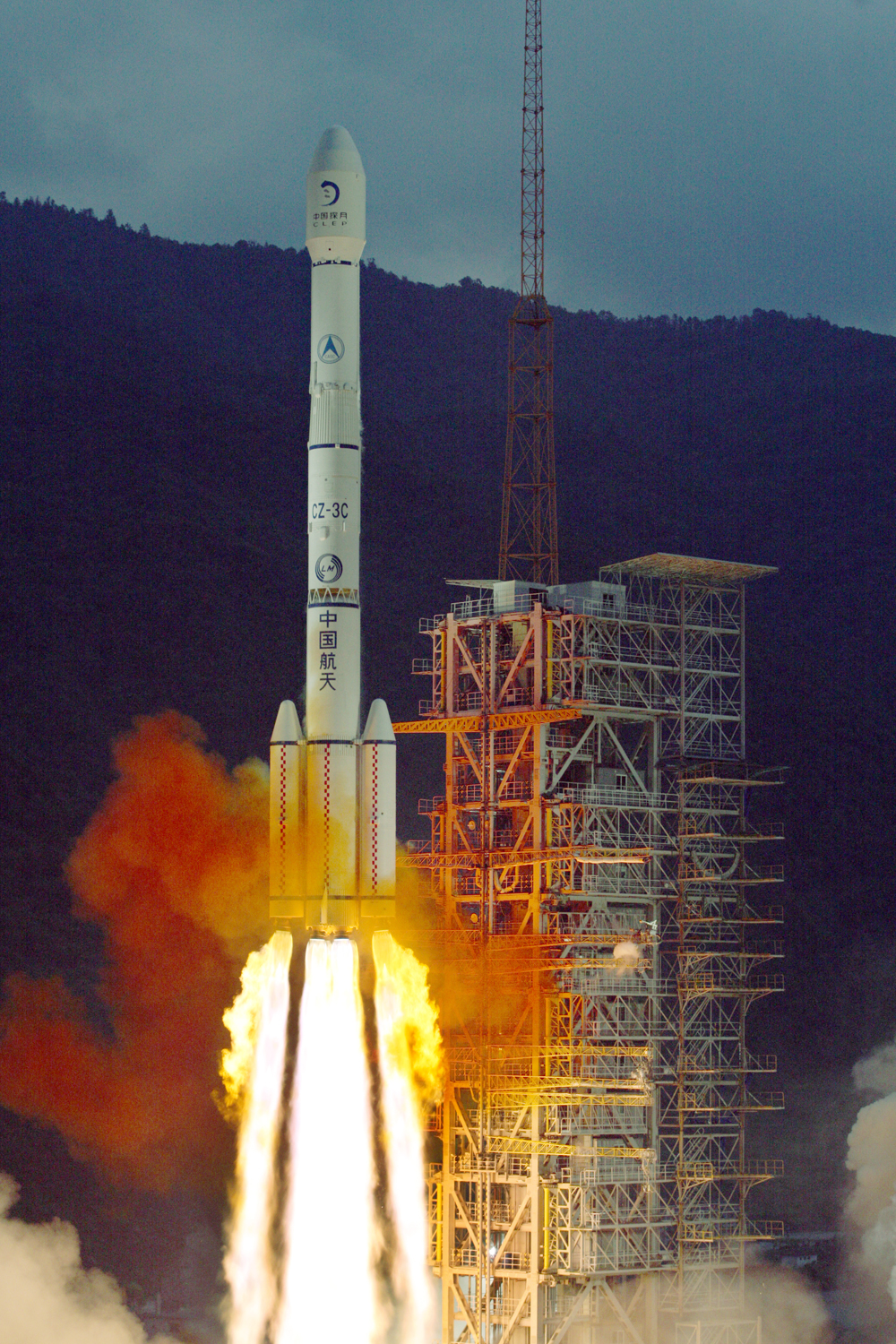
About the Long March 3C
Long March 3C
The Long March 3C (also designated CZ-3C) is a Chinese orbital launch vehicle developed and operated by the China Aerospace Science and Technology Corporation (CASC). It belongs to the Long March 3 family of cryogenic upper-stage rockets and occupies a middle position between the baseline Long March 3B and the lighter Long March 3A, offering a capability tailored for medium-to-heavy payloads destined for geostationary transfer orbit. Launches are conducted from the Xichang Satellite Launch Center in Sichuan Province, southwestern China.
Design and Configuration
The Long March 3C is a three-stage vehicle that retains the liquid-fueled cryogenic third stage — using liquid hydrogen and liquid oxygen — that defines the Long March 3 family. Its distinguishing characteristic is the use of two strap-on liquid boosters, compared to the four boosters of the larger Long March 3B and the none carried by the Long March 3A. This configuration allows the vehicle to serve missions that require more performance than the 3A can provide while avoiding the additional complexity and cost of the four-booster arrangement. The first and second stages burn storable hypergolic propellants, a configuration common across the Long March 3 series.
Operational History
The Long March 3C made its debut in 2008 and remained in active service through at least 2019, accumulating a flight record of 14 launches with 14 successes — a perfect reliability record across its tracked operational life. This consistent performance made it a dependable workhorse for high-value Chinese national missions.
The vehicle's manifest reflects a strong focus on two strategic Chinese satellite programs. It served as a primary carrier for the Beidou navigation satellite system, lofting multiple geostationary Beidou-2 satellites including Compass-G6, Beidou-2 G7, and Beidou-2 G8. Beidou, China's homegrown counterpart to GPS, relied heavily on the Long March 3C to place its geostationary and inclined geosynchronous orbit components. The rocket also delivered satellites in the Tianlian data relay series — including Tianlian 1-03 and Tianlian 1-04 — which form the backbone of China's space-to-ground relay communication network, supporting crewed spacecraft and other assets in low Earth orbit. The TJS-3 (TJSW-3) mission, a Chinese communication and technology satellite, further demonstrates the vehicle's versatility across government payloads.
Across all tracked missions, CASC stands as the dominant customer, consistent with the rocket's role as a dedicated instrument of China's national space infrastructure rather than a commercial launch provider serving international clients.
Legacy and Context
The Long March 3C represents an important element of China's methodical approach to building a modular, scalable launch vehicle family. By sharing core stages and systems with the 3A and 3B variants, it allowed CASC to match rocket capability to payload requirements efficiently. Its unblemished record across 14 flights underscores the maturity of the Long March 3 design lineage and contributed to China's growing reputation for launch reliability during a period of significant expansion in the country's space program.
- May 17, 2019Long March 3C | Beidou-2 G8Success
- Dec 24, 2018Long March 3C | TJS-3 (TJSW-3)Success
- Nov 22, 2016Long March 3C | Tianlian 1-04Success
- Jun 12, 2016Long March 3C | Beidou-2 G7Success
- Oct 25, 2012Long March 3C | Compass-G6Success
- Jul 25, 2012Long March 3C | Tianlian 1-03Success
- Feb 24, 2012Long March 3C | Compass-G5Success
- Jul 11, 2011Long March 3C | Tianlian 1-02Success
- Oct 31, 2010Long March 3C | Compass-G4Success
- Oct 01, 2010Long March 3C | Chang'e 2Success
- Jun 02, 2010Long March 3C | Compass-G3Success
- Jan 16, 2010Long March 3C | Compass-G1Success
- Apr 14, 2009Long March 3C | Beidou DW 2Success
- Apr 25, 2008Long March 3C | Tian Lian 1ASuccess