Long March 3B/YZ-1
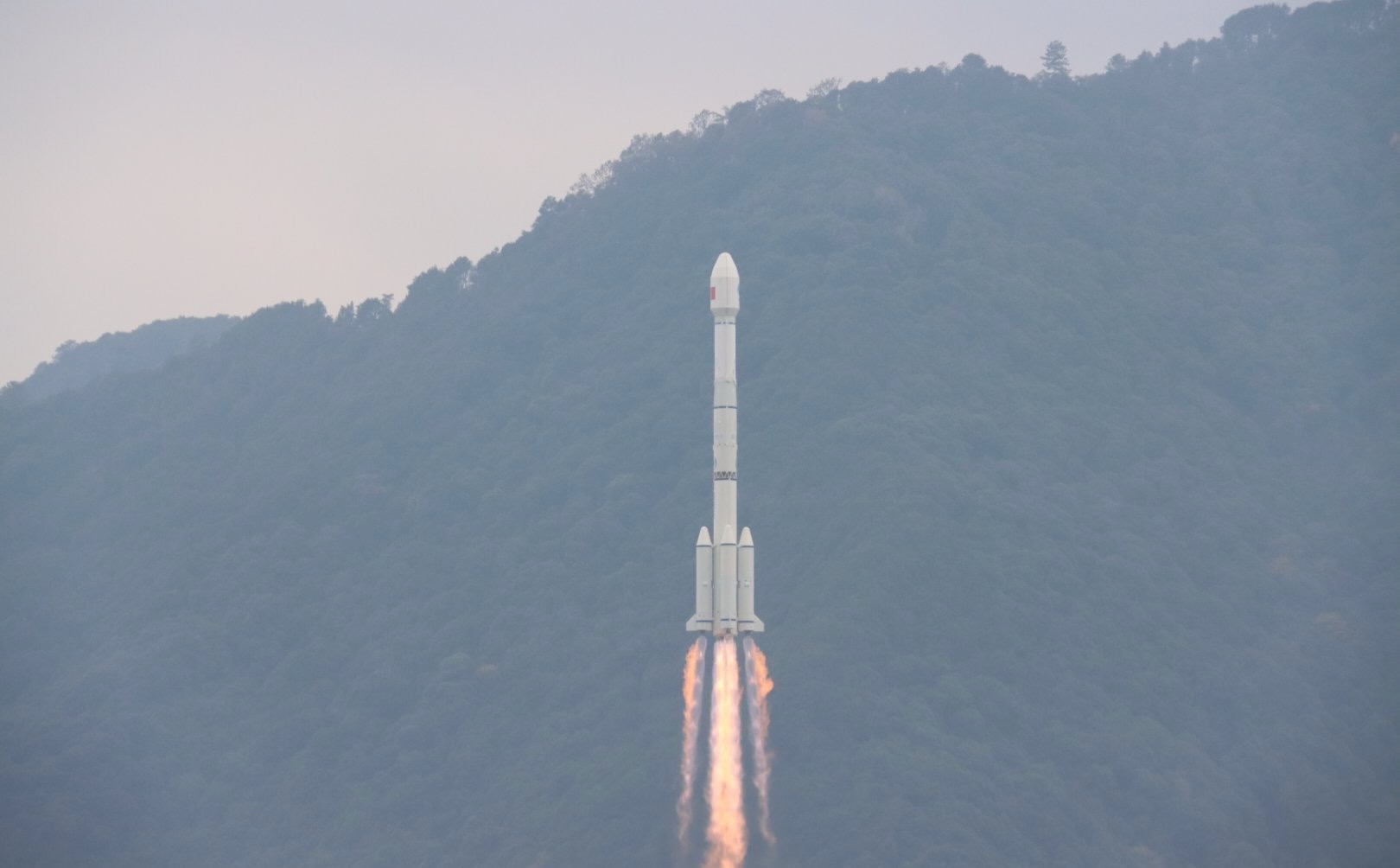
About the Long March 3B/YZ-1
Long March 3B/YZ-1
The Long March 3B/YZ-1 is a Chinese orbital launch vehicle operated by the China Aerospace Science and Technology Corporation (CASC), developed as a specialized variant of the Long March 3B family for the deployment of multiple satellites into medium Earth orbit (MEO) and other intermediate trajectories. It is manufactured by the China Academy of Launch Vehicle Technology (CALT) and launches from the Xichang Satellite Launch Center in Sichuan Province, southwestern China.
Design and Capability
The Long March 3B/YZ-1 extends the baseline Long March 3B configuration by incorporating the Yuanzheng-1 ("Expedition-1") upper stage, a restartable kick stage capable of performing multiple burns after the core vehicle's third stage completes its work. This upper stage is the defining feature of the variant, allowing the rocket to precisely place payloads into orbital regimes — such as MEO — that would be difficult or inefficient to reach with a conventional three-stage liquid-fueled rocket alone. Standing 54.8 meters tall with a core diameter of 3.35 meters, the vehicle shares its physical heritage with the broader Long March 3B family, which has been a workhorse of Chinese commercial and government launch operations for decades. Rated payload capacity reaches 11,500 kg to low Earth orbit and 5,100 kg to geostationary transfer orbit.
Role and Operational History
The Long March 3B/YZ-1 entered service in 2015 and has been employed almost exclusively in support of China's Beidou Navigation Satellite System — the country's indigenous global navigation satellite system (GNSS) analogous to GPS or Galileo. A defining characteristic of this variant's mission profile is its ability to loft two MEO satellites simultaneously, doubling the cadence at which Beidou's orbital constellation can be built out and refreshed.
Our tracking data records 15 flights between 2015 and 2024, all of which were successful, giving the vehicle a perfect launch record across its tracked operational life. Every mission in the record was contracted by CASC, reflecting the vehicle's tightly focused role as a dedicated government constellation-builder rather than a commercial multi-customer workhorse.
Recent Missions
The most recent missions in the flight record illustrate the vehicle's steady, methodical contribution to the Beidou-3 program. Paired launches — such as Beidou-3 M25 & M27, M26 & M28, M19 & M20, M21 & M22, M23 & M24, and M17 & M18 — each placed two third-generation Beidou MEO satellites into their intended orbital slots in a single flight. This dual-manifest approach has been instrumental in completing and maintaining the global Beidou-3 constellation, which reached full operational capability in 2020.
Significance
Though modest in launch cadence compared to high-frequency commercial vehicles, the Long March 3B/YZ-1 occupies a strategically important niche within China's space infrastructure. Its unblemished record and singular focus on navigation satellite deployment underscore both the reliability of the Yuanzheng-1 upper stage and the degree to which China has tailored specific launch vehicles to serve the precise needs of major national programs.
- Sep 19, 2024Long March 3B/YZ-1 | Beidou-3 M25 & M27Success
- Dec 26, 2023Long March 3B/YZ-1 | Beidou-3 M26 & M28Success
- Dec 16, 2019Long March 3B/YZ-1 | Beidou-3 M19 & M20Success
- Nov 23, 2019Long March 3B/YZ-1 | Beidou-3 M21 & M22Success
- Sep 22, 2019Long March 3B / YZ-1 | Beidou-3 M23 & M24Success
- Nov 18, 2018Long March 3B / YZ-1 | Beidou-3 M17 & M18Success
- Oct 15, 2018Long March 3B / YZ-1 | Beidou-3 M15 & M16Success
- Sep 19, 2018Long March 3B / YZ-1 | Beidou-3 M13 & M14Success
- Aug 24, 2018Long March 3B / YZ-1 | Beidou-3 M11 & M12Success
- Jul 29, 2018Long March 3B / YZ-1 | Beidou-3 M5 & M6Success
- Mar 29, 2018Long March 3B / YZ-1 | Beidou-3 M9 & M10Success
- Feb 12, 2018Long March 3B / YZ-1 | Beidou-3 M3 & M4Success
- Jan 11, 2018Long March 3B / YZ-1 | Beidou-3 M7 & M8Success
- Nov 05, 2017Long March 3B / YZ-1 | Beidou-3 M1 & M2Success
- Jul 25, 2015Long March 3B / YZ-1 | BDS M1-S & BDS M2-SSuccess