Long March 3B/E
About the Long March 3B/E
Long March 3B/E
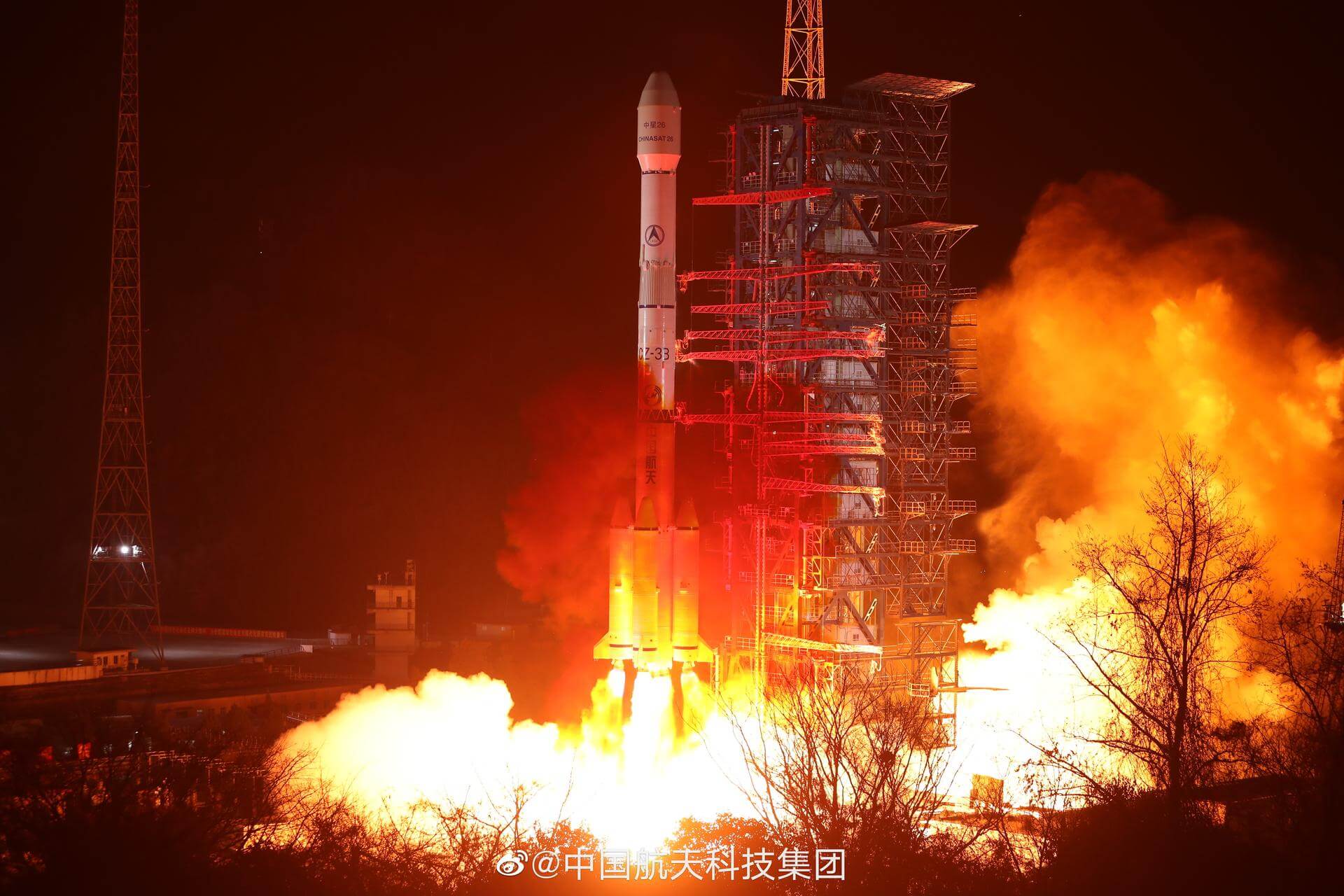
The Long March 3B/E (also written CZ-3B/E) is a Chinese orbital launch vehicle operated by the China Aerospace Science and Technology Corporation (CASC) and manufactured by the China Academy of Launch Vehicle Technology (CALT). An enhanced derivative of the Long March 3B, the "E" designation signifies an enlarged core stage and strengthened boosters, giving it meaningfully greater payload capacity than its predecessor. It serves as one of China's primary heavy-lift workhorses for high-energy orbital missions, particularly deliveries to geostationary transfer orbit (GTO).
Design and Capability
The Long March 3B/E stands 56.3 metres tall with a core diameter of 3.35 metres. It is a three-stage vehicle augmented by four liquid-fuelled strap-on boosters, carrying on the general architecture of the Long March 3B family. The rocket is capable of lifting 12,000 kg to low Earth orbit (LEO) and 5,500 kg to GTO, the latter being the figure most relevant to its primary commercial and national mission profile. Its upper stage burns cryogenic liquid hydrogen and liquid oxygen, a defining feature of the Long March 3-series that enables the high specific impulse required for GTO insertion.
The vehicle launches from the Xichang Satellite Launch Center in Sichuan Province, a facility purpose-built for high-inclination and geosynchronous missions owing to its relatively low latitude and mountainous surroundings.
Operational History
According to tracked flight data, the Long March 3B/E has conducted 76 flights between 2007 and 2026, recording 74 successes alongside 2 failures or partial failures — a strong but not unblemished record that reflects both the rocket's maturity and the inherent complexity of demanding GTO missions.
The vehicle has been central to China's national space infrastructure programmes, lofting communications satellites, meteorological platforms, and classified or experimental spacecraft alike. Recent missions illustrate this breadth: the rocket has delivered the Fengyun-4C meteorological satellite, the Gaofen-14 02 Earth-observation spacecraft, and multiple TJSW and ChinaSat communications satellites, as well as the experimental Shijian 32 platform. These assignments span civilian Earth observation, national broadcasting and communications infrastructure, and technology demonstration — underscoring the 3B/E's role as a versatile, high-confidence launcher for China's most strategically significant payloads.
Role and Significance
Within China's launch vehicle fleet, the Long March 3B/E occupies a position comparable in function to large GTO-capable rockets operated by other major space powers. Its sustained cadence of flights has made it one of the most frequently flown large launch vehicles in Chinese history, and its consistent deployment for flagship national missions reflects the confidence CASC places in the design.
While newer vehicles such as the Long March 5 have assumed the heaviest-lift roles, the Long March 3B/E remains highly active, continuing to anchor China's geosynchronous launch manifest well into the mid-2020s. Its combination of proven reliability, substantial GTO capacity, and operational familiarity ensures it retains a prominent place in China's near-term launch cadence.
- Jul 23, 2026Long March 3B/E | Tianlian 2-06Success
- Jun 16, 2026Long March 3B/E | Shijian 31Success
- Jan 16, 2026Long March 3B/E | Shijian 32Failure
- Dec 26, 2025Long March 3B/E | Fengyun-4CSuccess
- Dec 09, 2025Long March 3B/E | TJSW-22Success
- Nov 21, 2025Long March 3B/E | TJSW-21Success
- Oct 26, 2025Long March 3B/E | Gaofen-14 02Success
- Jun 20, 2025Long March 3B/E | ChinaSat 9CSuccess
- May 28, 2025Long March 3B/E | Tianwen-2Success
- Apr 27, 2025Long March 3B/E | Tianlian 2-05Success
- Apr 10, 2025Long March 3B/E | TJSW-17Success
- Mar 26, 2025Long March 3B/E | Tianlian 2-04Success
- Mar 09, 2025Long March 3B/E | TJSW-15Success
- Feb 22, 2025Long March 3B/E | ChinaSat 10RSuccess
- Jan 23, 2025Long March 3B/E | TJSW-14Success
- Jan 06, 2025Long March 3B/E | Shijian 25Success
- Dec 20, 2024Long March 3B/E | TJSW-12Success
- Dec 03, 2024Long March 3B/E | TJSW-13Success
- Oct 10, 2024Long March 3B/E | WHG-03Success
- Aug 01, 2024Long March 3B/E | WHG-02Success
- May 30, 2024Long March 3B/E | Paksat MM1(R)Success
- May 09, 2024Long March 3B/E | ZHTW 1-01Success
- Feb 29, 2024Long March 3B/E | WHG-01Success
- Nov 09, 2023Long March 3B/E | ChinaSat 6ESuccess
- Aug 12, 2023Long March 3B/E | L-SAR4-01 (LTDC-4A)Success
- Mar 17, 2023Long March 3B/E | Gaofen 13-02Success
- Feb 23, 2023Long March 3B/E | ChinaSat 26Success
- Dec 29, 2022Long March 3B/E | Shiyan 10-02Success
- Nov 05, 2022Long March 3B | ChinaSat 19Success
- Jul 12, 2022Long March 3B/E | Tianlian 2-03Success
- Apr 15, 2022Long March 3B | ChinaSat 6DSuccess
- Dec 29, 2021Long March 3B | TJSW-9Success
- Dec 13, 2021Long March 3B | Tianlian 2-02Success
- Nov 26, 2021Long March 3B | ChinaSat 1DSuccess
- Oct 24, 2021Long March 3B | Shijian 21Success
- Sep 27, 2021Long March 3B/E | Shiyan 10Success
- Sep 09, 2021Long March 3B | ChinaSat 9BSuccess
- Aug 24, 2021Long March 3B | TJSW-7Success
- Aug 05, 2021Long March 3B | Zhongxing 2E (Chinasat 2E)Success
- Feb 04, 2021Long March 3B | TJSW-6Success
- Jan 19, 2021Long March 3B/E | Tiantong-1-03Success
- Dec 06, 2020Long March 3B/E | Gaofen 14Success
- Nov 12, 2020Long March 3B | Tiantong-1-02Success
- Oct 11, 2020Long March 3B/E | Gaofen 13Success
- Jul 09, 2020Long March 3B/E | APStar-6DSuccess
- Nov 04, 2019Long March 3B/E | Beidou-3 IGSO-3Success
- Oct 17, 2019Long March 3B/E | TJS-4 (TJSW-4)Success
- Aug 19, 2019Long March 3B/E | Zhongxing-18 (Chinasat-18)Success
- Jun 24, 2019Long March 3B/E | Beidou-3 IGSO-2Success
- Apr 20, 2019Long March 3B/E | Beidou-3 IGSO-1Success
- Mar 31, 2019Long March 3B/E | Tianlian 2-01Success
- Mar 09, 2019Long March 3B/E | Zhongxing 6C (Chinasat 6C)Success
- Dec 07, 2018Long March 3B/E | Chang'e 4 (lander and rover)Success
- May 03, 2018Long March 3B/E | APStar-6CSuccess
- Dec 10, 2017Long March 3B/E | Alcomsat-1Success
- Jun 18, 2017Long March 3B/E | Zhongxing-9A (Chinasat-9A)Partial Failure
- Aug 05, 2016Long March 3B/E | Tiantong 1-01Success
- Jan 15, 2016Long March 3B/E | BELINTERSAT-1Success
- Dec 28, 2015Long March 3B/E | Gaofen 4Success
- Dec 09, 2015Long March 3B/E | ChinaSat-1CSuccess
- Nov 20, 2015Long March 3B/E | LaoSat-1Success
- Nov 03, 2015Long March 3B/E | Zhongxing-2C (Chinasat-2C)Success
- Oct 16, 2015Long March 3B/E | APStar-9Success
- Sep 29, 2015Long March 3B/E | BDS I2-SSuccess
- Sep 12, 2015Long March 3B/E | TJS-1 (TJSW-1)Success
- Dec 20, 2013Long March 3B/E | Túpac Katari 1Success
- May 01, 2013Long March 3B/E | Zhongxing 11Success
- Nov 27, 2012Long March 3B/E | Zhongxing 12 / SupremeSAT-ISuccess
- Sep 18, 2012Long March 3B/E | Compass-M5 & Compass-M6Success
- May 26, 2012Long March 3B/E | Chinasat-2ASuccess
- Apr 29, 2012Long March 3B/E | Compass-M3 & Compass-M4Success
- Mar 31, 2012Long March 3B/E | APStar-7Success
- Dec 19, 2011Long March 3B/E | NigComSat-1RSuccess
- Oct 07, 2011Long March 3B/E | Eutelsat W3CSuccess
- Sep 18, 2011Long March 3B/E | Chinasat-1ASuccess
- Aug 11, 2011Long March 3B/E | Paksat-1RSuccess
- Oct 29, 2008Long March 3B/E | Simon BolivarSuccess
- May 13, 2007Long March 3B/E | Nigcomsat 1Success