Long March 3B
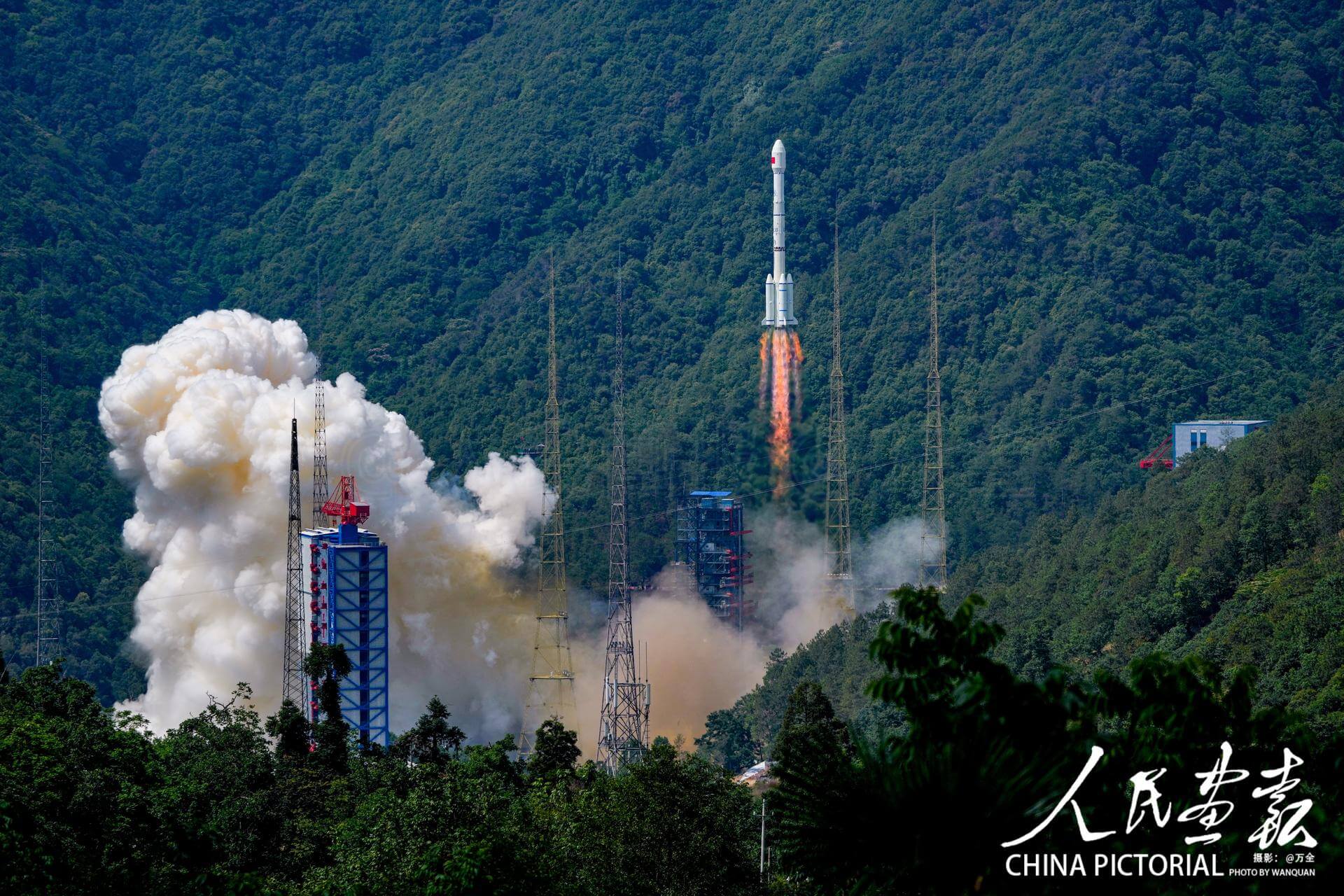
About the Long March 3B
Long March 3B
The Long March 3B (also written as CZ-3B) is a Chinese expendable orbital launch vehicle developed and operated by the China Academy of Launch Vehicle Technology (CALT), a subsidiary of the China Aerospace Science and Technology Corporation (CASC). It serves as one of China's primary heavy-lift rockets for delivering payloads to geostationary transfer orbit (GTO) and is a cornerstone of the country's commercial and national launch programs.
Design and Capability
The Long March 3B is a three-stage rocket augmented by four liquid-fueled strap-on boosters, giving it substantially more lift capacity than its predecessor, the Long March 3A. Standing 54.8 meters tall with a core diameter of 3.35 meters, the vehicle is capable of delivering up to 11,500 kg to low Earth orbit (LEO) and 5,100 kg to GTO. Its upper stage uses cryogenic liquid hydrogen and liquid oxygen propellants, a technology that has distinguished the Long March 3 family within China's launch fleet. An enhanced variant, the Long March 3B/E (Extended), features enlarged strap-on boosters for increased GTO performance.
Launches are conducted primarily from the Xichang Satellite Launch Center in Sichuan province, a facility purpose-built for geosynchronous missions owing to its relatively low latitude.
History and Operations
The Long March 3B made its first flight in 1996, an inauspicious debut that ended in a catastrophic failure shortly after liftoff. The vehicle subsequently recovered to become a reliable workhorse, accumulating a strong track record across commercial and government missions over the following decades.
Our tracking data covers 24 flights of the Long March 3B between 1996 and 2023, of which 21 were fully successful and 3 resulted in failure or partial failure. This represents a success rate broadly consistent with the vehicle's reputation as a mature, capable platform, while acknowledging that its early difficulties and a small number of later anomalies have contributed to its mixed overall record.
Notable Missions
The Long March 3B has been instrumental in building China's Beidou Navigation Satellite System, delivering multiple Beidou-3 geostationary satellites — including Beidou-3 G2, G3, and G4 — to their operational orbits. It has also lofted meteorological satellites such as the Fengyun-4B, which supports weather forecasting and disaster monitoring across the Asia-Pacific region.
Beyond national programs, the rocket has carried commercial communications satellites for international customers. The Nusantara Dua mission for Indonesia and the TJS-5 (Tongxin Jishu Shiyan) satellite demonstrate the vehicle's dual role serving both foreign operators and China's own strategic communications interests.
Legacy
The Long March 3B occupies a central place in Chinese launch history as the country's leading GTO-class vehicle for nearly three decades. While newer rockets — including members of the Long March 5 family — are beginning to assume heavier missions, the 3B continues to fly regularly and remains a primary delivery vehicle for China's navigation, meteorological, and communications satellite infrastructure.
- May 17, 2023Long March 3B/E | Beidou-3 G4Success
- Jun 02, 2021Long March 3B | Fengyun-4BSuccess
- Jun 23, 2020Long March 3B | Beidou-3 G3Success
- Apr 09, 2020Long March 3B | Nusantara DuaFailure
- Mar 09, 2020Long March 3B | Beidou-3 G2Success
- Jan 07, 2020Long March 3B | TJS-5 (TJSW-5)Success
- Jan 10, 2019Long March 3B | Zhongxing 2D (Chinasat 2D)Success
- Nov 01, 2018Long March 3B | Beidou-3 G1Success
- Apr 12, 2017Long March 3B | Shijian-13/Chinasat-16Success
- Jan 05, 2017Long March 3B | TJS-2 (TJSW-2)Success
- Dec 10, 2016Long March 3B | Fengyun-4ASuccess
- Dec 01, 2013Long March 3B | Chang'e 3 & YutuSuccess
- Jun 20, 2011Long March 3B | Chinasat-10Success
- Sep 04, 2010Long March 3B | Chinasat-6ASuccess
- Aug 31, 2009Long March 3B | Palapa-DPartial Failure
- Jun 09, 2008Long March 3B | Zhongxing 9Success
- Jul 05, 2007Long March 3B | Zhongxing 6BSuccess
- Oct 28, 2006Long March 3B | Xinnuo 2Success
- Apr 12, 2005Long March 3B | Apstar 6Success
- Jul 18, 1998Long March 3B | Xinnuo 1Success
- May 30, 1998Long March 3B | Zhongwei 1Success
- Oct 16, 1997Long March 3B | Apstar 2RSuccess
- Aug 19, 1997Long March 3B | Agila 2Success
- Feb 14, 1996Long March 3B | INTELSAT 708Failure