Long March 3
About the Long March 3
Long March 3
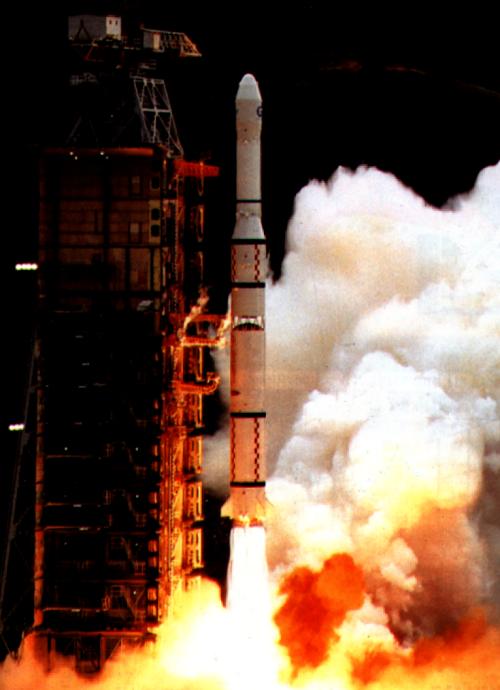
The Long March 3 (CZ-3) is a Chinese orbital launch vehicle developed and operated by the China Academy of Launch Vehicle Technology (CALT) under the broader Chinese space program. A member of the Long March family, it was designed primarily to deliver payloads to geostationary transfer orbit (GTO), making it a cornerstone of China's early ambitions in commercial and governmental satellite deployment.
Development and Design
The Long March 3 builds on the foundations of earlier Long March vehicles, adding a cryogenic liquid hydrogen and liquid oxygen third stage — a significant technical milestone that marked China's entry into the use of high-energy propellants for orbital launches. Standing 23.49 meters tall with a core diameter of 3.35 meters, the vehicle is compact by international standards but was well-suited to the GTO mission profile it was designed to fulfill. It is capable of delivering 5,000 kg to low Earth orbit and 1,500 kg to geostationary transfer orbit.
Operational History
Based on tracked flight data, the Long March 3 conducted 13 flights between 1984 and 2000, achieving 10 successes alongside 3 failures or partial failures. This record reflects both the ambition of the program and the inherent challenges of pioneering cryogenic upper-stage technology during a period when China was rapidly advancing its spaceflight capabilities.
The vehicle launched from the Xichang Satellite Launch Center in Sichuan Province, a facility purpose-built for GTO missions owing to its relatively low latitude. Xichang became the primary hub for China's geostationary launch efforts, and the Long March 3 was among its earliest and most important tenants.
Notable Missions
The Long March 3's manifest reflects its dual role serving both domestic institutions and, eventually, the commercial market. Early customers included the Ministry of Aerospace Industry and the China Aerospace Corporation, reflecting the vehicle's roots in state-directed satellite programs. Among its most significant payloads were the DFH-2A series of communications satellites, which represented China's first domestically produced geostationary communications spacecraft.
The vehicle also carried the APSTAR 1 and Apstar 1A satellites, demonstrating China's growing role in regional commercial communications. Later missions included Zhongxing 7 and the Feng Yun 2A and Feng Yun 2B meteorological satellites — the latter two representing a major contribution to China's domestic weather monitoring and Earth observation infrastructure. The China Aerospace Science and Technology Corporation (CASC) featured prominently among customers across the vehicle's operational life.
Legacy
The Long March 3 laid essential groundwork for China's subsequent GTO launch capabilities. The experience gained with its cryogenic third stage directly informed the development of the more capable Long March 3A, 3B, and 3C variants, which went on to become workhorses of China's commercial and governmental launch manifest. Though retired by 2000, the Long March 3's contributions — particularly in demonstrating indigenous cryogenic propulsion and enabling China's first steps in the commercial satellite launch market — cement its place as a historically significant vehicle in the Long March family's evolution.
- Jun 25, 2000Long March 3 | Feng Yun 2BSuccess
- Jun 10, 1997Long March 3 | Feng Yun 2ASuccess
- Aug 18, 1996Long March 3 | Zhongxing 7Failure
- Jul 03, 1996Long March 3 | Apstar 1ASuccess
- Jul 21, 1994Long March 3 | APSTAR 1Success
- Dec 28, 1991Long March 3 | DFH-2A 5Partial Failure
- Apr 07, 1990Long March 3 | Asiasat 1Success
- Feb 04, 1990Long March 3 | DFH-2A 4Success
- Dec 22, 1988Long March 3 | DFH-2A 3Success
- Mar 07, 1988Long March 3 | DFH-2A 2Success
- Feb 01, 1986Long March 3 | DFH-2A 1Success
- Apr 08, 1984Long March 3 | DFH-2 2Success
- Jan 29, 1984Long March 3 | DFH-2 1Partial Failure