Long March 2E
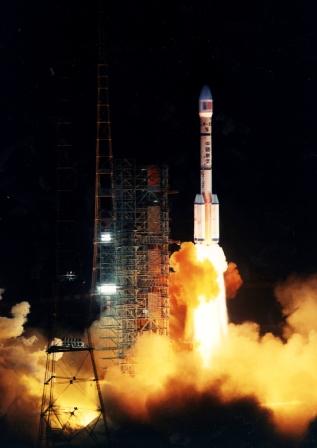
About the Long March 2E
Long March 2E
The Long March 2E (also written LM-2E, and known in Chinese as *Chang Zheng 2E*) is a Chinese orbital launch vehicle developed and operated by the China Great Wall Industry Corporation under the broader Long March family of rockets. Manufactured in the People's Republic of China, it was designed to carry heavy payloads into low Earth orbit and, when paired with an upper stage, to deliver communications satellites into geostationary transfer orbit for commercial customers.
Development and Design
The Long March 2E is an augmented derivative of the Long March 2C, distinguished principally by the addition of four liquid-fueled strap-on boosters clustered around its first stage. This configuration substantially increases liftoff thrust and allows the vehicle to carry up to 9,200 kg to low Earth orbit, making it one of the more capable members of the Long March family during its operational period. Standing nearly 49.7 meters tall and measuring 7.85 meters across its widest point at the base — accounting for the strap-on boosters — the rocket presents a compact but powerful profile by the standards of its era.
Launches were conducted from the Xichang Satellite Launch Center in Sichuan Province, which serves as China's primary facility for geostationary-orbit missions.
Operational History
The Long March 2E was active from 1990 to 1995, during which time our flight records document seven tracked flights. Of those, five were successful and two resulted in failure or partial failure, giving the vehicle a mixed but broadly competitive record for the commercial launch market of the early 1990s.
The rocket's customer manifest reflects its commercial ambitions. It carried satellites for Australian operator Optus on three successive missions — *Optus B1*, *Optus B2*, and *Optus B3* — as well as the regional communications satellite Apstar 2 and the Asiasat 2 spacecraft serving the Asia-Pacific market. A mission carrying the Echostar I communications satellite also appears in the record. Domestic customers included the China Aerospace Corporation and the Ministry of Aerospace Industry, reflecting the vehicle's dual role serving both Chinese institutional clients and international commercial operators.
Significance
The Long March 2E represented a deliberate push by China to compete in the international commercial launch market during a period when Western launch providers held near-dominant positions. By offering heavy-lift capability at competitive prices, the vehicle attracted real contracts from operators in Australia, Hong Kong, and beyond. Its partial failures — including an incident that destroyed the Optus B2 payload during ascent — raised concerns about reliability and contributed to later scrutiny of Chinese launch vehicles in the mid-1990s.
Despite its relatively brief operational window of just five years, the Long March 2E helped establish China as a credible commercial launch provider and laid important groundwork for subsequent Long March variants. Its design heritage and the operational lessons drawn from its seven flights informed the development of the larger and more capable Long March 3 series rockets that would follow.
- Dec 28, 1995Long March 2E | Echostar ISuccess
- Nov 28, 1995Long March 2E | Asiasat 2Success
- Jan 25, 1995Long March 2E | Apstar 2Failure
- Aug 27, 1994Long March 2E | Optus B3Success
- Dec 21, 1992Long March 2E | Optus B2Failure
- Aug 13, 1992Long March 2E | Optus B1Success
- Jul 16, 1990Long March 2E | BADR & Aussat-B-MFSSuccess