Long March 2A
About the Long March 2A
Long March 2A
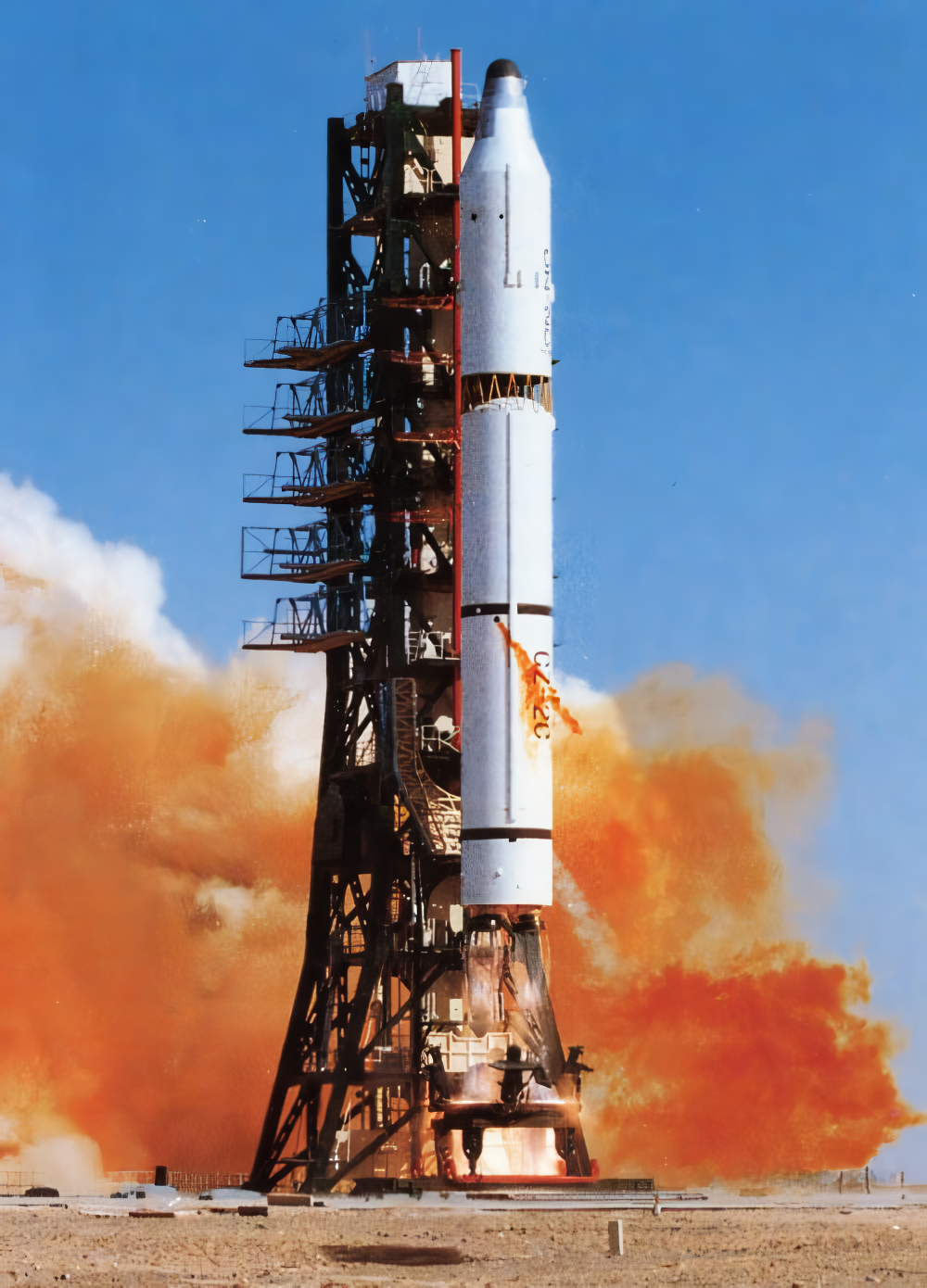
The Long March 2A (also written as CZ-2A) is a Chinese orbital launch vehicle developed and operated by what was then the Seventh Ministry of Machine Building Industry, the state body responsible for China's aerospace and defense manufacturing during the 1970s. It represents an early and foundational chapter in the Long March rocket family, which remains China's primary lineage of space launch vehicles to this day.
Origins and Design
The Long March 2A was derived from the DF-5 intercontinental ballistic missile, a heritage it shares with several early members of the Long March series. Standing 31.17 meters tall with a core diameter of 3.35 meters, the vehicle followed a two-stage liquid-propellant configuration typical of its era. It was capable of delivering up to 1,800 kilograms to low Earth orbit, making it a meaningful workhorse for early Chinese national space ambitions. Launch operations were conducted from the Jiuquan Satellite Launch Center in the Gobi Desert, China's oldest and most historically significant launch facility.
Operational History
Our flight record attributes four tracked flights to the Long March 2A between 1974 and 1978, of which three were successful and one resulted in failure or a partial failure. This relatively brief operational window reflects the vehicle's role as a transitional design — proving the core architecture before more capable derivatives entered service.
All tracked missions were flown on behalf of the Seventh Ministry of Machine Building Industry and carried FSW-0 payloads — China's first generation of recoverable reconnaissance satellites, known in the West as the FSW (返回式卫星, *Fanhui Shi Weixing*) series. The four missions in our record are designated Long March 2 | FSW-0 0 through FSW-0 3, representing China's initial efforts to master satellite recovery technology, a capability that placed it among a very small group of nations at the time.
Significance
The successful return of FSW-0 satellites aboard Long March 2A missions marked a landmark achievement in Chinese spaceflight. China became only the third country in the world to independently recover a satellite from orbit, following the United States and the Soviet Union. This capability had clear dual-use implications, underpinning both scientific remote sensing and national security reconnaissance programs.
Legacy
The Long March 2A's short but consequential service life laid the groundwork for an enduring family of rockets. Its core stage diameter of 3.35 meters became a standard dimension that persisted through subsequent Long March 2, 3, and 4 series vehicles. The lessons absorbed during its development and four-flight operational career fed directly into the Long March 2C and later derivatives, which went on to significantly longer and more prolific careers. In this sense, the Long March 2A is best understood not as a mature operational system, but as a critical proving ground — the vehicle that demonstrated China could reliably reach orbit, deploy payloads with precision, and bring hardware safely home from space.