Little Joe II
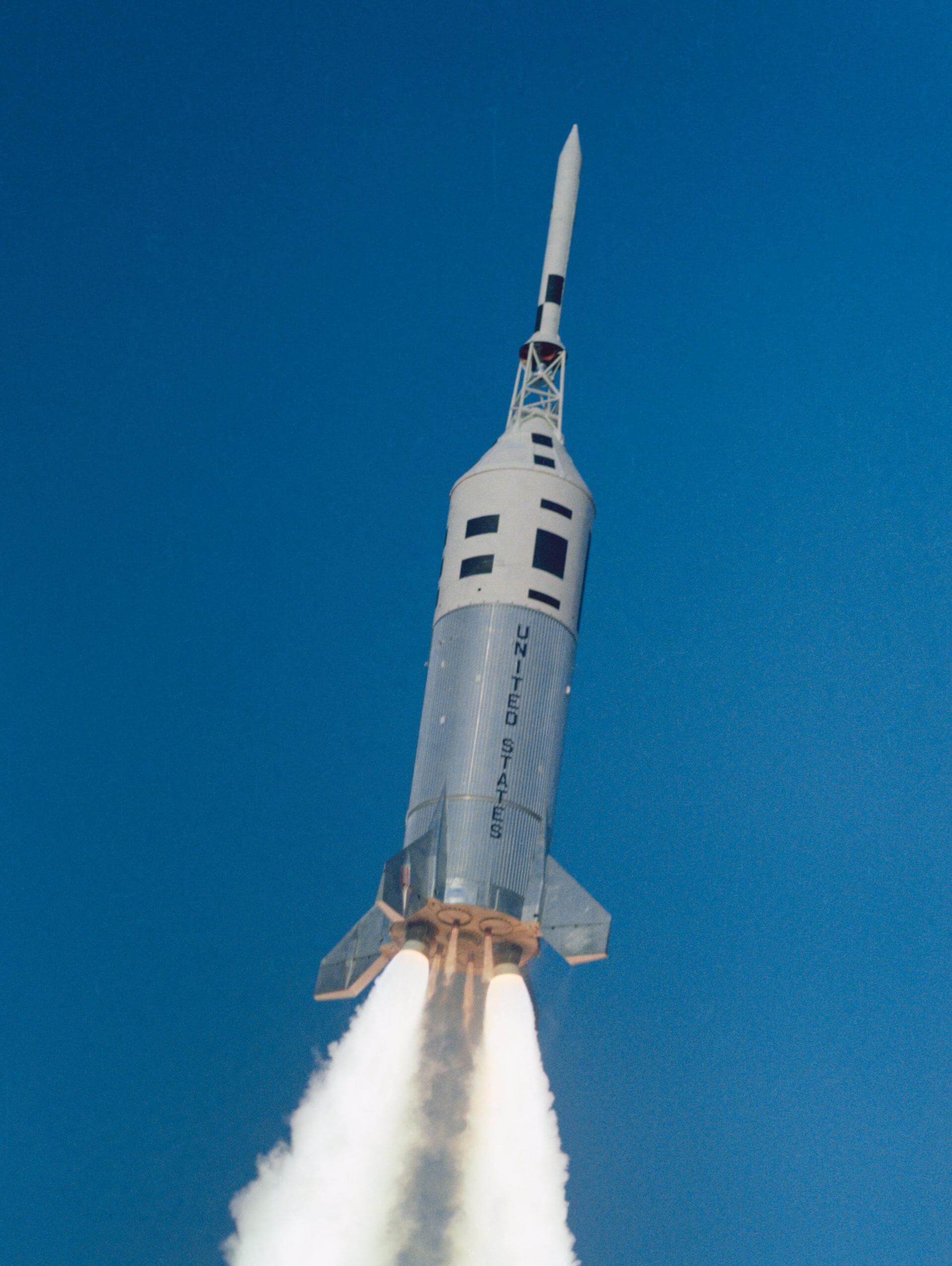
About the Little Joe II
Little Joe II
The Little Joe II was an American unguided solid-fueled rocket developed to support NASA's Apollo program during the 1960s. Designed and built by General Dynamics Convair under contract for NASA, it served a narrow but critical purpose: testing the Apollo Launch Escape System (LES), the tower-mounted abort system intended to pull a crewed command module away from a failing rocket during an emergency. The vehicle was never intended to reach orbit, making it an unusual entry in the history of launch vehicles — a rocket whose success was measured by its ability to simulate failure.
Design and Role
Little Joe II took its name from an earlier, smaller vehicle that had performed similar abort-testing duties for the Mercury program. Like its predecessor, the design prioritized simplicity and cost-effectiveness over performance. Standing 26.2 meters tall with a diameter of 3.9 meters, the rocket was large enough to carry a full-scale Apollo command and service module mockup and push it through the high-stress aerodynamic conditions — particularly the region of maximum dynamic pressure known as Max-Q — where an in-flight abort would be most challenging. Its solid-fuel motors required no complex propellant handling, which kept ground operations straightforward at its primary launch site, White Sands Missile Range in New Mexico.
Flight History
Our tracking records document five flights of the Little Joe II between 1963 and 1966, with four successes and one failure or partial failure. All missions were conducted on behalf of NASA, making the agency the vehicle's sole customer.
The program opened with the QTV (Qualification Test Vehicle) mission, which verified the rocket's basic performance before abort testing began in earnest. This was followed by a series of four dedicated abort tests designated A-001 through A-004, each designed to stress the Launch Escape System under progressively demanding conditions. The A-001 through A-003 missions validated the LES across a range of flight profiles, while A-004, the final flight of the program in 1966, represented the most ambitious test: a high-altitude, high-speed abort using a production-representative command module. The successful outcome of A-004 gave NASA confidence that astronauts could survive a launch emergency across virtually the full envelope of ascent.
The single failure or partial failure recorded in the data serves as a reminder that test programs are, by nature, exercises in finding the limits of hardware — and that not every outcome is a clean one.
Legacy
Though the Little Joe II never placed a satellite or spacecraft into orbit, its contribution to human spaceflight was substantial. The data gathered from its five flights directly informed the design and certification of the Apollo LES, a system that was never called upon in an actual emergency during Apollo missions — a testament, in part, to the thoroughness of the ground and flight testing it underwrote. The program stands as an example of the often-overlooked category of expendable test vehicles that quietly made crewed spaceflight safer without ever making headlines for reaching orbit.