Little Joe
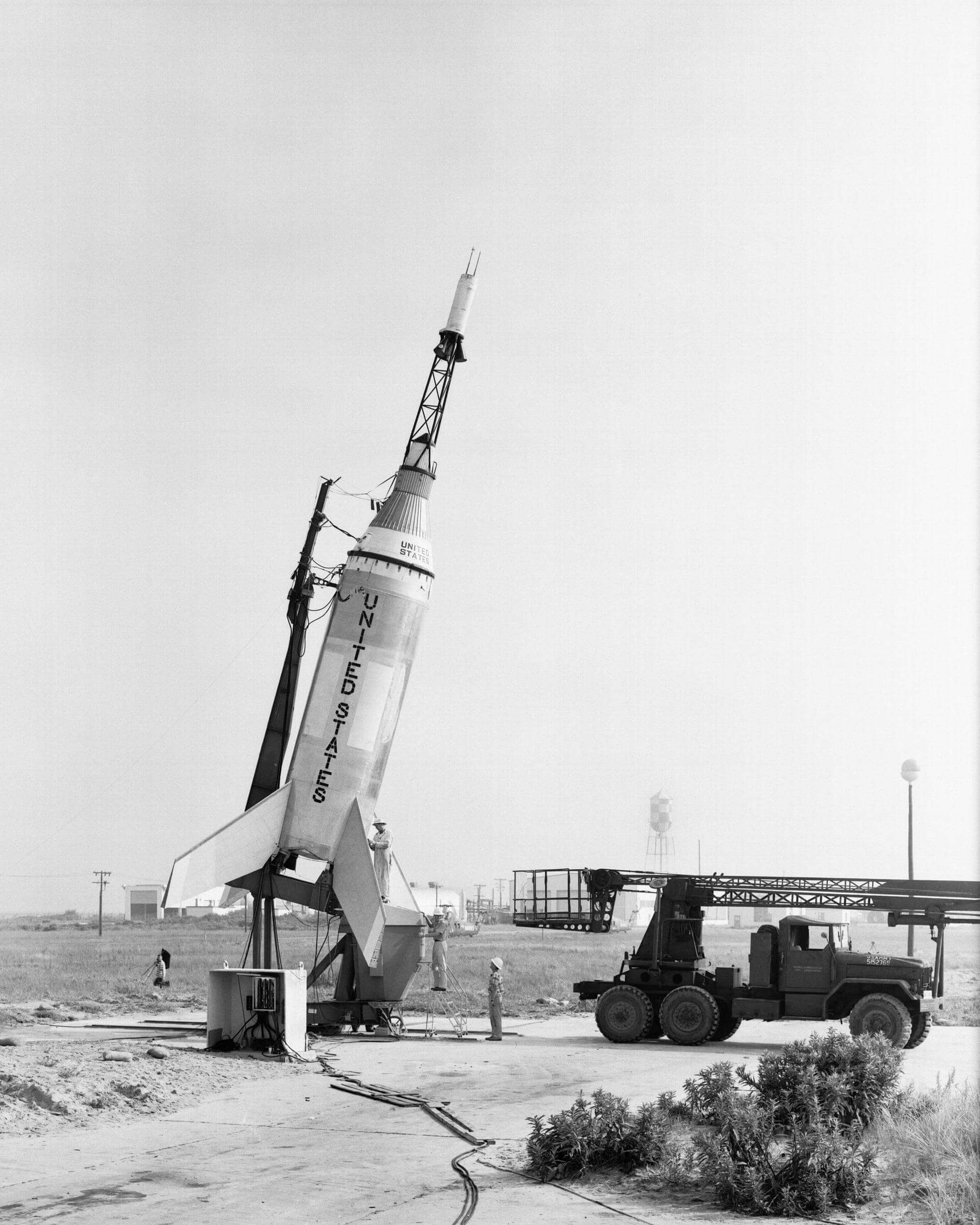
About the Little Joe
Little Joe
Little Joe was an American uncrewed solid-fuel rocket developed by NASA and manufactured by North American Aviation, used primarily to test the launch escape system (LES) and capsule abort capabilities intended for the Mercury program. Rather than expending costly orbital rockets on abort tests, NASA designed Little Joe as an economical, purpose-built vehicle capable of subjecting Mercury capsules to realistic aerodynamic and structural stresses at high altitude and high dynamic pressure.
Design and Purpose
Standing 17 meters tall, Little Joe was a compact, fin-stabilized rocket powered by a cluster of solid-propellant motors. Its relatively simple design kept costs low and turnaround times short, making it well suited for a rapid test cadence. The vehicle was not designed to achieve orbit; its mission was to loft Mercury capsules to altitudes and velocities where abort scenarios — particularly the maximum aerodynamic pressure region known as "Max Q" — could be realistically simulated and the escape tower's performance verified.
Operational History
Little Joe flew eight times in our records, spanning 1959 to 1961, all on behalf of NASA. Of those eight flights, three were fully successful, while five resulted in failure or only partial success — a reflection of the experimental, pathfinding nature of the program rather than any fundamental deficiency in the vehicle itself.
The flight manifest recorded here includes missions designated LJ-1A, LJ-1B, LJ-2, LJ-5, LJ-5A, and LJ-5B, among others. The numbering sequence reflects the evolving test objectives of the Mercury abort program, with later missions in the LJ-5 series specifically focused on verifying the production-standard escape system under the most demanding conditions. Early flights encountered anomalies that led to redesigns of both the rocket and the capsule systems it carried, underscoring the iterative nature of the test campaign.
Launch Site and Operations
Little Joe missions were conducted from Wallops Island, Virginia, a NASA facility on the Atlantic coast well suited to suborbital test flights over open ocean. The site allowed recovery of capsules and escape system hardware, providing engineers with physical evidence to complement telemetry data.
Significance
Despite its modest size and unassuming role, Little Joe made a meaningful contribution to the success of Project Mercury. By demonstrating that the launch escape system could reliably pull a crew capsule away from a failing booster across a range of abort conditions, the program provided confidence that human astronauts could be protected during ascent. The mixed success rate across Little Joe's eight flights was itself valuable: anomalies exposed weaknesses in escape tower sequencing and capsule systems that were corrected before astronauts flew.
Little Joe is remembered as an early example of NASA's philosophy of testing hardware aggressively and affordably before committing crew, a principle that would carry forward through subsequent American human spaceflight programs. Though it never carried a person or reached orbit, its brief operational life between 1959 and 1961 helped lay the groundwork for the crewed Mercury missions that followed.
- Apr 28, 1961Little Joe | LJ-5BSuccess
- Mar 18, 1961Little Joe | LJ-5APartial Failure
- Nov 08, 1960Little Joe | LJ-5Failure
- Jan 21, 1960Little Joe | LJ-1BSuccess
- Dec 04, 1959Little Joe | LJ-2Success
- Nov 04, 1959Little Joe | LJ-1APartial Failure
- Oct 04, 1959Little Joe | LJ-6Partial Failure
- Aug 21, 1959Little Joe | LJ-1Failure