LauncherOne
About the LauncherOne
LauncherOne
LauncherOne is an air-launched orbital rocket developed and operated by Virgin Orbit, a commercial launch company founded as a spin-off of Richard Branson's Virgin Galactic. Designed to deliver small payloads to low Earth orbit, LauncherOne occupies a notable place in spaceflight history as one of the few orbital-class rockets designed from the outset to be carried aloft by a modified aircraft before igniting its engines in flight.
Design and Launch Method
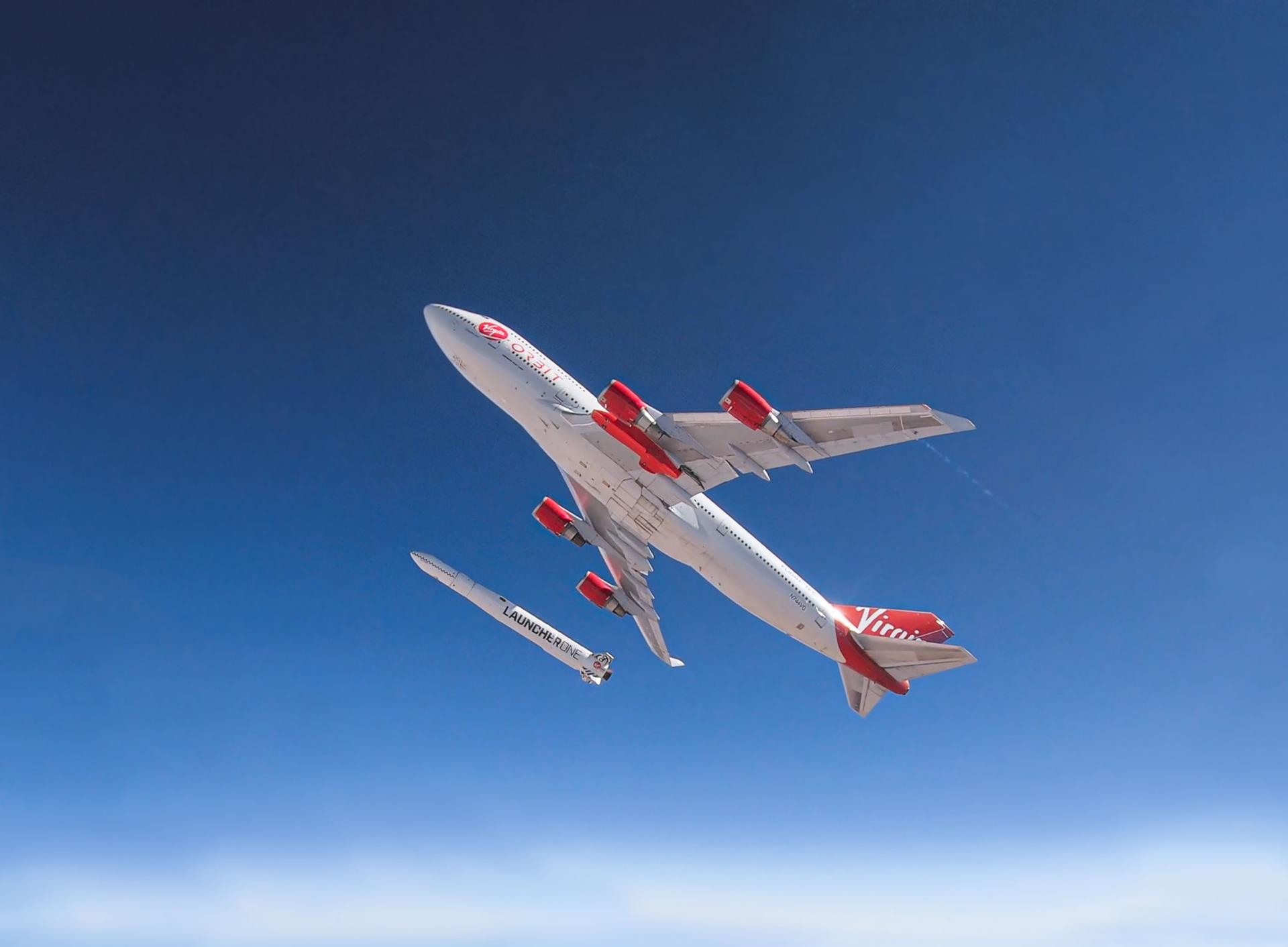
Rather than lifting off from a conventional ground pad, LauncherOne was carried beneath the wing of a heavily modified Boeing 747-400 named Cosmic Girl. Released at high altitude, the two-stage liquid-fueled rocket would ignite and complete its journey to orbit independently. This air-launch approach gave Virgin Orbit flexibility in launch site selection and allowed operations from conventional airports. At 16 meters tall and 1.6 meters in diameter, LauncherOne was a compact vehicle sized specifically for the growing small-satellite market, with a rated capacity of 500 kg to low Earth orbit.
Flight History
LauncherOne conducted six tracked flights between 2020 and 2023, achieving four successes and two failures or partial failures. The program opened with Launch Demo in 2020, which ended in an early mission failure. The follow-up attempt, Launch Demo 2, succeeded in early 2021, marking Virgin Orbit's first successful orbital delivery and validating the air-launch concept at an orbital scale.
Subsequent missions carried names drawn from classic rock music, reflecting Virgin's brand identity. Tubular Bells, Part One and Above the Clouds both flew successfully, building on the program's momentum. Straight Up and Start Me Up followed, the latter launching from Spaceport Cornwall in the United Kingdom — a historically significant attempt to conduct an orbital launch from British soil. The Cornwall mission ultimately suffered a failure that prevented payloads from reaching orbit, ending the streak of consecutive successes.
Role and Context
LauncherOne emerged during a period of rapid expansion in the small-satellite industry, competing in a market alongside other dedicated small-lift vehicles. Its air-launch architecture was relatively unusual among orbital rockets and offered theoretical advantages in range safety and weather flexibility. The vehicle was aimed primarily at government and commercial customers seeking dedicated rideshare alternatives rather than secondary slots on larger rockets. Virgin Orbit itself served as the top customer across the tracked flight manifest, operating the vehicle on behalf of various payload clients including national defense agencies and commercial operators.
Legacy
The LauncherOne program concluded in 2023 following the unsuccessful Spaceport Cornwall mission, which contributed to severe financial difficulties at Virgin Orbit. The company subsequently filed for bankruptcy and ceased operations, bringing the LauncherOne program to a close. Despite its short operational life, the vehicle demonstrated that air-launched orbital rockets are technically feasible and flew a meaningful number of missions on behalf of real customers. Its six-flight record — spanning an initial failure, a run of successes, and a final setback — reflects the broader challenges facing early-stage commercial launch providers in a competitive and unforgiving industry.