Kuaizhou 1A
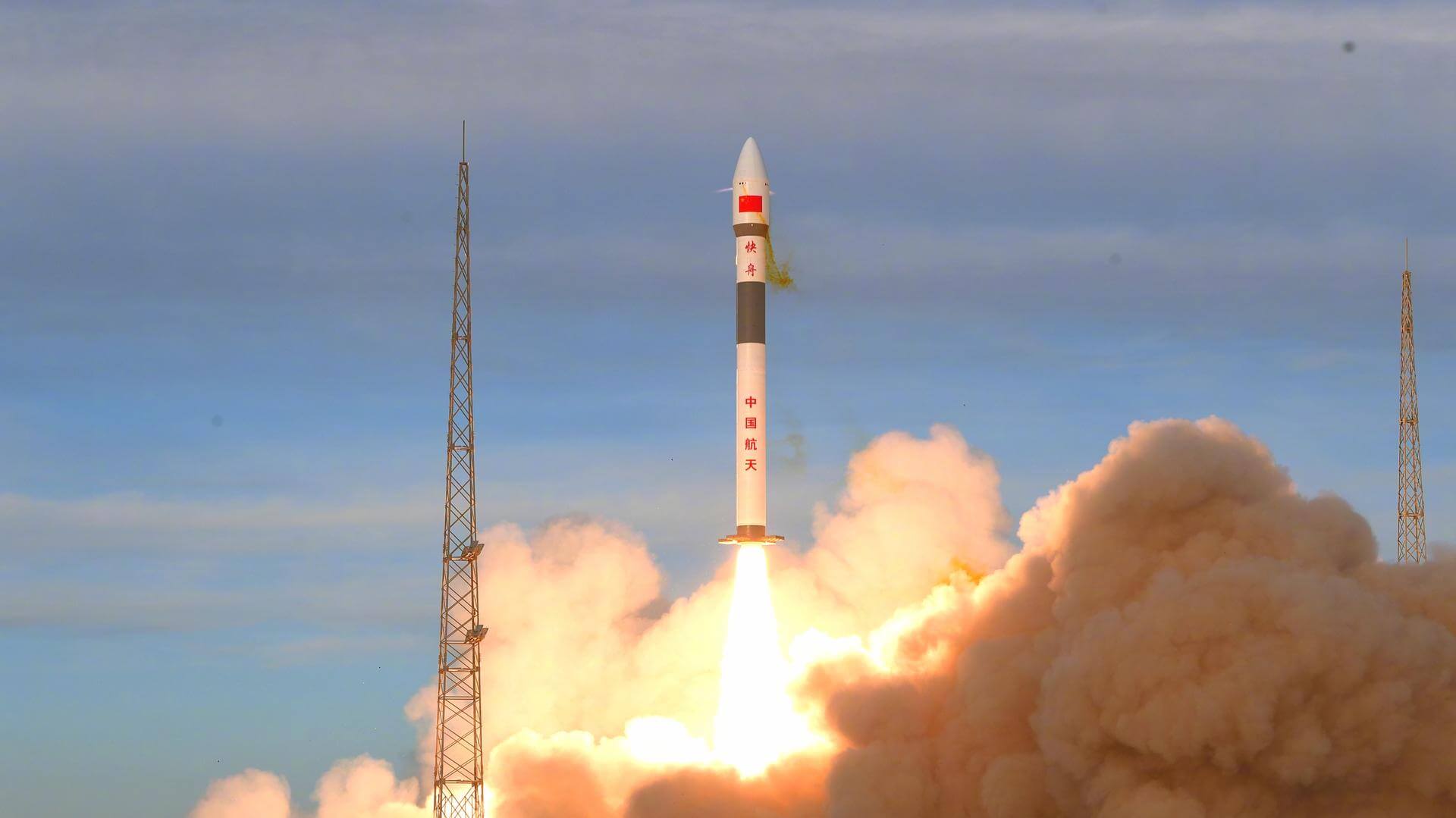
About the Kuaizhou 1A
Kuaizhou 1A
The Kuaizhou 1A (快舟一号甲, literally "Fast Vessel 1A") is a Chinese small solid-fueled orbital launch vehicle operated by ExPace Technology Corporation, a commercial subsidiary of the state-owned China Aerospace Science and Industry Corporation (CASIC). Designed to offer rapid, low-cost access to low Earth orbit, it represents one of China's most active entries in the global commercial small-satellite launch market.
Design and Capabilities
Standing 19.4 meters tall with a diameter of 1.4 meters, the Kuaizhou 1A is a compact, road-mobile rocket built around a stack of solid-propellant stages. Its mobility and relatively simple launch infrastructure allow it to operate from multiple sites, including the Jiuquan Satellite Launch Center and Taiyuan Satellite Launch Center in China. The vehicle can deliver up to 300 kg to low Earth orbit, positioning it squarely in the small-lift category alongside other modern dedicated small-satellite launchers. A liquid-propellant upper stage provides the precise orbital insertion capability required by commercial customers.
Operational History
The Kuaizhou 1A conducted its first flight in 2017 and has maintained an active launch cadence through at least 2025. Based on our tracked flight record, the vehicle has completed 31 flights, of which 28 were fully successful and 3 resulted in failure or partial failure — reflecting a strong but not unblemished reliability profile consistent with a maturing commercial launcher.
Its primary customers have been ExPace itself and CASIC, frequently flying payloads related to commercial Internet-of-Things (IoT) constellations, remote sensing, and technology demonstration. The Tianqi satellite series — IoT connectivity satellites operated by Guodian Gaoke — has been a notable repeat customer, with missions such as Tianqi 29–32 launching multiple smallsats in a single rideshare. Other recent missions in our record include Traffic VDES A & B, a maritime communications payload; PRSC-S1; Haishao-1; and Tianxing-1-02, illustrating the vehicle's role across a range of civil and commercial applications. Some flights have carried unknown payloads, likely reflecting government or sensitive commercial missions.
Role and Significance
The Kuaizhou 1A occupies an important place in the history of Chinese commercial spaceflight. When it entered service, it was among the first vehicles in China to be marketed openly to commercial satellite operators under a dedicated commercial launch subsidiary, predating many of the private Chinese launch startups that emerged in the late 2010s. Its solid-fuel architecture prioritizes responsiveness and simplicity over raw performance, making it well-suited for operators needing timely launches on a defined schedule rather than waiting for a rideshare slot on a larger vehicle.
While newer and more capable Chinese small-lift vehicles have since entered the market, the Kuaizhou 1A continues to fly regularly, sustained by a steady pipeline of domestic constellation builds and commercial rideshare demand. Its track record of more than two dozen successful missions makes it one of the most flown dedicated small-satellite launchers currently operating anywhere in the world.
- Dec 05, 2025Kuaizhou 1A | Traffic VDES A & BSuccess
- Jul 31, 2025Kuaizhou 1A | PRSC-S1Success
- Mar 01, 2025Kuaizhou 1A | Unknown PayloadFailure
- Dec 04, 2024Kuaizhou 1A | Haishao-1Success
- Sep 20, 2024Kuaizhou 1A | Tianqi 29-32Success
- Jan 11, 2024Kuaizhou 1A | Tianxing-1-02Success
- Jan 05, 2024Kuaizhou 1A | Tianmu-1 15-18Success
- Dec 27, 2023Kuaizhou 1A | Tianmu-1 19-22Success
- Dec 25, 2023Kuaizhou 1A | Tianmu-1 11-14Success
- Aug 14, 2023Kuaizhou 1A | HEAD-3A/B/C/D/ESuccess
- Jul 20, 2023Kuaizhou 1A | Tianmu-1 07-10Success
- Jun 09, 2023Kuaizhou 1A | Longjiang 3Success
- Mar 22, 2023Kuaizhou 1A | Tianmu-1 03-06Success
- Sep 24, 2022Kuaizhou 1A | Shiyan 14 & Shiyan 15Success
- Sep 06, 2022Kuaizhou 1A | CentiSpace-1 S3 & S4Success
- Aug 23, 2022Kuaizhou 1A | Chuangxin-16Success
- Jun 22, 2022Kuaizhou 1A | Tianxing-1Success
- Dec 15, 2021Kuaizhou 1A | GeeSat x2Failure
- Nov 24, 2021Kuaizhou 1A | Shiyan 11Success
- Oct 27, 2021Kuaizhou 1A | Jilin-1-02FSuccess
- Sep 27, 2021Kuaizhou 1A | Jilin-1-02DSuccess
- Sep 12, 2020Kuaizhou 1A | Jilin-1-02CFailure
- May 12, 2020Kuaizhou 1A | Xingyun-2 01, 02Success
- Jan 16, 2020Kuaizhou 1A | Yinhe-1Success
- Dec 07, 2019Kuaizhou 1A | HEAD-2A, 2B & Tianyi-16, 17 & Tianqi-4A, 4BSuccess
- Dec 07, 2019Kuaizhou 1A | Jilin-1-02BSuccess
- Nov 17, 2019Kuaizhou 1A | KL-AlphaSuccess
- Nov 13, 2019Kuaizhou 1A | Jilin-1-02ASuccess
- Aug 30, 2019Kuaizhou 1A | KX-09 & TY-1-07 (Xiaoxiang-1-07)Success
- Sep 29, 2018Kuaizhou 1A | Centispace-1-S1Success
- Jan 09, 2017Kuaizhou 1A | Multiple payloadsSuccess