Kuaizhou
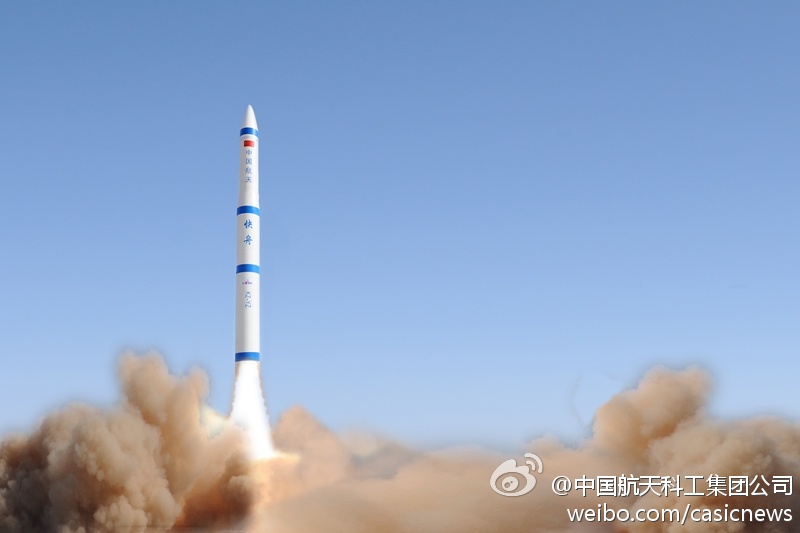
About the Kuaizhou
Kuaizhou
The Kuaizhou (快舟, meaning "Fast Vessel") is a Chinese small solid-fueled orbital launch vehicle developed and operated by the China Aerospace Science and Industry Corporation (CASIC). Designed for rapid deployment of small satellites, it represents an important step in China's effort to develop responsive, cost-effective access to low Earth orbit outside the country's traditional liquid-fueled rocket programs.
Background and Design
Kuaizhou is a compact, road-mobile rocket built around solid-propellant motor stages, a configuration that allows for significantly shorter preparation times compared to conventional orbital launch vehicles. Standing 11 meters tall with a diameter of 1.4 meters, the vehicle is notably small even among small-lift launchers, reflecting its focus on quick-turnaround missions with modest payloads. Its road-mobile nature means it is not tied to a fixed launch pad, giving operators considerable flexibility in launch site selection — a characteristic with both civil and strategic value.
The vehicle is derived in part from technologies associated with Chinese ballistic missile programs, a lineage it shares with several other solid-fueled small launchers developed during this era. This heritage contributed to its rapid development timeline and emphasis on operational simplicity.
Flight History
Our records show two tracked flights of the Kuaizhou, both conducted successfully, spanning the years 2013 to 2014. This early operational period established Kuaizhou as a functional orbital delivery system, with both missions achieving their objectives without a recorded failure or partial failure.
The two missions tracked in this database are Kuaizhou-1 and Kuaizhou-2, each carrying small Earth observation or experimental satellites for Chinese government-affiliated customers. Both flights were managed under the auspices of CASIC, which served as the top customer across the vehicle's tracked flight history. The clean two-for-two success record across its initial flights gave early confidence in the design's reliability.
Role and Significance
Kuaizhou holds a notable place in Chinese spaceflight history as one of the first solid-fueled vehicles from China to successfully demonstrate an orbital delivery capability in operational service. Its introduction in 2013 signaled a broader shift within China's space industry toward diversified launch options, including smaller, faster-to-launch vehicles suited to emerging commercial and government small-satellite needs.
The original Kuaizhou vehicle formed the foundation for a growing family of launchers. CASIC subsequently developed the larger Kuaizhou-1A, which expanded payload capacity and entered commercial service, becoming one of China's more prolific small-satellite launchers. The original vehicle's short but successful run demonstrated the viability of the concept and directly informed those follow-on developments.
Operator
China Aerospace Science and Industry Corporation, one of China's two major state-owned defense and aerospace conglomerates, is responsible for Kuaizhou's development and operation. Unlike CASC — which oversees the Long March rocket family — CASIC has pursued its own launch vehicle program, with Kuaizhou as its flagship product. The original Kuaizhou's two successful flights between 2013 and 2014 laid the groundwork for what would become an expanding commercial launch enterprise under the Expace subsidiary established by CASIC in later years.