Kosmos 11K63
About the Kosmos 11K63
Kosmos 11K63
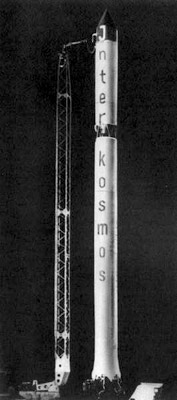
The Kosmos 11K63 is a Soviet small orbital launch vehicle developed and operated by the Soviet Space Program, designed primarily to place lightweight military and scientific satellites into low Earth orbit. A member of the broader Kosmos rocket family, the 11K63 was derived from the R-12 intermediate-range ballistic missile and represented the Soviet Union's approach to providing a reliable, dedicated launcher for small payloads during the early decades of the Space Age.
Design and Capabilities
Standing 31 metres tall with a diameter of 1.6 metres, the 11K63 is a slender, two-stage liquid-propellant rocket. It is capable of delivering up to 300 kg to low Earth orbit, placing it firmly in the small-lift category. Its modest but dependable performance made it well suited to the standardized small satellites — commonly designated under the DS (Dnepropetrovsk Sputnik) series — that formed the backbone of Soviet scientific and military space operations during its operational period. The vehicle was manufactured and developed at the Yuzhnoye Design Bureau in Dnipropetrovsk (present-day Ukraine), which was a central institution in Soviet missile and space launch vehicle production.
Operational History
The 11K63 conducted its first tracked flight in 1965 and remained in active service through 1977, spanning more than a decade of Soviet space operations. Across that period, the vehicle accumulated 126 flights in our records, achieving 118 successes against 8 failures or partial failures — a success rate that speaks to the fundamental reliability engineered into the platform. Launches were conducted from Kapustin Yar, the Soviet launch site on the Volga steppe, which served as the primary range for small military and experimental satellites throughout this era.
The 11K63's manifest was dominated almost entirely by Soviet state missions, reflecting its role as an institutional workhorse rather than a commercial offering. Its payloads were routinely given generic Kosmos designations, the umbrella name the Soviet Union applied to satellites whose specific purposes — whether electronic intelligence, calibration, geodesy, or space environment research — were not publicly disclosed at the time.
Recent Missions
The final flights recorded for the 11K63 include a series of DS-P1-I and DS-P1-Yu payloads, spacecraft types associated with radar calibration and active instrumentation experiments conducted in support of Soviet military space activities. Missions such as DS-P1-I 17 through 20 and DS-P1-Yu 78 and 79 illustrate the vehicle's sustained operational tempo in its final years, as the Soviet program continued to cycle standardized small satellites through routine on-orbit campaigns.
Legacy
The Kosmos 11K63 occupies a distinctive place in spaceflight history as one of the most prolific small-lift launchers of the 1960s and 1970s. Its long service life, solid reliability record, and close association with the systematic expansion of Soviet military space capabilities make it an important, if often overlooked, vehicle in the story of early spaceflight. By the late 1970s, evolving mission requirements and the maturation of successor systems brought the 11K63's operational career to a close, but its contribution to establishing routine access to orbit for small payloads remains significant.
- Jun 18, 1977Kosmos 11K63 | DS-P1-I 20Success
- Apr 05, 1977Kosmos 11K63 | DS-P1-I 19Success
- Aug 26, 1976Kosmos 11K63 | DS-P1-Yu 79Success
- Aug 18, 1976Kosmos 11K63 | DS-P1-I 18Success
- May 18, 1976Kosmos 11K63 | DS-P1-Yu 78Success
- Feb 05, 1976Kosmos 11K63 | DS-P1-I 17Success
- Jul 17, 1975Kosmos 11K63 | DS-P1-I 16Success
- Jun 24, 1975Kosmos 11K63 | DS-P1-Yu 77Success
- Apr 08, 1975Kosmos 11K63 | DS-P1-Yu 76Success
- Jan 28, 1975Kosmos 11K63 | DS-P1-Yu 75Success
- Jan 21, 1975Kosmos 11K63 | DS-P1-Yu 74Success
- Nov 20, 1974Kosmos 11K63 | DS-P1-Yu 73Success
- Sep 26, 1974Kosmos 11K63 | DS-P1-Yu 72Success
- Jul 25, 1974Kosmos 11K63 | DS-P1-Yu 71Success
- Jul 11, 1974Kosmos 11K63 | DS-P1-Yu 70Failure
- Jun 26, 1974Kosmos 11K63 | DS-P1-I 15Success
- Mar 05, 1974Kosmos 11K63 | DS-P1-Yu 69Success
- Feb 27, 1974Kosmos 11K63 | DS-P1-Yu 68Success
- Dec 13, 1973Kosmos 11K63 | DS-P1-I 14Success
- Nov 28, 1973Kosmos 11K63 | DS-P1-Yu 67Success
- Nov 20, 1973Kosmos 11K63 | DS-P1-Yu 66Success
- Oct 16, 1973Kosmos 11K63 | DS-P1-Yu 65Success
- Aug 22, 1973Kosmos 11K63 | DS-P1-Yu 64Success
- Jun 05, 1973Kosmos 11K63 | DS-P1-Yu 63Success
- May 17, 1973Kosmos 11K63 | DS-P1-Yu 62Success
- Apr 19, 1973Kosmos 11K63 | DS-U2-IK 3 & Kopernik-500Success
- Apr 12, 1973Kosmos 11K63 | DS-P1-Yu 61Success
- Jan 24, 1973Kosmos 11K63 | DS-P1-Yu 60Success
- Nov 30, 1972Kosmos 11K63 | DS-U1-IK 2Success
- Oct 25, 1972Kosmos 11K63 | DS-P1-Yu 59Success
- Oct 11, 1972Kosmos 11K63 | DS-P1-Yu 58Success
- Oct 05, 1972Kosmos 11K63 | DS-P1-Yu 57Success
- Jul 12, 1972Kosmos 11K63 | DS-P1-Yu 56Success
- Jul 05, 1972Kosmos 11K63 | DS-P1-Yu 55Success
- Jun 30, 1972Kosmos 11K63 | DS-P1-I 13Success
- Jun 30, 1972Kosmos 11K63 | DS-U3-IK 3Success
- Apr 25, 1972Kosmos 11K63 | DS-P1-Yu 54Failure
- Apr 21, 1972Kosmos 11K63 | DS-P1-Yu 53Success
- Apr 11, 1972Kosmos 11K63 | DS-P1-Yu 52Success
- Mar 25, 1972Kosmos 11K63 | DS-P1-Yu 51Success
- Jan 25, 1972Kosmos 11K63 | DS-P1-Yu 50Success
- Dec 17, 1971Kosmos 11K63 | DS-P1-Yu 49Success
- Dec 02, 1971Kosmos 11K63 | DS-U2-IK 2Success
- Nov 29, 1971Kosmos 11K63 | DS-P1-Yu 48Success
- Nov 17, 1971Kosmos 11K63 | DS-P1-Yu 47Success
- Oct 19, 1971Kosmos 11K63 | DS-P1-Yu 46Success
- Sep 24, 1971Kosmos 11K63 | DS-P1-I 11Success
- Aug 27, 1971Kosmos 11K63 | DS-P1-Yu 45Success
- Aug 03, 1971Kosmos 11K63 | DS-P1-Yu 44Failure
- May 27, 1971Kosmos 11K63 | DS-P1-Yu 43Success
- May 19, 1971Kosmos 11K63 | DS-P1-Yu 42Success
- Apr 24, 1971Kosmos 11K63 | DS-P1-Yu 41Success
- Mar 05, 1971Kosmos 11K63 | Zenit-2M 17Failure
- Jan 26, 1971Kosmos 11K63 | DS-P1-Yu 39Success
- Jan 14, 1971Kosmos 11K63 | DS-P1-I 10Success
- Dec 18, 1970Kosmos 11K63 | DS-P1-Yu 38Success
- Nov 24, 1970Kosmos 11K63 | DS-P1-Yu 37Success
- Oct 14, 1970Kosmos 11K63 | DS-U3-IK 2Success
- Oct 08, 1970Kosmos 11K63 | DS-P1-Yu 36Success
- Sep 16, 1970Kosmos 11K63 | DS-P1-I 9Success
- Aug 19, 1970Kosmos 11K63 | DS-P1-Yu 35Success
- Aug 10, 1970Kosmos 11K63 | DS-U2-MG 2Success
- Aug 07, 1970Kosmos 11K63 | DS-U2-IK 1Success
- Jun 27, 1970Kosmos 11K63 | DS-P1-Yu 34Success
- Jun 13, 1970Kosmos 11K63 | DS-U2-GK 2Success
- Jun 12, 1970Kosmos 11K63 | DS-P1-Yu 33Success
- May 22, 1970Kosmos 11K63 | DS-P1-Yu 32Failure
- Apr 24, 1970Kosmos 11K63 | DS-U1-RSuccess
- Apr 23, 1970Kosmos 11K63 | DS-P1-Yu 31Success
- Mar 18, 1970Kosmos 11K63 | DS-P1-I 8Success
- Feb 27, 1970Kosmos 11K63 | DS-P1-Yu 30Success
- Jan 30, 1970Kosmos 11K63 | DS-P1-I 7Failure
- Jan 20, 1970Kosmos 11K63 | DS-U2-MG 1Success
- Jan 16, 1970Kosmos 11K63 | DS-MO 2Success
- Jan 15, 1970Kosmos 11K63 | DS-P1-Yu 29Success
- Dec 25, 1969Kosmos 11K63 | DS-U1-IK 1Success
- Dec 11, 1969Kosmos 11K63 | DS-P1-Yu 28Success
- Nov 24, 1969Kosmos 11K63 | DS-P1-Yu 27Success
- Nov 04, 1969Kosmos 11K63 | DS-P1-I 6Success
- Oct 24, 1969Kosmos 11K63 | DS-P1-Yu 26Success
- Oct 18, 1969Kosmos 11K63 | DS-P1-Yu 25Success
- Oct 14, 1969Kosmos 11K63 | DS-U3-IK 1Success
- Aug 22, 1969Kosmos 11K63 | DS-P1-Yu 24Success
- Jul 23, 1969Kosmos 11K63 | DS-P1-Yu 23Failure
- Jun 03, 1969Kosmos 11K63 | DS-P1-Yu 22Success
- May 27, 1969Kosmos 11K63 | DS-P1-Yu 21Success
- Apr 04, 1969Kosmos 11K63 | DS-P1-Yu 20Success
- Mar 28, 1969Kosmos 11K63 | DS-P1-I 5Success
- Mar 05, 1969Kosmos 11K63 | DS-P1-Yu 19Success
- Feb 07, 1969Kosmos 11K63 | DS-P1-Yu 18Success
- Dec 26, 1968Kosmos 11K63 | DS-U2-GFSuccess
- Dec 19, 1968Kosmos 11K63 | DS-U2-GK 1Success
- Dec 14, 1968Kosmos 11K63 | DS-U2-I 3Success
- Dec 03, 1968Kosmos 11K63 | DS-P1-Yu 17Success
- Oct 03, 1968Kosmos 11K63 | DS-P1-Yu 16Success
- Sep 20, 1968Kosmos 11K63 | DS-P1-I 4Success
- Jul 18, 1968Kosmos 11K63 | DS-P1-Yu 15Success
- Jul 05, 1968Kosmos 11K63 | DS-U3-S 2Success
- Jun 11, 1968Kosmos 11K63 | DS-U1-Ya 2Success
- May 30, 1968Kosmos 11K63 | DS-P1-Yu 14Success
- May 24, 1968Kosmos 11K63 | DS-P1-Yu 13Success
- Apr 26, 1968Kosmos 11K63 | DS-U2-D 2Success
- Apr 18, 1968Kosmos 11K63 | DS-U1-ASuccess
- Apr 09, 1968Kosmos 11K63 | DS-P1-Yu 12Success
- Mar 06, 1968Kosmos 11K63 | DS-U1-Ya 1Failure
- Mar 05, 1968Kosmos 11K63 | DS-P1-I 3Success
- Feb 20, 1968Kosmos 11K63 | DS-U2-V 4Success
- Dec 26, 1967Kosmos 11K63 | DS-U2-V 3Success
- Nov 21, 1967Kosmos 11K63 | DS-P1-Yu 11Success
- Sep 12, 1967Kosmos 11K63 | DS-P1-Yu 10Success
- Aug 24, 1967Kosmos 11K63 | DS-P1-Yu 9Success
- Jun 16, 1967Kosmos 11K63 | DS-U3-S 1Success
- Jun 12, 1967Kosmos 11K63 | DS-P1-Yu 8Success
- Jun 05, 1967Kosmos 11K63 | DS-U2-MP 2Success
- Mar 25, 1967Kosmos 11K63 | DS-P1-Yu 7Success
- Mar 21, 1967Kosmos 11K63 | DS-MO 1Success
- Mar 16, 1967Kosmos 11K63 | DS-P1-I 2Success
- Mar 03, 1967Kosmos 11K63 | DS-U2-M 2Success
- Feb 14, 1967Kosmos 11K63 | DS-U2-I 2Success
- Dec 12, 1966Kosmos 11K63 | DS-U2-MP 1Success
- May 24, 1966Kosmos 11K63 | DS-U2-I 1Success
- Apr 26, 1966Kosmos 11K63 | DS-P1-Yu 5Success
- Jan 25, 1966Kosmos 11K63 | DS-P1-I 1Success
- Nov 26, 1965Kosmos 11K63 | DS-U2-M 1Success
- Nov 04, 1965Kosmos 11K63 | DS-U2-V 2Success
- Oct 19, 1965Kosmos 11K63 | DS-U2-V 1Success