Juno II
About the Juno II
Juno II
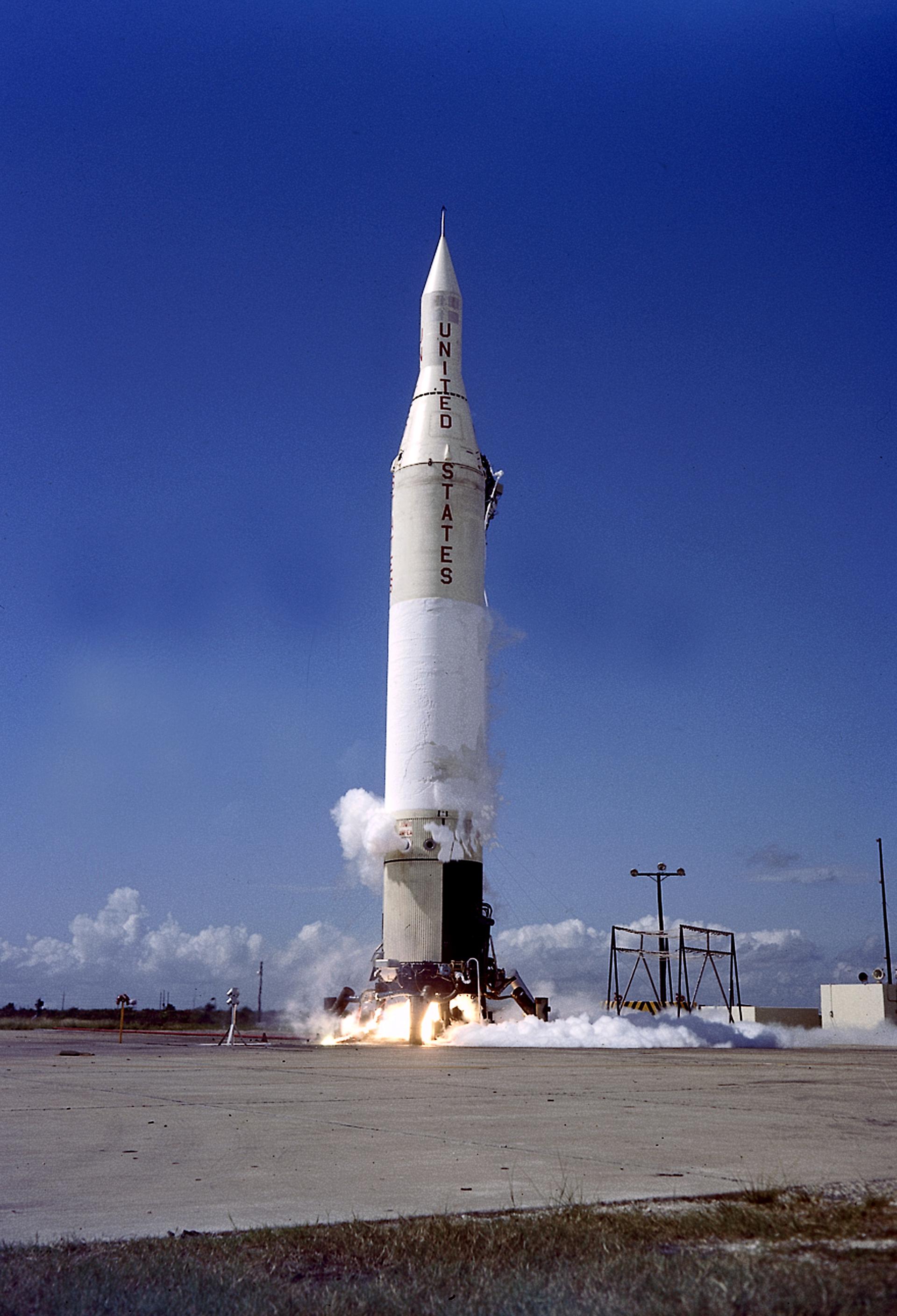
The Juno II was an American orbital launch vehicle developed and operated by the Army Ballistic Missile Agency (ABMA) in partnership with the Jet Propulsion Laboratory (JPL), and later flown under the authority of the newly established National Aeronautics and Space Administration (NASA). A direct descendant of the Jupiter-C family, it represented one of the United States' earliest dedicated small-satellite launch systems and played a modest but meaningful role in the pioneering years of the Space Age.
Origins and Design
Juno II was derived from the Jupiter intermediate-range ballistic missile, which served as its first stage. Above that liquid-fueled core, engineers stacked clusters of small solid-fueled Sergeant rocket motors — the same upper-stage approach that had proven successful on the earlier Juno I vehicle that lofted Explorer 1 in 1958. Standing 24 meters tall with a base diameter of 2.67 meters, the vehicle was a slender, repurposed missile adapted for science payloads rather than warheads. Its capacity to deliver up to 41 kilograms to low Earth orbit made it suitable for the small scientific satellites of the era.
Operational History
Juno II conducted 10 tracked flights between 1958 and 1961, achieving 5 successes and 5 failures or partial failures — a record that reflects the enormous technical difficulty of early orbital rocketry. Its missions were exclusively scientific in nature, serving both the Army Ballistic Missile Agency and NASA as primary customers during a formative period of American space exploration.
Among the notable payloads carried by Juno II were Explorer 7, which studied solar X-rays and cosmic rays; Explorer 8, which investigated the ionosphere; and Explorer 11, which carried one of the first space-based gamma-ray telescopes. The vehicle also attempted to orbit several S-45, S-45A, and S-46 payloads, though some of these missions ended in failure, underscoring the persistent reliability challenges facing American launchers during the late 1950s and early 1960s.
Launches were conducted from Cape Canaveral in Florida, the primary American launch site of the period.
Historical Significance
Juno II occupied a brief but important niche in spaceflight history. It flew during the height of the early Space Race, bridging the era of improvised missile-derived launchers and the more purpose-built vehicles — such as the Scout and Thor-Delta — that would soon follow. The Explorer satellites it successfully orbited contributed real scientific data about Earth's radiation environment, ionosphere, and the broader near-Earth space environment at a time when such knowledge was entirely new.
The vehicle's mixed reliability record was not unusual for its time; nearly all launch vehicles of the late 1950s struggled with high failure rates as engineers learned to master the complexities of multi-stage rocketry. By 1961, Juno II had been retired, its role absorbed by more capable and dependable successors. Its legacy endures through the scientific returns of the Explorer program it helped sustain and its place as one of the earliest vehicles to carry NASA payloads into orbit.
- May 24, 1961Juno II | S-45AFailure
- Apr 27, 1961Juno II | Explorer 11Success
- Feb 25, 1961Juno II | S-45Failure
- Nov 03, 1960Juno II | Explorer 8Success
- Mar 23, 1960Juno II | NASA S-46Failure
- Oct 13, 1959Juno II | Explorer 7Success
- Aug 15, 1959Juno II | BeaconFailure
- Jul 16, 1959Juno II | NASA S-1Failure
- Mar 03, 1959Juno II | Pioneer 4Success
- Dec 06, 1958Juno II | Pioneer 3Success