Juno-I
About the Juno-I
Juno-I
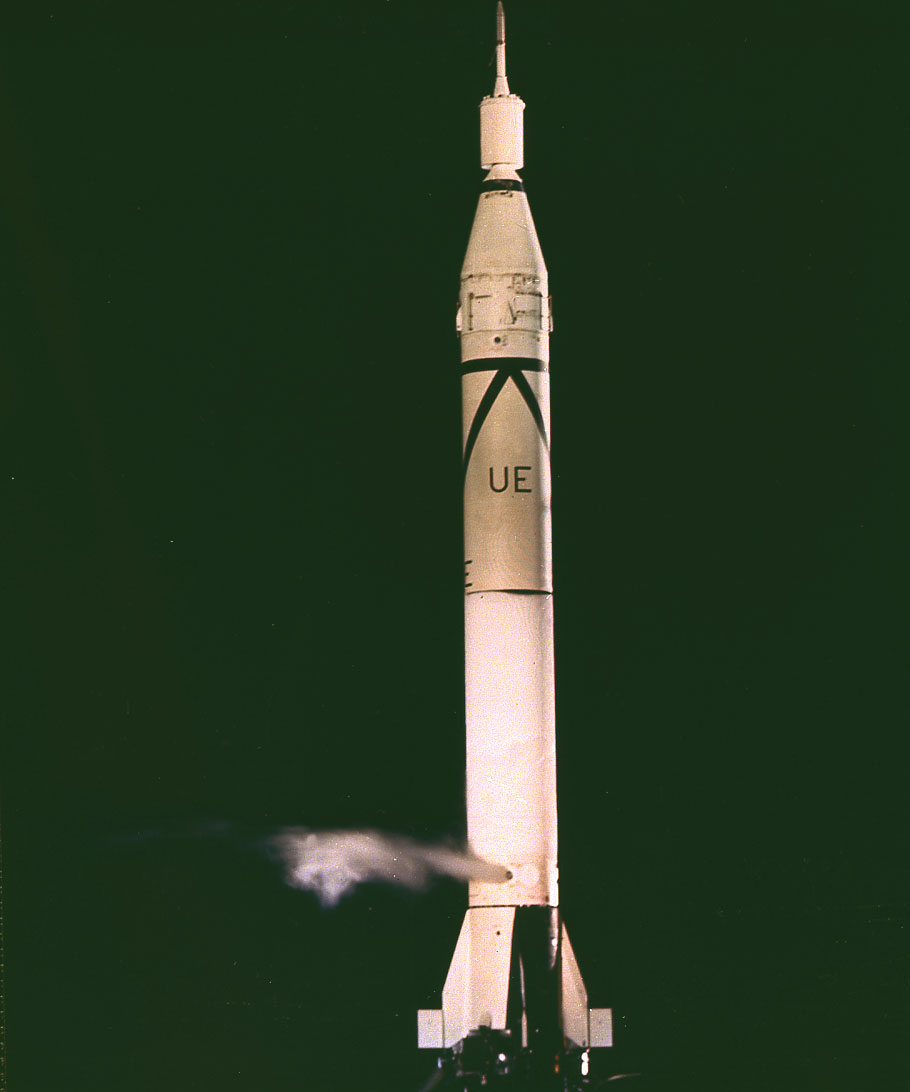
Juno-I was an American orbital launch vehicle operated by the Army Ballistic Missile Agency (ABMA) during the pivotal opening months of the Space Age. A direct descendant of the Jupiter-C sounding rocket — itself a modified Redstone ballistic missile — Juno-I holds an enduring place in spaceflight history as the rocket that carried the first American satellite into orbit.
Origins and Design
The vehicle was developed under the technical leadership of Wernher von Braun and his team at the ABMA's Redstone Arsenal in Huntsville, Alabama. Juno-I inherited the Jupiter-C's basic architecture: a liquid-fueled Redstone first stage topped by a cluster of solid-fueled upper stages derived from JPL's Sergeant rocket motor. Standing 21.2 meters tall with a base diameter of 1.78 meters, the vehicle was relatively slender by the standards of later orbital rockets, but its stacked-stage design proved capable of delivering small payloads — up to 11 kg — to low Earth orbit.
Flight History
All six of Juno-I's tracked flights took place in 1958, a single, concentrated year of activity that coincided with the United States' urgent response to the Soviet Union's Sputnik launches. The vehicle achieved three successes and three failures, giving it a success rate of exactly 50% across its operational lifetime.
The program opened triumphantly on January 31, 1958, when Juno-I successfully delivered Explorer 1 to orbit — the first American satellite. Explorer 1 carried a cosmic-ray detector designed by James Van Allen, and data from the mission led directly to the discovery of the Van Allen radiation belts, one of the landmark scientific findings of the twentieth century.
Subsequent missions demonstrated the mixed fortunes typical of early spaceflight. Explorer 2 was lost to a launch failure, while Explorer 3 reached orbit successfully in March 1958, returning additional scientific data. Explorer 4, launched in July 1958, also succeeded, supporting research related to high-altitude nuclear test effects. Explorer 5 was lost when the vehicle failed to achieve orbit, and the final flight — carrying the Beacon inflatable satellite — likewise ended in failure.
Operational Context
Juno-I launched from Cape Canaveral on the Florida coast, the primary American launch site of the era. Its operational period was extraordinarily brief, encompassing only a single calendar year, yet its impact far exceeded what that timeline might suggest. The vehicle was a stopgap solution, fielded rapidly in competition with both Soviet ambitions and a rival American program, the Navy's Vanguard rocket. Where Vanguard suffered a highly publicized early failure, Juno-I's success with Explorer 1 gave the United States its first credible foothold in space.
Legacy
Juno-I was quickly superseded by more capable launch vehicles as American space programs matured, but its role as the rocket that opened the American chapter of orbital spaceflight remains undiminished. The Explorer 1 mission it carried is commemorated as a defining moment of the International Geophysical Year and a founding event in the history of NASA, which was established later in 1958 partly in response to the pressures that produced this vehicle.