Hyperbola-1
About the Hyperbola-1
Hyperbola-1
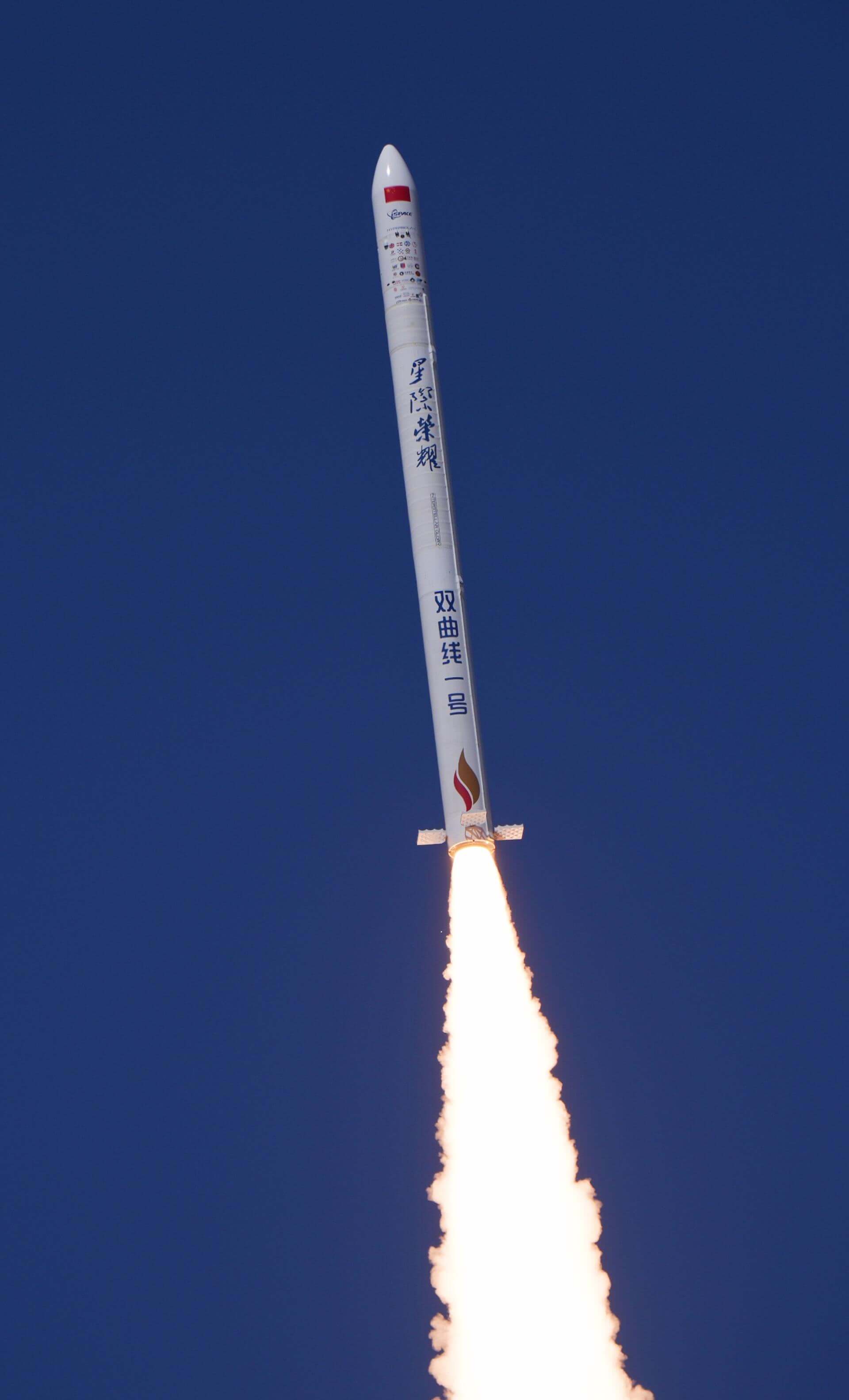
Hyperbola-1 (Chinese: 双曲线一号, also romanized as *Shuangquxian-1*) is a small Chinese orbital launch vehicle developed and operated by Beijing Interstellar Glory Space Technology Co., Ltd., commonly known as i-Space. It holds the distinction of being the first commercial rocket developed entirely by a private Chinese company to successfully reach orbit, a milestone achieved on its debut flight in July 2019.
Overview
Standing 38 meters tall with a diameter of 2.5 meters, Hyperbola-1 is a compact, four-stage vehicle combining solid-propellant upper stages with a liquid-fueled first stage. It is designed to serve the small satellite market, carrying payloads of up to 300 kg to low Earth orbit (LEO). The vehicle launches from the Jiuquan Satellite Launch Center in the Gobi Desert, one of China's primary orbital launch facilities.
Role and Significance
Hyperbola-1 emerged from China's broader opening of the commercial space sector in the mid-2010s, which encouraged private capital and entrepreneurship to enter a field previously dominated by state enterprises. i-Space's success in reaching orbit placed Hyperbola-1 among a small cohort of privately developed rockets worldwide to have achieved that threshold, drawing comparisons to early milestones by companies like Rocket Lab and SpaceX in the United States. For China's growing commercial launch industry, the vehicle demonstrated that privately funded orbital-class rockets were viable.
Flight History
Our tracking record covers 8 flights between 2019 and 2025, reflecting a mixed operational history. Of those launches, 4 are recorded as successes and 4 as failures or partial failures, giving the vehicle a success rate that underscores the difficulty of maturing a new rocket design in a competitive commercial environment.
The vehicle's inaugural mission in 2019 successfully delivered a small technology demonstrator to orbit. Subsequent flights have carried a range of commercial and institutional payloads, including satellites from the Jilin-1 optical imaging constellation, the Yunyao-1 meteorological satellite series, and a dedicated DEAR-1 mission. A dummy payload flight appears in the record, indicating at least one mission used for vehicle qualification or testing purposes. The Kunpeng-03 mission represents among the more recent tracked flights.
i-Space is both the manufacturer and the top customer in the flight record, a common arrangement among launch startups that often fly demonstration or internally sponsored payloads while building out a commercial manifest.
Operational Context
Hyperbola-1 occupies the small-lift segment of the Chinese commercial launch market, competing with a growing number of domestic vehicles targeting the same LEO smallsat customers. Its relatively modest payload capacity makes it well-suited to the expanding Chinese commercial Earth-observation sector, where operators frequently procure dedicated or rideshare launches for satellites in the sub-300 kg class.
With flights continuing into 2025, Hyperbola-1 remains an active vehicle and a tangible milestone in the maturation of China's private spaceflight industry, even as i-Space develops more capable successors intended to address higher-demand payload requirements.
- Jul 29, 2025Hyperbola-1 | Kunpeng-03Success
- Jul 10, 2024Hyperbola-1 | Yunyao-1 15-17Failure
- Dec 17, 2023Hyperbola-1 | DEAR-1Success
- Apr 07, 2023Hyperbola-1 | Dummy PayloadSuccess
- May 13, 2022Hyperbola-1 | Jilin-1 Mofang-01A(R)Failure
- Aug 03, 2021Hyperbola-1 | Jilin-1 Mofang-01A (?)Failure
- Feb 01, 2021Hyperbola-1 | UnknownFailure
- Jul 25, 2019Hyperbola-1 | Maiden FlightSuccess