H3-22
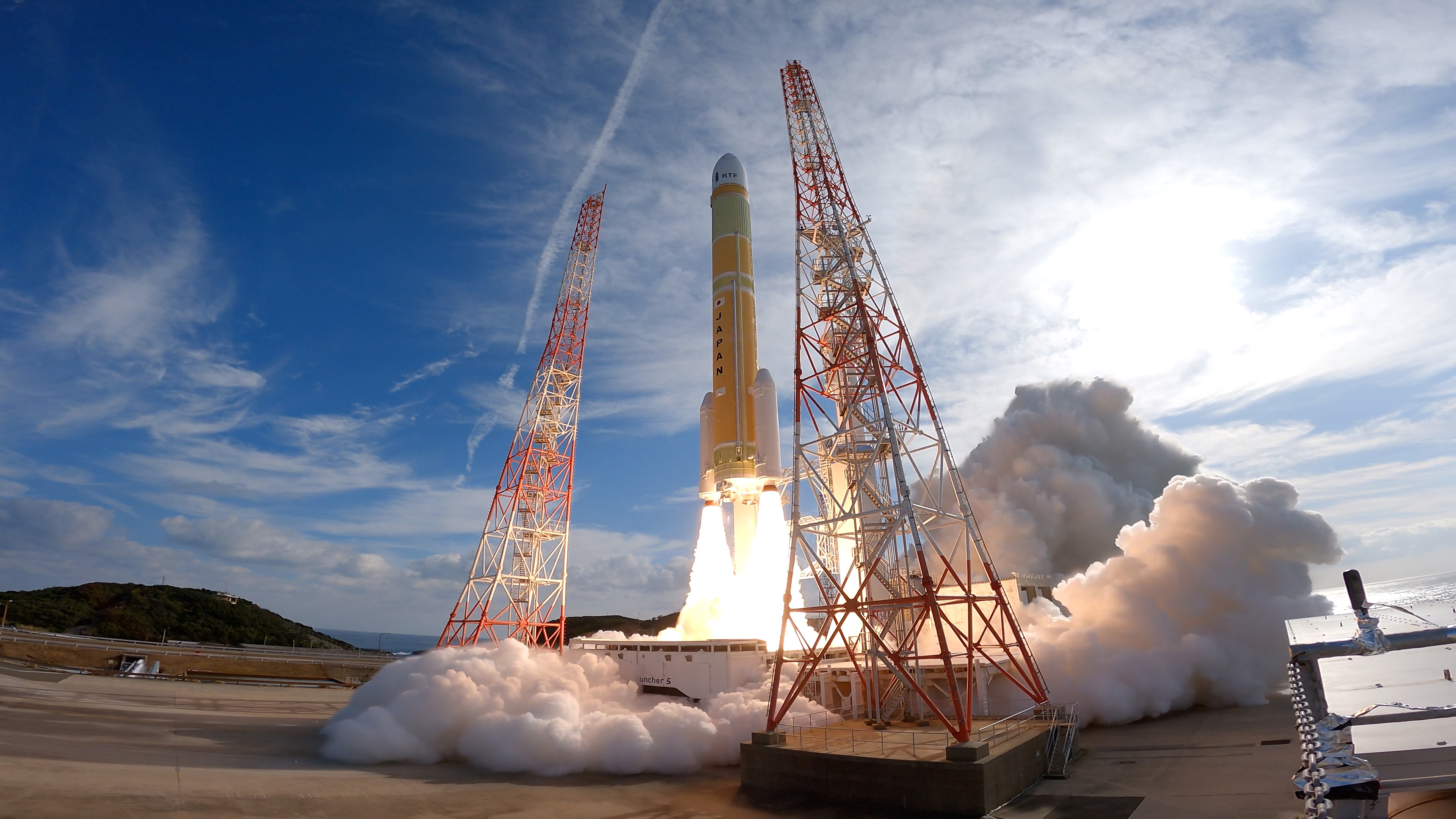
About the H3-22
H3-22
The H3-22 is a configuration of the H3 launch vehicle, developed and operated by the Japan Aerospace Exploration Agency (JAXA) in partnership with Mitsubishi Heavy Industries (MHI). It represents Japan's primary heavy-lift orbital rocket of the mid-2020s, designed to succeed the long-serving H-IIA and carry Japan's most demanding civil, commercial, and government payloads to orbit. The vehicle lifts off from the Tanegashima Space Center on the southwestern coast of Japan.
Configuration and Capability
The designation "H3-22" reflects the rocket's specific configuration within the broader H3 family: two first-stage main engines and two solid rocket boosters. Standing 63 meters tall with a core diameter of 5.27 meters, it is a large vehicle by any standard. Its payload capacity to geostationary transfer orbit (GTO) reaches 5,400 kg, making it well-suited to the heavy communications and navigation satellites that have defined its customer manifest. The fairing is large enough to accommodate the next generation of Japanese government spacecraft.
Operational History
The H3-22 entered service in 2023 and has been tracked through 2026, accumulating eight flights in available records. Of those, four were fully successful, while two resulted in failure or only partial success — a candid reminder that even mature spacefaring nations face challenges when introducing a new rocket generation. The early difficulties were characteristic of the H3 program overall, which encountered setbacks during its development and inaugural launch period before achieving reliable operations.
The vehicle's customer base has been dominated by Mitsubishi Heavy Industries, reflecting the deep integration between the rocket's manufacturer and the Japanese government's space procurement structure. In practice, this has meant a manifest heavily weighted toward high-value national assets.
Notable Missions
The H3-22's mission history reads as a who's who of Japanese strategic space infrastructure. It has lofted multiple satellites in the Michibiki (QZS) series — the Japanese Quasi-Zenith Satellite System that provides high-precision positioning services across the Asia-Oceania region — including Michibiki 5 (QZS-5), Michibiki 6 (QZS-6), and Michibiki 7 (QZS-7). These missions are cornerstone national infrastructure projects.
The rocket also carried DSN 3 (Kirameki 3), a defense communications satellite operated by the Japanese Ministry of Defense, and the Advanced Land Observing Satellite-4 (ALOS-4), JAXA's Earth-observation platform continuing a lineage of remote-sensing missions with applications in disaster monitoring and cartography. Most recently, the manifest includes ETS-9, an engineering test satellite developed to mature next-generation satellite bus and optical communication technologies.
Significance
The H3-22 occupies a critical role in Japan's strategic autonomy in space. By providing an indigenous heavy-lift capability for navigation constellations, defense communications, and Earth observation, it reduces Japan's dependence on foreign launch providers for its most sensitive national payloads. Its development and early operation have been closely watched as a benchmark for Japan's ambitions to compete in the global commercial launch market while guaranteeing sovereign access to orbit.
- Dec 31, 2026H3-22 | ETS-9TBD
- Aug 10, 2026H3-22 | Michibiki 7 (QZS-7)Success
- Dec 22, 2025H3-22 | Michibiki 5 (QZS-5)Failure
- Feb 02, 2025H3-22 | Michibiki 6 (QZS-6)Success
- Nov 04, 2024H3-22 | DSN 3 (Kirameki 3)Success
- Jul 01, 2024H3-22 | Advanced Land Observing Satellite-4 (ALOS-4)Success
- Feb 17, 2024H3-22 | VEP 4, CE-SAT-1E & TIRSATSuccess
- Mar 07, 2023H3-22 | ALOS-3 (Maiden flight)Failure