H-IIB 304
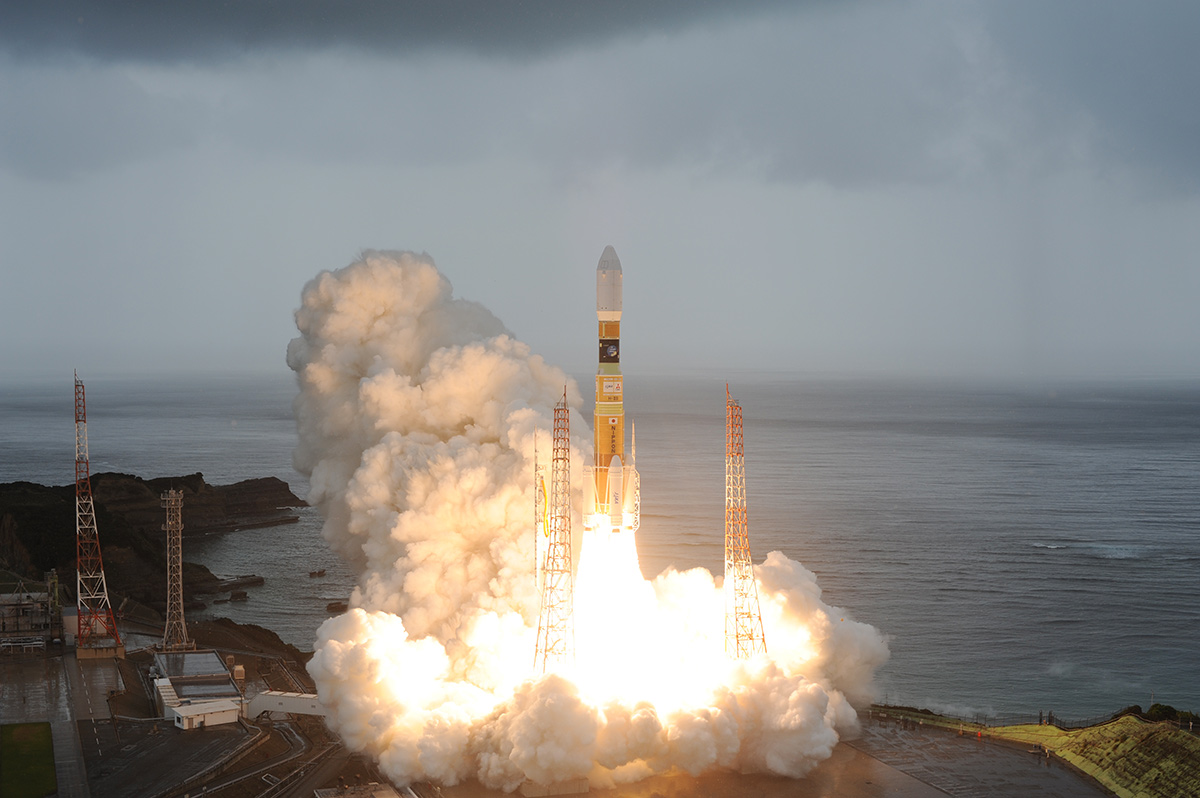
About the H-IIB 304
H-IIB 304
The H-IIB 304 is a Japanese orbital launch vehicle configuration operated by Mitsubishi Heavy Industries (MHI) on behalf of the Japan Aerospace Exploration Agency (JAXA). It represents the primary variant of the H-IIB rocket family, which was developed in Japan as an evolution of the earlier H-IIA to support heavier payload requirements, most notably the resupply of the International Space Station.
Design and Specifications
Standing 56.6 metres tall with a core diameter of 5.2 metres, the H-IIB 304 is a notably large vehicle by Japanese standards. Its enhanced liftoff capability allows it to deliver up to 16,500 kg to low Earth orbit (LEO) or 8,000 kg to geostationary transfer orbit (GTO). The "304" designation reflects its stage and booster configuration — specifically the use of four solid rocket boosters alongside its liquid-fueled core and upper stages. The H-IIB's first stage employs a twin-engine arrangement using LE-7A engines, a key departure from the single-engine layout of the H-IIA, and one that contributes significantly to its higher performance ceiling.
Launch Site and Operations
All H-IIB 304 missions were conducted from the Tanegashima Space Center on Tanegashima Island in southern Japan, the primary launch facility operated by JAXA. Tanegashima's geographic location allows launches toward both eastward and southward trajectories, supporting the vehicle's dual role in LEO and GTO missions.
Flight History
According to tracked flight data, the H-IIB 304 compiled a perfect record of 9 successful flights over an operational lifespan running from 2009 to 2020, with no recorded failures or partial failures. This unblemished record stands as a testament to the reliability of both the vehicle design and its operational teams.
The rocket's mission manifest was defined almost entirely by a single, critical purpose: delivering Kounotori (HTV) cargo spacecraft to the International Space Station. The Kounotori — meaning "white stork" in Japanese — was JAXA's H-II Transfer Vehicle, an uncrewed freighter capable of carrying pressurized and unpressurized cargo. Every tracked mission in the vehicle's history carried one of these spacecraft, from Kounotori 4 (HTV-4) through to Kounotori 9 (HTV-9), the final flight of the series.
Role and Legacy
The H-IIB 304's decade of service gave Japan an independent, dependable logistics pipeline to the ISS at a time when such capabilities were held by only a handful of nations. Its consistent performance reinforced Japan's standing as a serious spacefaring nation and demonstrated Mitsubishi Heavy Industries' maturity as a launch services provider.
The retirement of the H-IIB in 2020 following the Kounotori 9 mission marked the natural conclusion of the HTV program itself, as JAXA transitioned toward next-generation systems. The vehicle's 9-for-9 success rate across more than a decade of ISS support missions remains one of the more quietly impressive records in the history of operational launch vehicles.
- May 20, 2020H-IIB 304 | Kounotori 9 (HTV-9)Success
- Sep 24, 2019H-IIB 304 | Kounotori 8 (HTV-8)Success
- Sep 22, 2018H-IIB 304 | Kounotori 7 (HTV-7)Success
- Dec 09, 2016H-IIB 304 | Kounotori 6 (HTV-6)Success
- Aug 19, 2015H-IIB 304 | Kounotori 5 (HTV-5)Success
- Aug 03, 2013H-IIB 304 | Kounotori 4 (HTV-4)Success
- Jul 21, 2012H-IIB 304 | Kounotori 3 (HTV-3)Success
- Jan 22, 2011H-IIB 304 | Kounotori 2 (HTV-2)Success
- Sep 10, 2009H-IIB 304 | Kounotori 1 (HTV-1)Success