H-I
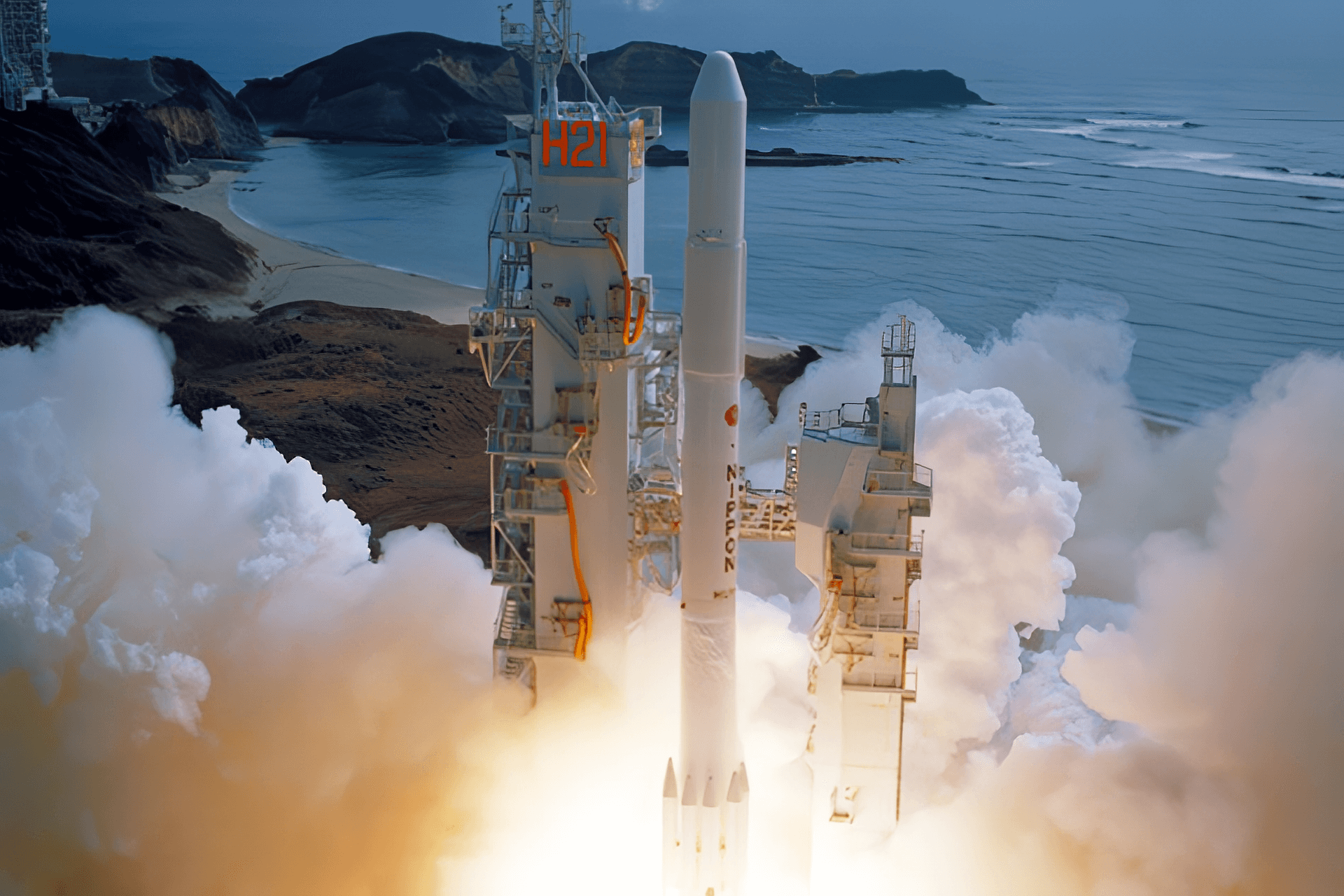
About the H-I
H-I
The H-I is a Japanese orbital launch vehicle developed and operated by the National Space Development Agency of Japan (NASDA), with Mitsubishi Heavy Industries serving as the primary industrial contractor. It represents a significant milestone in Japan's space program, bridging the gap between earlier, largely American-derived rockets and the fully domestically developed vehicles that would follow. The H-I launched from the Tanegashima Space Center on the southern Japanese island of Tanegashima.
Development and Design
The H-I was a three-stage vehicle standing 42 meters tall with a core diameter of 2.44 meters. It was designed to carry up to 3,200 kg to low Earth orbit and 1,100 kg to geostationary transfer orbit, giving Japan a meaningful capability to deploy both domestic satellites and payloads for institutional customers. The rocket combined a liquid-fueled first stage derived from American technology with a domestically developed cryogenic upper stage, reflecting Japan's deliberate, staged approach to building indigenous launch competence. Solid-fueled strap-on boosters augmented liftoff thrust.
Operational History
The H-I conducted its first flight in 1986 and remained in service through 1992, a span during which it compiled a remarkable record. All 9 flights tracked in the operational history concluded successfully, giving the vehicle a perfect reliability score across its service life. This unblemished record was a point of considerable pride for NASDA and reinforced Japan's reputation for meticulous engineering discipline in the space sector.
The manifest reflected Japan's national satellite infrastructure priorities of the era. Missions included the Himawari 4 meteorological satellite, the Sakura 3B communications satellite, and the Yuri 3A and Yuri 3B broadcasting satellites — all part of Japan's effort to establish sovereign capabilities in weather monitoring, telecommunications, and direct broadcast services. The Momo 1b and Fuyo 1 missions extended the vehicle's record into Earth observation, with Fuyo 1 representing one of the final flights and demonstrating Japan's growing ambitions in remote sensing.
Mitsubishi Heavy Industries was the dominant customer and contractor throughout the program, a relationship that would carry forward into subsequent Japanese launch vehicle programs and solidify MHI's role as the backbone of Japan's launch industry.
Legacy
The H-I was retired in 1992 as NASDA transitioned to the more capable and more fully indigenous H-II rocket, which promised greater payload performance and represented a deliberate break from reliance on licensed foreign technology. The H-I's nine-for-nine success record, however, made it one of the more reliable vehicles of its generation and validated the incremental development philosophy that characterized Japan's approach to launch technology.
Its operational period coincided with a formative era in Japanese civil space activity, during which the country steadily built the technical workforce, industrial base, and institutional knowledge that would underpin later programs. The H-I occupies an essential position in that story — capable enough to do meaningful work, reliable enough to earn trust, and purposeful enough to serve as the foundation for what came next.