GSLV Mk. II
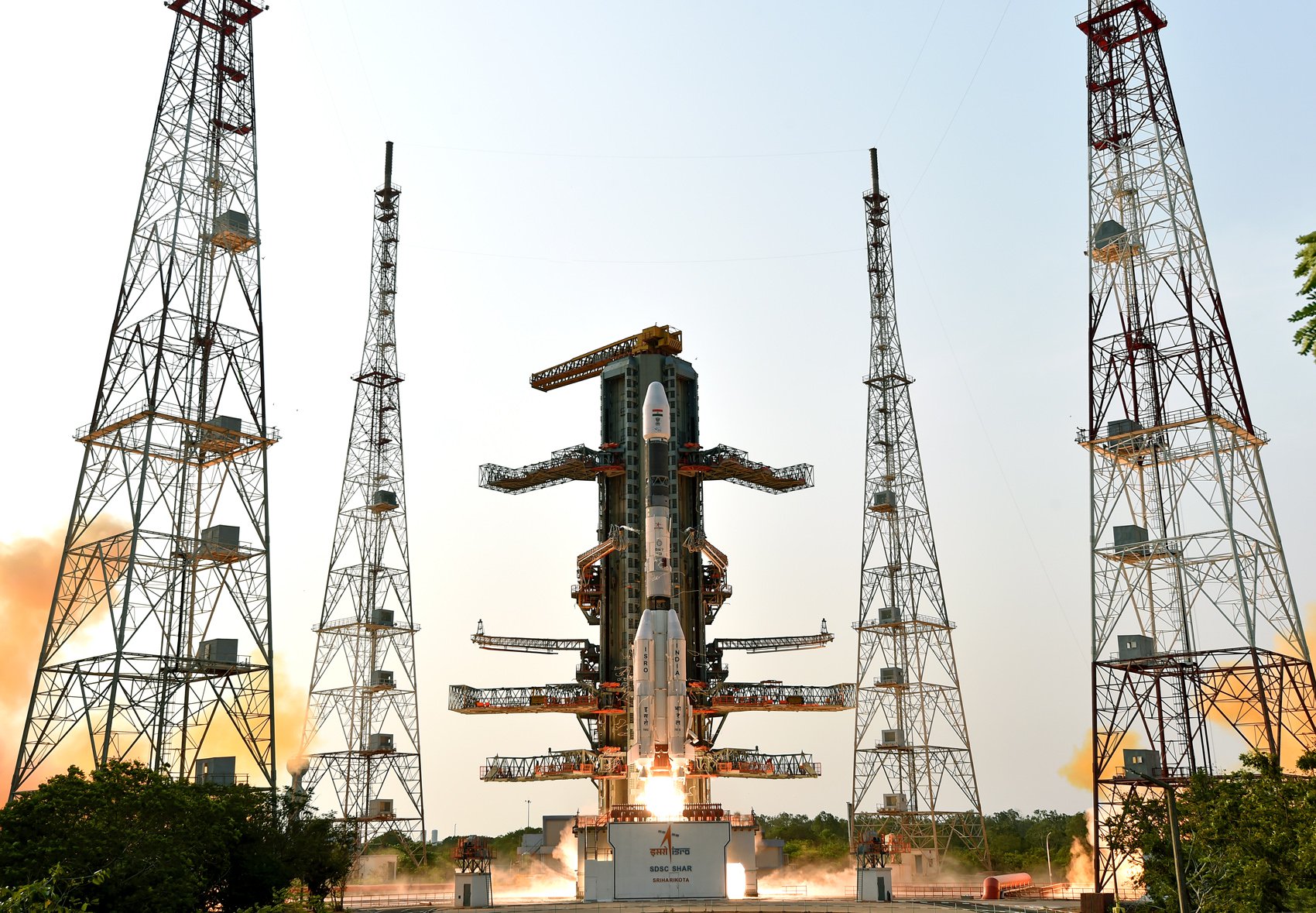
About the GSLV Mk. II
GSLV Mk. II
The GSLV Mk. II (Geosynchronous Satellite Launch Vehicle Mark II) is a medium-lift orbital launch vehicle developed and operated by the Indian Space Research Organisation (ISRO). It serves as India's primary workhorse for delivering communications, navigation, and Earth-observation satellites to geostationary transfer orbit (GTO), and has been central to the country's effort to achieve self-reliance in launching its own operational spacecraft.
Development and Design
The Mk. II represents a significant evolution over earlier GSLV configurations, most notably through its use of an indigenous cryogenic upper stage — a development that took ISRO years to master and whose success transformed India's launch capabilities. Standing 49 metres tall with a core diameter of 2.8 metres, the vehicle follows a three-stage architecture: a solid-fueled first stage augmented by liquid-fueled strap-on boosters, a liquid-fueled second stage, and the cryogenic third stage. This upper stage was the key technological hurdle that distinguishes the Mk. II from its predecessors and gives it the sustained high-energy burn needed to place payloads onto GTO trajectories. The rocket is capable of delivering 2,500 kg to GTO.
All GSLV Mk. II missions depart from the Satish Dhawan Space Centre on Sriharikota Island, off the eastern coast of India.
Flight History
Our tracking data records 17 GSLV Mk. II flights spanning from 2010 to 2026, of which 10 were fully successful and 2 resulted in failure or partial failure. This history reflects both the genuine difficulty of developing an indigenous cryogenic stage and the program's ultimate maturation into a reliable operational system.
The vehicle's manifest has been dominated by ISRO's own national programs, making the organization by far the rocket's top customer. Payloads have included satellites from India's GSAT communications series, the IRNSS/NVS navigation constellation (India's homegrown regional positioning system), and Earth-imaging platforms. Among the most significant recent missions is NISAR, a joint NASA–ISRO Synthetic Aperture Radar satellite representing one of the most ambitious international Earth-science collaborations in the program's history. Other recent flights include IDRSS-1 and IDRSS-2, supporting India's relay satellite infrastructure, and GISAT-1A (EOS-05), an Earth-observation platform. The navigation mission IRNSS-1L (NVS-03) continued the build-out of India's independent positioning capability.
Role and Significance
The GSLV Mk. II occupies a strategically important place in ISRO's launch portfolio. Before its reliable operation, India was dependent on foreign rockets — particularly Arianespace's Ariane series — to launch its heavier geostationary satellites. The Mk. II's cryogenic stage effectively closed that gap for a broad class of national payloads, reducing both cost and political dependency.
While ISRO's newer GSLV Mk. III (LVM3) has taken on the heaviest GTO missions, the Mk. II continues to serve a distinct role for payloads within its lift class, and its long operational record makes it one of the most significant launch vehicles in the history of the Asian space industry.
- Dec 31, 2026GSLV | IDRSS-1TBD
- Dec 31, 2026GSLV | IDRSS-2TBD
- Oct 30, 2026GSLV Mk II | IRNSS-1L (NVS-03)TBC
- Sep 03, 2026GSLV Mk II | GISAT-1A (EOS-05)Success
- Jul 30, 2025GSLV Mk II | NISAR (NASA-ISRO Synthetic Aperture Radar)Success
- Jan 29, 2025GSLV Mk II | IRNSS-1K (NVS-02)Success
- Feb 17, 2024GSLV Mk II | INSAT-3DSSuccess
- May 29, 2023GSLV Mk II | IRNSS-1J (NVS-01)Success
- Aug 12, 2021GSLV Mk II | EOS-03 (GISAT-1)Failure
- Dec 19, 2018GSLV Mk II | GSAT-7ASuccess
- Mar 29, 2018GSLV Mk II | GSAT-6ASuccess
- May 05, 2017GSLV Mk II | SouthAsiaSat (GSAT-9)Success
- Sep 08, 2016GSLV Mk II | INSAT-3DRSuccess
- Aug 27, 2015GSLV Mk II | GSAT-6Success
- Jan 05, 2014GSLV Mk II | GSAT-14Success
- Apr 15, 2010GSLV Mk II | GSAT-4 (HealthSat)Failure