GSLV
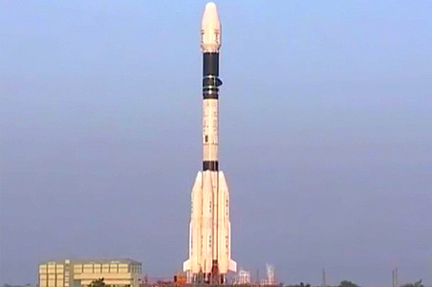
About the GSLV
GSLV (Geosynchronous Satellite Launch Vehicle)
The Geosynchronous Satellite Launch Vehicle, commonly known as GSLV, is an Indian orbital launch vehicle developed and operated by the Indian Space Research Organisation (ISRO). Designed primarily to place communication satellites into geostationary transfer orbit, the GSLV represented a significant step in India's ambition to achieve indigenous heavy-lift launch capability and reduce dependence on foreign launch services for its national satellite programs.
Design and Configuration
The GSLV is a three-stage vehicle standing 49.13 metres tall with a core diameter of 2.8 metres. Its architecture combines a solid-fueled first stage augmented by four liquid-fueled strap-on boosters, a liquid-fueled second stage, and a cryogenic upper stage — the last of which proved to be the vehicle's most technically challenging component. The cryogenic stage, capable of burning liquid hydrogen and liquid oxygen, was initially supplied by Russia before ISRO pursued development of an indigenous equivalent. This upper stage gave the GSLV its ability to deliver payloads to high-energy orbits, with a quoted capacity of 5,000 kg to low Earth orbit and 2,500 kg to geostationary transfer orbit.
Operational History
Based on our flight record, the GSLV conducted six tracked flights between 2001 and 2010, achieving two successes against four failures or partial failures — a record that reflects the considerable difficulty of mastering cryogenic propulsion technology during this formative period.
The vehicle's debut came in 2001 with the launch of GSAT-1, marking India's first attempt to orbit a satellite aboard a domestically developed heavy-lift rocket. Subsequent missions carried a series of ISRO communication satellites: GSAT-2, GSAT-3 (also known as EDUSAT), INSAT-4C, INSAT-4CR, and GSAT-5P. The INSAT-4C mission in 2006 ended in a launch failure, and the GSAT-5P mission in 2010 was similarly lost — losses that were costly both financially and in terms of national communication infrastructure, as these satellites were intended to expand India's operational geostationary fleet.
The high failure rate during this period was largely attributable to the developmental challenges associated with the cryogenic upper stage and other vehicle subsystems. Despite these setbacks, each mission contributed valuable engineering data that informed subsequent improvements to the vehicle and, eventually, to its successor configurations.
Role and Significance
The top customer throughout this period was exclusively ISRO itself, reflecting the vehicle's primary purpose as an instrument of Indian national space policy rather than a commercial launch service. The GSLV was launched from the Satish Dhawan Space Centre on Sriharikota Island, India's principal spaceport.
The early GSLV program is widely regarded as a critical, if turbulent, chapter in India's spaceflight history. It established the foundational experience in cryogenic propulsion and large-vehicle integration that ISRO would draw upon in developing the more capable GSLV Mk III (later renamed the LVM3). The struggles and lessons of this first-generation vehicle ultimately shaped a more mature and reliable Indian heavy-lift capability in the decades that followed.