Europa I
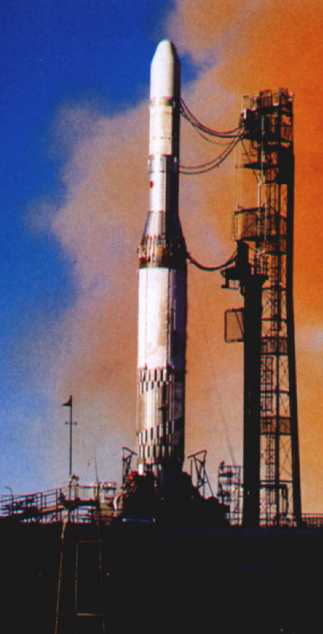
About the Europa I
Europa I
Europa I was a European orbital launch vehicle developed and operated by the European Launcher Development Organisation (ELDO), a multinational agency formed in the early 1960s to give Western Europe an independent capability to place satellites into orbit. The programme represented one of the continent's earliest and most ambitious cooperative efforts in space launch technology, drawing on contributions from the United Kingdom, France, West Germany, and other member states.
The rocket followed a staged design philosophy, with each stage contributed by a different member nation — a politically significant but technically challenging arrangement that would prove central to the programme's difficulties. At 33 metres tall with a diameter of 3.05 metres, Europa I was a substantial vehicle for its era, and its design anticipated the ambitions of later European launch efforts that would ultimately lead to the Ariane family.
Development and Configuration
Europa I used the British Blue Streak missile as its first stage, a heritage that gave the programme its initial technical foundation. French and German contributions formed the upper stages. The vehicle was launched from Woomera in Australia, making use of existing range infrastructure during its test campaign. Its rated payload capacity stood at 200 kg to both low Earth orbit and geostationary transfer orbit — a modest figure reflective of the exploratory nature of the programme and the technological constraints of the late 1960s.
Flight History
Europa I conducted three flights in our tracking record, spanning the years 1968 to 1970, none of which achieved full success. All three missions — designated STV 1, STV 2, and STV 3 (ELDO F9) — were test flights operated on behalf of ELDO, aimed at validating the vehicle's integrated multi-stage performance. The consistent failure across these attempts underscored the profound difficulty of coordinating stage development and integration across multiple national programmes with differing engineering standards and communication structures.
The failures were not attributable to any single systemic flaw but reflected the broader challenge of achieving reliable stage separation, ignition sequencing, and guidance performance in a vehicle assembled from internationally sourced components. Each mission added to the engineering understanding of the vehicle's shortcomings, but the programme was unable to translate that knowledge into a successful orbital insertion before political and financial pressures mounted.
Legacy
Europa I's troubled record played a significant role in reshaping European thinking about collaborative space launch programmes. The difficulties demonstrated that distributing critical subsystems across sovereign boundaries, without a sufficiently unified management and technical authority, introduced coordination risks that could undermine the most carefully laid plans. These lessons directly informed the restructuring that led to the Europa II programme and, eventually, to the far more successful Ariane series under the European Space Agency.
Despite its operational failures, Europa I holds an important place in spaceflight history as a genuine attempt by multiple European nations to establish launch autonomy at a time when only the United States and Soviet Union possessed that capability. The programme's shortcomings were as instructive as any success might have been, and its legacy is woven into the foundations of European access to space.