Epsilon
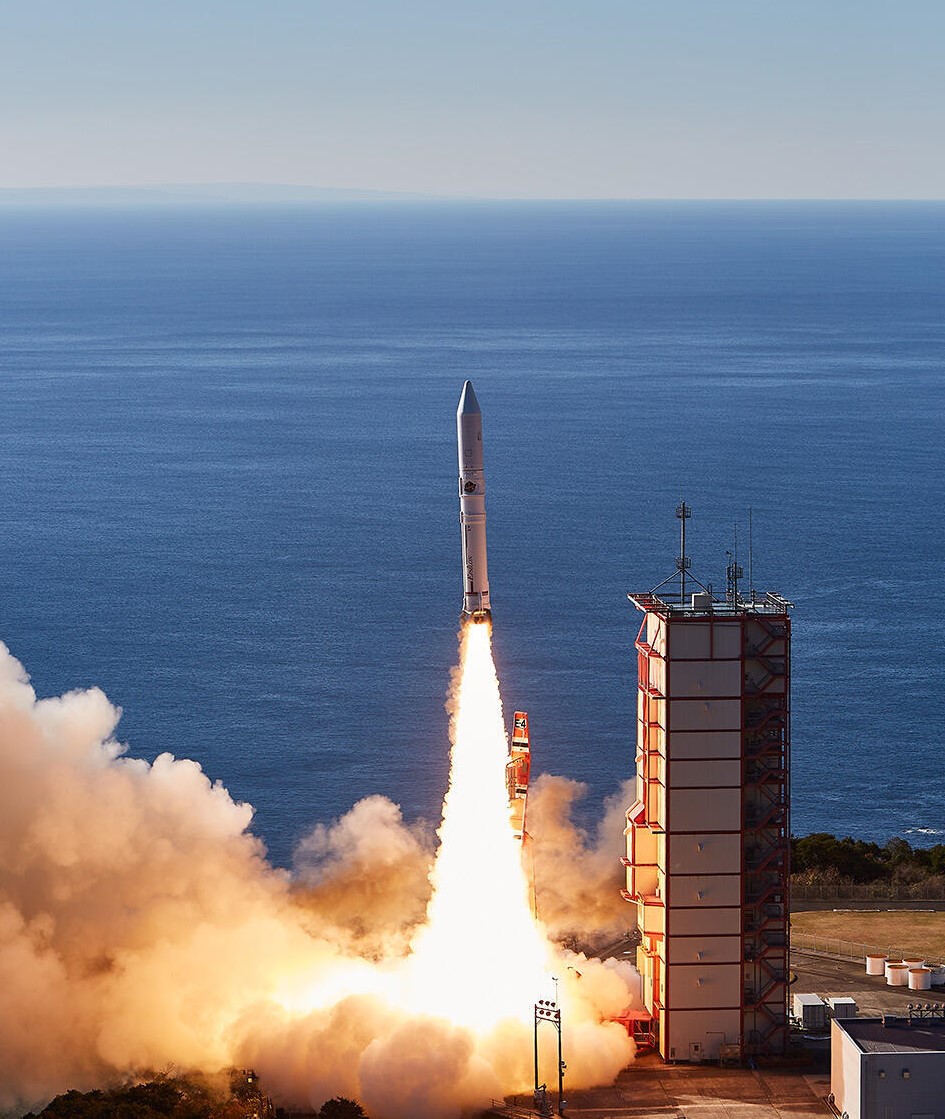
About the Epsilon
Epsilon
The Epsilon is a Japanese solid-fueled orbital launch vehicle developed and operated by the Japan Aerospace Exploration Agency (JAXA) in partnership with IHI Aerospace. Designed as a compact, cost-efficient alternative to Japan's larger H-IIA rocket, Epsilon was conceived to lower the barriers to launching small scientific and observation satellites, streamlining both operations and ground infrastructure compared to its predecessors.
Development and Design
Epsilon traces its lineage to JAXA's earlier M-V solid rocket, which was retired in 2006. Engineers drew on that heritage while introducing modern technologies intended to reduce the manpower and time required for launch preparations. A key innovation was the integration of an autonomous health-monitoring system, allowing ground crews to be significantly smaller than those needed for comparable vehicles. Standing 24.4 meters tall with a diameter of 2.5 meters, Epsilon is a relatively slender rocket by orbital launch standards, well suited to the small-satellite missions it was designed to serve.
The vehicle launches from the Uchinoura Space Center in Kagoshima Prefecture, Japan — the same historic site used by Japan's earliest satellite programs — making Epsilon a continuation of a long tradition of solid-rocket spaceflight from that facility.
Flight History
Epsilon conducted its first flight in 2013 and remained active through 2022, accumulating six tracked flights over that period. Of those, five were fully successful, with one resulting in a failure or partial failure, giving the vehicle a strong but not unblemished record across its operational life.
Its manifest was dominated by JAXA's own scientific and Earth-observation programs, reflecting the rocket's primary role as a dedicated government launcher for national space science. Notable missions included the Hisaki (SPRINT-A) spacecraft, Japan's first space telescope designed to observe planetary atmospheres, and the ERG (Arase) satellite, which studied Earth's radiation belts. The ASNARO-2 mission carried a radar Earth-observation satellite for the Cabinet Office of Japan. Later flights, including RAPIS-1, RAISE-2, and RAISE-3, demonstrated the rocket's growing role in hosting multiple small payloads simultaneously, reflecting broader trends in the small-satellite industry.
Role and Legacy
Epsilon occupied an important niche in Japan's launch architecture as the country's primary small-payload solid-rocket option. Its emphasis on operational simplicity and reduced launch costs represented a deliberate policy choice to keep Japan's scientific satellite programs viable without the expense of larger liquid-fueled rockets.
The vehicle's later missions increasingly flew rideshare configurations, bundling multiple small satellites alongside a primary payload — a model that became common across the global launch industry during the same era. This evolution showed Epsilon adapting to a rapidly changing market even within its relatively short operational life.
The 2022 failure, which occurred during the sixth and final tracked flight, marked a somber end to the program. JAXA subsequently began work on a next-generation small launcher, Epsilon S, intended to build on the lessons of the original Epsilon while improving reliability and performance. The original Epsilon nonetheless secured its place as a meaningful chapter in Japanese spaceflight history, reliably delivering some of the country's most scientifically significant small satellites over nearly a decade of service.