Electron
About the Electron
Electron
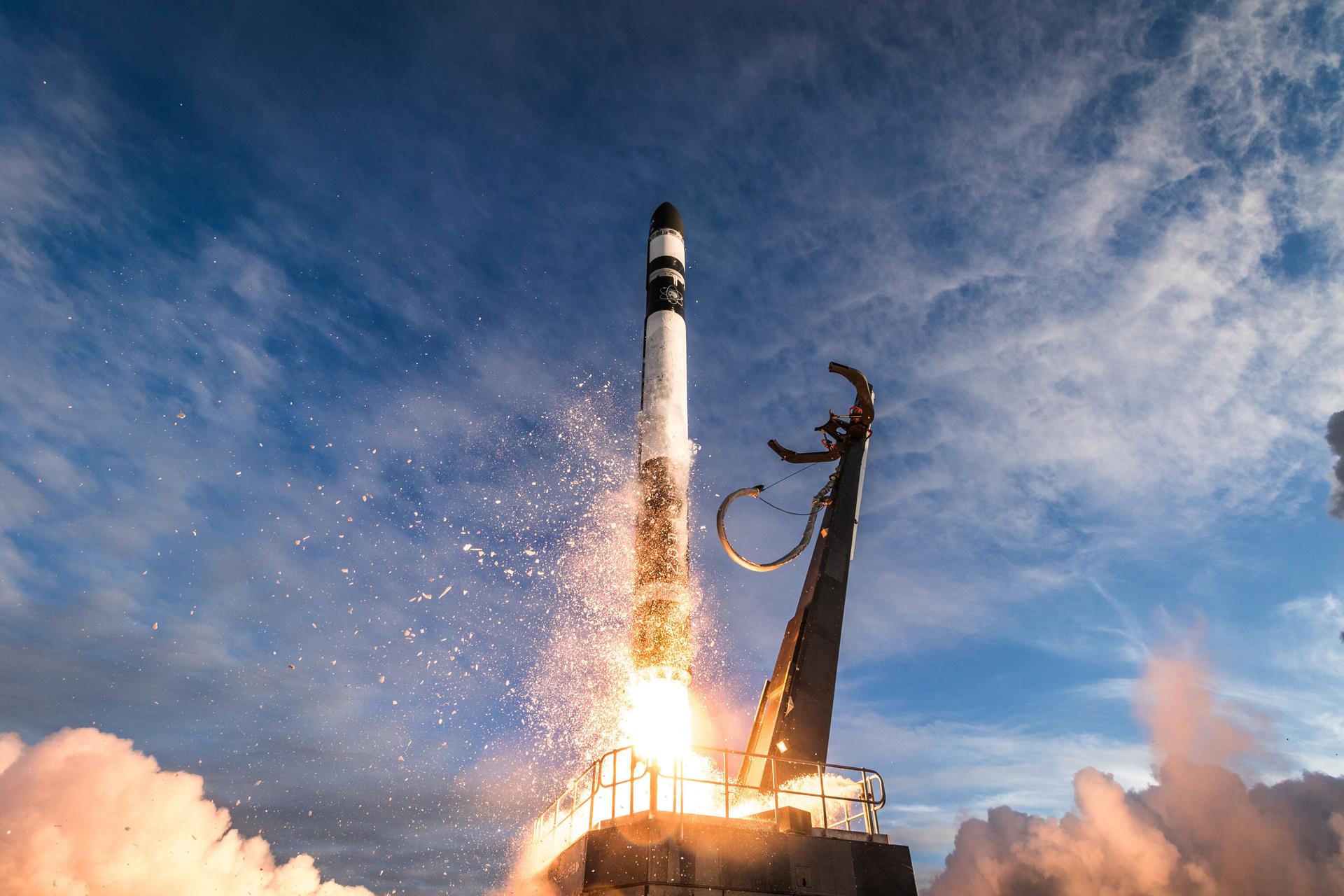
Electron is a small-lift orbital launch vehicle designed, manufactured, and operated by Rocket Lab, a company with roots in New Zealand and the United States. Purpose-built to serve the rapidly growing commercial small satellite market, Electron has established itself as one of the most frequently flown dedicated small-satellite launchers in history, offering responsive and flexible access to low Earth orbit for a wide range of commercial, government, and research customers.
The vehicle stands 18 metres tall with a diameter of 1.2 metres, making it a compact but capable two-stage rocket. It can deliver up to 300 kg to low Earth orbit, a payload class well matched to the proliferating generation of small and microsatellites. Electron launches from Rocket Lab's private launch facility on the Māhia Peninsula in New Zealand — Launch Complex 1 — as well as from Launch Complex 2 at NASA's Wallops Flight Facility in Virginia, giving operators flexibility in orbital inclination and launch cadence.
Design and Innovation
Electron is notable for several engineering innovations that set it apart from earlier small launchers. Its main engines, the Rutherford engines, are manufactured using additive manufacturing (3D printing) and employ an electric-pump-fed propulsion cycle rather than a conventional gas generator, reducing the part count and increasing reliability. The vehicle's structure makes extensive use of carbon composite materials, keeping mass low without sacrificing strength. Rocket Lab has also pursued a booster reuse program, recovering first stages from the ocean after splashdown in a bid to reduce production costs and increase flight rate.
Flight History
Our tracking data records 128 Electron flights between 2017 and 2029, of which 84 were fully successful and 4 were classified as failures or partial failures — a strong reliability record for a vehicle that entered service as the dedicated small-launch market was still maturing. This sustained cadence reflects both consistent customer demand and Rocket Lab's manufacturing throughput, which the company designed from the outset to support a high annual launch rate.
Rocket Lab itself is the top customer in our records, frequently flying Electron for constellation deployment and dedicated rideshare missions on behalf of third-party satellite operators. Among the most prominent repeat customers visible in recent missions are Synspective, whose StriX synthetic-aperture radar satellites have accounted for a notable series of dedicated flights, and NorthStar Earth & Space, which has used Electron for its space situational awareness constellation. Recent missions in our data — including StriX Launch 18, 19, 20, 21, and 22 as well as NorthStar 3 — illustrate the degree to which Electron has become a preferred vehicle for operators building out multi-satellite constellations requiring precise, dedicated orbital insertion.
Role and Legacy
Electron occupies a historically significant position in the commercial launch industry as one of the first small-lift vehicles to achieve a genuinely competitive flight rate, demonstrating that a privately developed rocket targeting the sub-300 kg payload class could sustain reliable commercial operations. Its success helped validate the dedicated small-launch business model and spurred broader industry investment in the sector. As of the period covered by our data, Electron remains an active and regularly flown vehicle, continuing to serve a diverse customer base across Earth observation, communications, and space services applications.
- Dec 31, 2029Electron | StriX Launch 21TBD
- Dec 31, 2029Electron | StriX Launch 27TBD
- Dec 31, 2029Electron | StriX Launch 26TBD
- Dec 31, 2029Electron | StriX Launch 25TBD
- Dec 31, 2029Electron | NorthStar 2TBD
- Dec 31, 2029Electron | NorthStar 3TBD
- Dec 31, 2029Electron | StriX Launch 18TBD
- Dec 31, 2029Electron | StriX Launch 19TBD
- Dec 31, 2029Electron | StriX Launch 20TBD
- Dec 31, 2029Electron | StriX Launch 24TBD
- Dec 31, 2029Electron | StriX Launch 23TBD
- Dec 31, 2029Electron | StriX Launch 22TBD
- Dec 31, 2028Electron | iQPS Launch 12TBD
- Dec 31, 2028Electron | iQPS Launch 13TBD
- Dec 31, 2028Electron | iQPS Launch 14TBD
- Dec 31, 2027Electron | StriX Launch 17TBD
- Dec 31, 2027Electron | StriX Launch 16TBD
- Dec 31, 2027Electron | StriX Launch 14TBD
- Dec 31, 2027Electron | StriX Launch 15TBD
- Jun 30, 2027Electron | PolSIR-2TBD
- Jun 30, 2027Electron | PolSIR-1TBD
- Mar 31, 2027Electron | TSIS-2TBD
- Dec 31, 2026Electron | BlackSky Gen-3 8TBD
- Dec 31, 2026Electron | BlackSky Gen-3 9TBD
- Dec 31, 2026Electron | iQPS Launch 11TBD
- Dec 31, 2026HASTE | Leidos-3TBD
- Dec 31, 2026Electron | BlackSky Gen-3 6TBD
- Dec 31, 2026HASTE | Leidos-4TBD
- Dec 31, 2026HASTE | Leidos-5TBD
- Dec 31, 2026Electron | LOXSAT 1TBD
- Dec 31, 2026Electron | BlackSky Gen-3 7TBD
- Nov 10, 2026Electron | The Mountain God Rises (iQPS Launch 10)TBD
- Nov 04, 2026Electron | The Sea God Surveys (iQPS Launch 9)TBD
- Oct 23, 2026Electron | We're Not Hawking Around (3x HawkEye 360)Go
- Sep 26, 2026Electron | Owlright, Owlright, Owlright (StriX Launch 13)Success
- Sep 19, 2026Electron | Owl By The Dozen (StriX Launch 12)Success
- Sep 11, 2026Electron | Happily Ever Faster (BlackSky Gen-3 5)Success
- Sep 02, 2026Electron | Owl Around The World (StriX Launch 11)Success
- Aug 20, 2026Electron | The Lightning God Defends (iQPS Launch 8)Success
- Aug 15, 2026Electron | AsperaTBD
- Aug 06, 2026Electron | The Grain Goddess Provides (iQPS Launch 7)Success
- Jun 26, 2026Electron | Ten Owl Of Ten (StriX Launch 10)Success
- Jun 19, 2026Electron | VICTUS HAZE PumaSuccess
- Jun 11, 2026HASTE | CurveballSuccess
- May 22, 2026Electron | Viva La StriX (StriX Launch 9)Success
- Apr 23, 2026Electron | Kakushin Rising (JAXA Rideshare)Success
- Apr 22, 2026HASTE | BubblesSuccess
- Mar 28, 2026Electron | Daughter Of The Stars (LEO-PNT Pathfinder A)Success
- Mar 20, 2026Electron | Eight Days A Week (StriX Launch 8)Success
- Mar 05, 2026Electron | Insight At Speed Is A Friend Indeed (BlackSky Gen-3 4)Success
- Feb 28, 2026HASTE | That's Not A Knife (DART AE)Success
- Jan 30, 2026Electron | Bridging The Swarm (NeonSat-1A)Success
- Jan 22, 2026Electron | The Cosmos Will See You Now (Open Cosmos Constellation Launch 1)Success
- Dec 21, 2025Electron | The Wisdom God Guides (iQPS Launch 6)Success
- Dec 18, 2025Electron | Don't Be Such A Square (STP-S30)Success
- Dec 14, 2025Electron | Raise and Shine (RAISE-4)Success
- Nov 20, 2025Electron | Follow My Speed (BlackSky Gen-3 3)Success
- Nov 18, 2025HASTE | Prometheus Run (VAN)Success
- Nov 05, 2025Electron | The Nation God Navigates (iQPS Launch 5)Success
- Oct 14, 2025Electron | Owl New World (StriX Launch 7)Success
- Oct 01, 2025HASTE | JUSTINSuccess
- Sep 23, 2025HASTE | JENNASuccess
- Aug 23, 2025Electron | Live, Laugh, Launch (Calistus A-E)Success
- Aug 05, 2025Electron | The Harvest Goddess Thrives (iQPS Launch 4)Success
- Jun 28, 2025Electron | Symphony In The Stars (EchoStar Lyra-4)Success
- Jun 26, 2025Electron | Get The Hawk Outta Here (4x HawkEye 360)Success
- Jun 11, 2025Electron | The Mountain God Guards (iQPS Launch 3)Success
- Jun 02, 2025Electron | Full Stream Ahead (BlackSky Gen-3 2)Success
- May 17, 2025Electron | The Sea God Sees (iQPS Launch 2)Success
- Mar 26, 2025Electron | Finding Hot Wildfires Near You (OroraTech OTC-P1)Success
- Mar 18, 2025Electron | High Five (Kinéis 21-25)Success
- Mar 15, 2025Electron | The Lightning God Reigns (iQPS Launch 1)Success
- Feb 18, 2025Electron | Fasten Your Space Belts (BlackSky Gen-3 1)Success
- Feb 08, 2025Electron | IoT 4 You and Me (Kinéis 16-20)Success
- Dec 21, 2024Electron | Owl The Way Up (StriX Launch 6)Success
- Dec 14, 2024HASTE | StonehengeSuccess
- Nov 25, 2024Electron | Ice AIS Baby (Kinéis 11-15)Success
- Nov 24, 2024HASTE | HASTE A La Vista (MACH-TB)Success
- Nov 05, 2024Electron | Changes In Latitudes, Changes In Attitudes (Protosat-1)Success
- Sep 20, 2024Electron | Kinéis Killed the RadIoT Star (Kinéis 6-10)Success
- Aug 11, 2024Electron | A Sky Full of SARs (Capella Acadia 3)Success
- Aug 02, 2024Electron | Owl for One, One for Owl (StriX Launch 5)Success
- Jun 20, 2024Electron | No Time Toulouse (Kinéis 1-5)Success
- Jun 05, 2024Electron | PREFIRE And Ice (PREFIRE 2)Success
- May 25, 2024Electron | Ready, Aim, PREFIRE (PREFIRE 1)Success
- Apr 23, 2024Electron | Beginning Of The Swarm (ACS3 & NeonSat-1)Success
- Mar 21, 2024Electron | Live and Let Fly (NROL-123)Success
- Mar 12, 2024Electron | Owl Night Long (StriX-3)Success
- Feb 18, 2024Electron | On Closer Inspection (ADRAS-J)Success
- Jan 31, 2024Electron | Four Of A Kind (NorthStar 1)Success
- Dec 15, 2023Electron | The Moon God Awakens (QPS-SAR-5)Success
- Sep 19, 2023Electron | We Will Never Desert You (Capella Acadia 2)Failure
- Aug 23, 2023Electron | We Love the Nightlife (Capella Acadia 1)Success
- Jul 18, 2023Electron | Baby Come Back (Rideshare)Success
- Jun 18, 2023HASTE | Scout's Arrow (DYNAMO-A)Success
- May 26, 2023Electron | Coming To A Storm Near You (TROPICS-3)Success
- May 08, 2023Electron | Rocket Like A Hurricane (TROPICS-2)Success
- Mar 24, 2023Electron | The Beat Goes On (BlackSky 18-19)Success
- Mar 16, 2023Electron | Stronger Together (Capella 9-10)Success
- Jan 24, 2023Electron | Virginia is for Launch Lovers (Hawk 6A-C)Success
- Nov 04, 2022Electron | Catch Me If You Can (MATS)Success
- Oct 07, 2022Electron | It Argos Up From Here (Argos-4)Success
- Sep 15, 2022Electron | The Owl Spreads Its Wings (StriX-1)Success
- Aug 04, 2022Electron | Antipodean Adventure (NROL-199)Success
- Jul 13, 2022Electron | Wise One Looks Ahead (NROL-162)Success
- Jun 28, 2022Electron | CAPSTONESuccess
- May 02, 2022Electron | There and Back Again (Rideshare)Success
- Apr 02, 2022Electron | Without Mission A Beat (BlackSky 16-17)Success
- Feb 28, 2022Electron | The Owl’s Night Continues (StriX-β)Success
- Dec 09, 2021Electron | A Data With Destiny (BlackSky 14-15)Success
- Nov 18, 2021Electron | Love At First Insight (BlackSky 10-11)Success
- Jul 29, 2021Electron | It’s a Little Chile Up Here (STP-27RM)Success
- May 15, 2021Electron | Running Out of Toes (BlackSky 8-9)Failure
- Mar 22, 2021Electron | They Go Up So Fast (Rideshare)Success
- Jan 20, 2021Electron | Another One Leaves The Crust (GMS-T)Success
- Dec 15, 2020Electron | The Owl's Night Begins (StriX-α)Success
- Nov 20, 2020Electron | Return to Sender (Rideshare)Success
- Oct 28, 2020Electron | In Focus (Rideshare)Success
- Aug 31, 2020Electron | I Can’t Believe It’s Not Optical (Capella 2 & First Light)Success
- Jul 04, 2020Electron | Pics Or It Didn’t Happen (Rideshare)Failure
- Jun 13, 2020Electron | Don't Stop Me Now (Rideshare)Success
- Jan 31, 2020Electron | Birds of a Feather (NROL-151)Success
- Dec 06, 2019Electron | Running Out Of Fingers (Rideshare)Success
- Oct 17, 2019Electron | As The Crow Flies (Palisade)Success
- Aug 19, 2019Electron | Look Ma, No Hands (Rideshare)Success
- Jun 29, 2019Electron | Make It Rain (Rideshare)Success
- May 05, 2019Electron | That's a Funny Looking Cactus (STP-27RD)Success
- Mar 28, 2019Electron | Two Thumbs Up (DARPA R3D2)Success
- Dec 16, 2018Electron | This One's For Pickering (VCLS ELaNa XIX)Success
- Nov 11, 2018Electron | It's Business Time (Rideshare)Success
- Jan 21, 2018Electron | Still TestingSuccess
- May 25, 2017Electron | It's a TestFailure