Diamant B
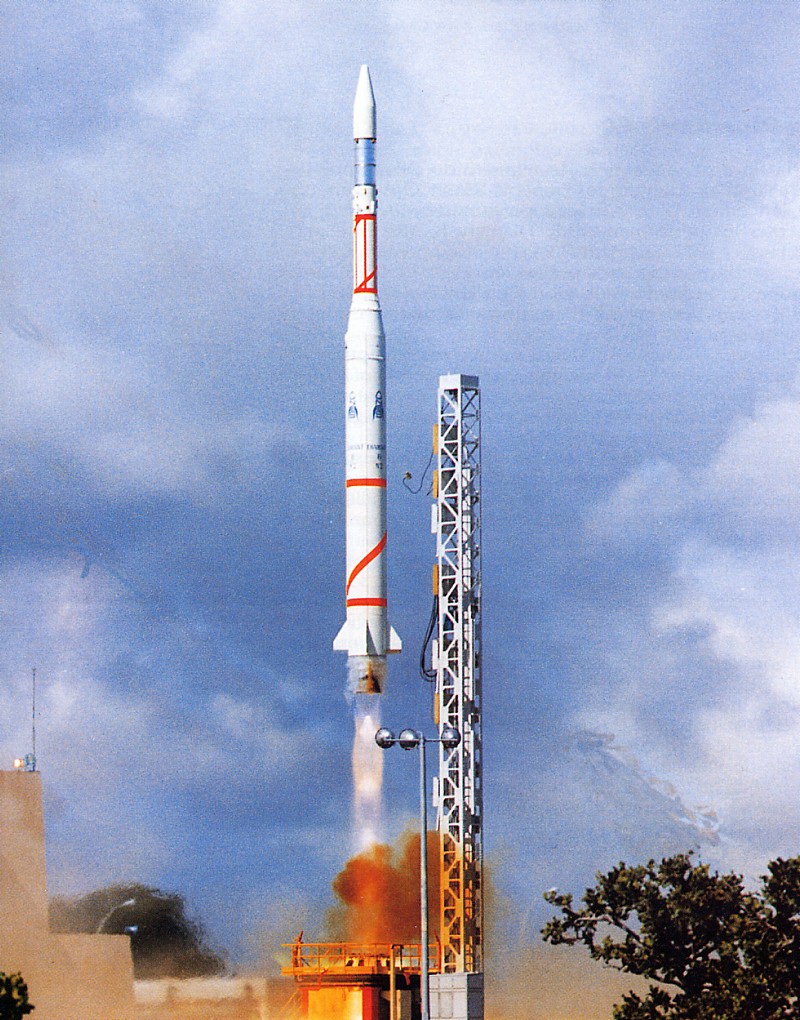
About the Diamant B
Diamant B
The Diamant B is a French orbital launch vehicle developed and operated by the Centre National d'Études Spatiales (CNES), France's national space agency. An evolution of the original Diamant A, it represented a significant upgrade within the Diamant family — France's indigenous rocket programme and the first operational launch vehicle developed by a nation other than the United States or Soviet Union.
Development and Design
The Diamant B improved upon its predecessor primarily through a more powerful first stage, allowing it to lift heavier payloads into low Earth orbit. Standing 23.5 metres tall with a diameter of 1.34 metres, the vehicle retained the slender, elegant profile characteristic of the Diamant family while incorporating the upgraded L-17 first stage engine. This gave the rocket a low Earth orbit payload capacity of approximately 160 kilograms — a meaningful increase over the earlier Diamant A variant, though still modest by the standards of contemporary superpower launch vehicles.
Like all Diamant rockets, the Diamant B flew from the Guiana Space Centre at Kourou, French Guiana, the equatorial launch facility that would later become the cornerstone of European space access. Its three-stage configuration used a combination of storable liquid propellants in the first stage and solid motors in the upper stages.
Operational History
The Diamant B was active from 1970 to 1973, during which time our flight record documents five launches, of which three were fully successful and two resulted in failure or partial failure. This reflects the inherent difficulty of early spaceflight development, and the mixed record was not unusual for pioneering national launch programmes of the era.
Its primary customer was the National Center of Space Research, reflecting the vehicle's role as a sovereign tool for French scientific ambitions in orbit. The missions flown under our tracked record include Péole, Dial Wika, Tournesol, Polaire, and Castor & Pollux — a suite of scientific and experimental satellites covering areas such as atmospheric research and geodesy.
Tournesol and Péole were among the more notable payloads, representing French efforts in ionospheric and meteorological study. Dial Wika was a Franco-German collaborative satellite, illustrating how the Diamant B also served as a vehicle for early European scientific cooperation even before a unified European launch capability existed.
Legacy
The Diamant B occupied an important moment in spaceflight history, bridging France's early independent launch capability with the more capable Diamant BP.4 that would follow. Though its operational window was brief and its payload capacity limited, it demonstrated that France possessed the industrial and technical depth to design, build, and operate a multi-stage orbital rocket entirely on national terms.
The programme as a whole laid the institutional and engineering groundwork that would eventually lead France and its European partners to develop the Ariane rocket family — one of the most commercially successful launch vehicle lineages in history. In that sense, the Diamant B is not merely a historical footnote but a foundational chapter in the story of European access to space.