Delta IV M+(5,4)
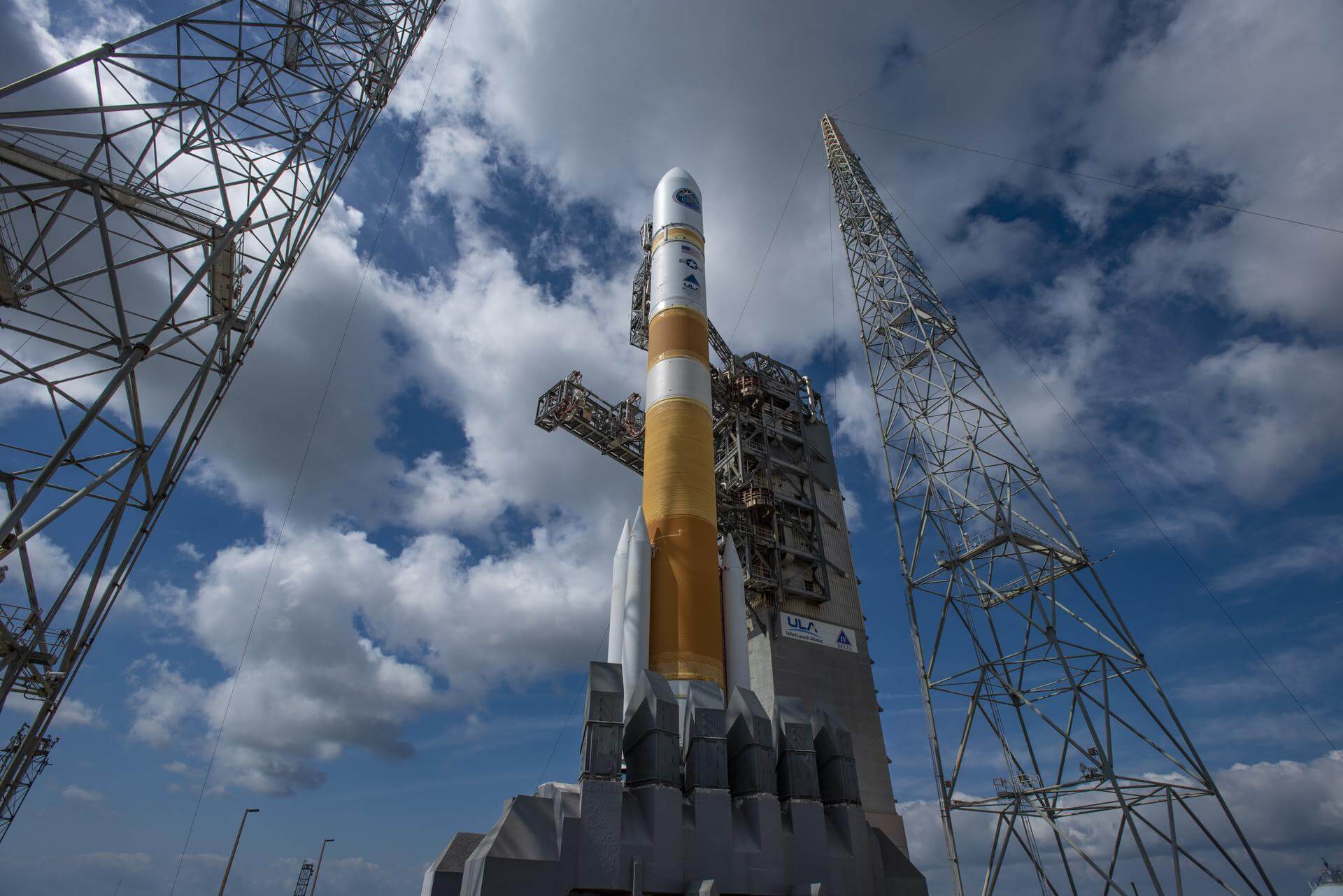
About the Delta IV M+(5,4)
Delta IV M+(5,4)
The Delta IV M+(5,4) is an expendable orbital launch vehicle operated by United Launch Alliance (ULA), a joint venture between Boeing and Lockheed Martin. It belongs to the Delta IV Medium+ family, itself a variant of the broader Delta IV product line developed by Boeing and later managed by ULA for both commercial and government customers. Manufactured and launched within the United States, the vehicle serves as a workhorse for medium-to-heavy payload missions, particularly those destined for geostationary transfer orbit.
Design and Configuration
The designation M+(5,4) describes the specific configuration of this vehicle: a 5-meter-diameter payload fairing paired with four solid rocket boosters strapped to the first stage. At 70.7 meters tall, the rocket is a substantial vehicle by any measure. The five-meter fairing — wider than the standard four-meter variant — accommodates larger spacecraft, giving operators additional volume for more capable satellites. The addition of four solid strap-on boosters significantly augments the thrust at liftoff compared to the baseline Medium variant, enabling the rocket to lift 13,730 kg to low Earth orbit and 6,890 kg to geostationary transfer orbit.
The first stage is powered by a single RS-68 engine burning liquid hydrogen and liquid oxygen, a propellant combination known for high efficiency. The upper stage, the Delta Cryogenic Second Stage (DCSS), uses the RL-10 engine and the same propellant combination, providing the precise in-space performance required for sensitive government payloads.
Flight History
According to tracked flight records, the Delta IV M+(5,4) flew eight times between 2009 and 2019, achieving a perfect success rate across all eight missions. This unblemished record reflects both the maturity of the Delta IV platform and the rigorous quality standards ULA applied to each mission.
The vehicle's manifest was dominated by a single, strategically critical program: the Wideband Global SATCOM (WGS) constellation, a high-capacity military communications satellite network operated by the United States Air Force. Missions including WGS-5 through WGS-10 formed the core of this rocket's operational history, with each WGS satellite representing a significant communications asset for the U.S. Department of Defense and allied nations. The consistency of pairing this specific vehicle configuration with the WGS program reflects how well the M+(5,4)'s payload capacity matched the mass and volume requirements of those satellites.
Role and Legacy
The Delta IV M+(5,4) occupies a distinct niche between the lighter Medium+ configurations and the massive Delta IV Heavy. Its combination of a large fairing and four solid boosters made it well suited to the class of government satellites too large for smaller configurations but not requiring the full capability of the Heavy. Launches were conducted from Space Launch Complex 37 (SLC-37) at Cape Canaveral Space Force Station, Florida.
The vehicle's concentrated use across a single flagship program, flawless track record, and decade-long service window make it a notable example of how a purpose-matched launch vehicle can reliably underpin a critical national security infrastructure initiative.
- Mar 16, 2019Delta IV M+(5,4) | WGS-10Success
- Mar 19, 2017Delta IV M+(5,4) | WGS-9 (USA-275)Success
- Dec 07, 2016Delta IV M+(5,4) | WGS-8 (USA-272)Success
- Jul 24, 2015Delta IV M+(5,4) | WGS-7 (USA-263)Success
- Aug 08, 2013Delta IV M+(5,4) | WGS-6 (USA-244)Success
- May 25, 2013Delta IV M+(5,4) | WGS-5 (USA-243)Success
- Jan 20, 2012Delta IV M+(5,4) | WGS-4 (USA-233)Success
- Dec 06, 2009Delta IV M+(5,4) | WGS-3 (USA-211)Success