Delta IV M+(4,2)
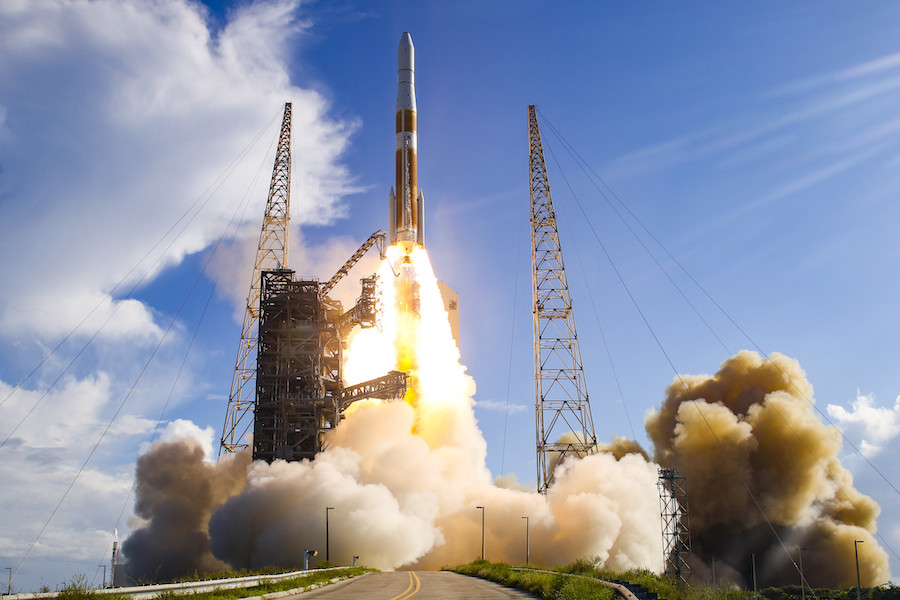
About the Delta IV M+(4,2)
Delta IV M+(4,2)
The Delta IV M+(4,2) is a medium-to-heavy orbital launch vehicle developed and operated by Boeing and later United Launch Alliance (ULA), a joint venture between Boeing and Lockheed Martin. A member of the broader Delta IV family, it represents one of several "Medium+" configurations designed to offer enhanced performance over the baseline Delta IV Medium by incorporating additional solid rocket boosters and an enlarged payload fairing.
Design and Configuration
The Delta IV M+(4,2) stands 66.2 meters tall with a core diameter of 5 meters. The designation "4,2" refers to its two 4-meter solid rocket boosters (GEM-60 strap-ons) attached to the common booster core, which is powered by a single Rocketdyne RS-68 engine burning liquid hydrogen and liquid oxygen. The "4" in the name denotes the diameter of the payload fairing in meters, while the "2" indicates the number of strap-on boosters. This configuration delivers a payload capacity of 11,920 kg to low Earth orbit and 6,270 kg to geostationary transfer orbit, making it well suited for medium-to-large government satellites.
Operational History
According to tracked flight records, the Delta IV M+(4,2) conducted 15 flights between 2002 and 2019, achieving a perfect 15-for-15 success rate — a remarkable record that reflects both the maturity of the Delta IV design and the rigorous launch processing standards maintained by ULA. The vehicle launched from facilities operated by the U.S. government, primarily serving national security and civil space missions.
The rocket's customer base was dominated by the United States Air Force, which relied heavily on the configuration for launching GPS constellation satellites. Several missions in the GPS IIF and GPS III series were carried to medium Earth orbit aboard this vehicle, including GPS IIF-5, GPS IIF-6, GPS IIF-9, and GPS III SV02. These navigation satellites form the backbone of the Global Positioning System, providing precision timing and positioning services to military and civilian users worldwide. Additional missions under the AFSPC-4 and AFSPC-6 designations served broader national security space objectives.
Role and Legacy
The Delta IV M+(4,2) occupied an important niche in the U.S. launch manifest throughout the 2000s and 2010s, offering a reliable and proven solution for payloads that exceeded the capacity of smaller vehicles but did not require the full power of the Delta IV Heavy. Its consistent performance across a diverse range of national security missions — spanning GPS replenishment, classified payloads, and strategic satellite programs — cemented its reputation as a dependable workhorse for American space launch requirements.
As ULA transitioned its strategic focus toward the Vulcan Centaur and wound down Delta IV production, the M+(4,2) configuration was retired following its final flight in 2019. Its unblemished launch record stands as a testament to the engineering heritage of the Delta rocket family, one of the longest-serving lineages in orbital spaceflight history.
- Aug 22, 2019Delta IV M+(4,2) | GPS III SV02Success
- Aug 19, 2016Delta IV M+(4,2) | AFSPC-6Success
- Mar 25, 2015Delta IV M+(4,2) | GPS IIF-9 (USA-260)Success
- Jul 28, 2014Delta IV M+(4,2) | AFSPC-4Success
- May 17, 2014Delta IV M+(4,2) | GPS IIF-6 (USA-251)Success
- Feb 21, 2014Delta IV M+(4,2) | GPS IIF-5 (USA-248)Success
- Oct 04, 2012Delta IV M+(4,2) | GPS IIF-3 (USA-239)Success
- Jul 16, 2011Delta IV M+(4,2) | GPS IIF-2 (USA-232)Success
- Mar 11, 2011Delta IV M+(4,2) | NROL-27 (SDS) (USA-227)Success
- May 28, 2010Delta IV M+(4,2) | GPS IIF SV-1 (USA-213)Success
- Mar 04, 2010Delta IV M+(4,2) | GOES-P (GOES 15)Success
- Jun 27, 2009Delta IV M+(4,2) | GOES-14Success
- Jun 28, 2006Delta IV M+(4,2) | NROL-22Success
- May 24, 2006Delta IV M+(4,2) | GOES 13Success
- Nov 20, 2002Delta IV M+(4,2) | Eutelsat W5Success